
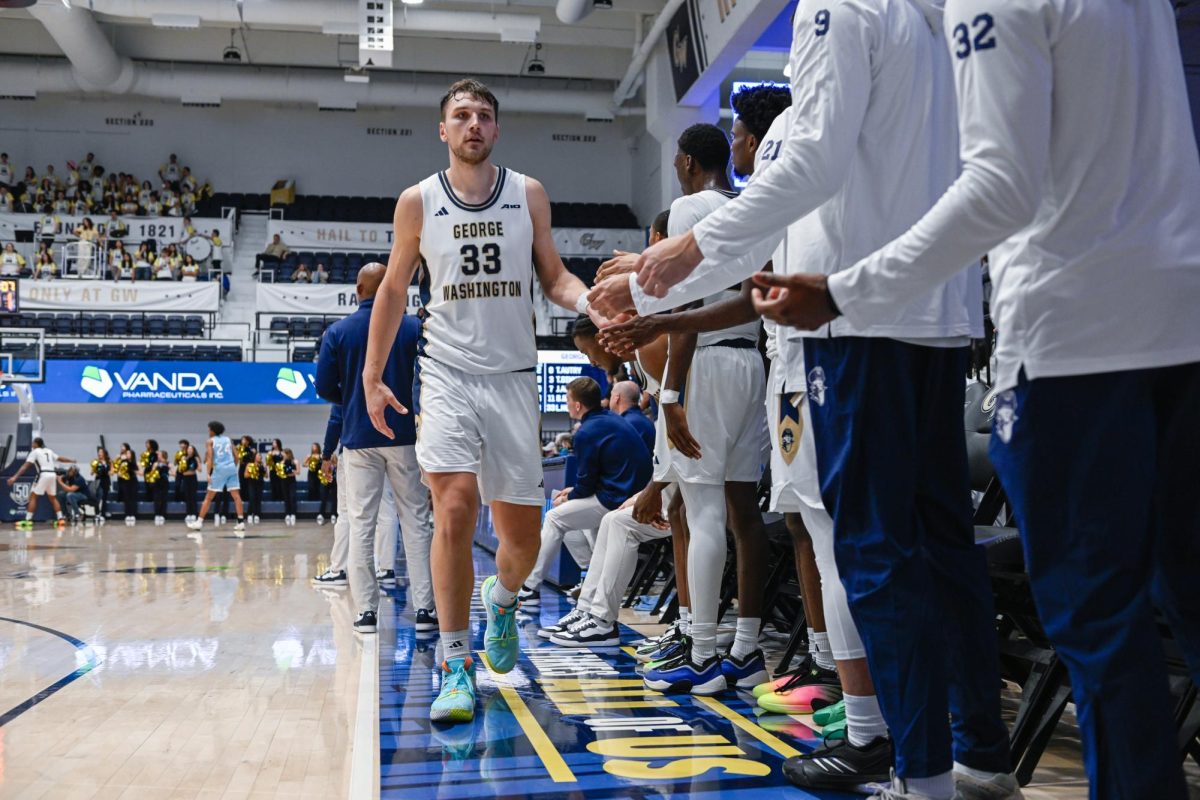
Graduate student forward Luke Hunger’s role on the team felt decided in mid-January.
Brought in to transform the frontcourt and form a towering, two-big lineup alongside redshirt senior center Rafael Castro, Hunger instead found himself confined to brief, sheltered minutes off the bench — a contrast to the vision Head Coach Chris Caputo laid out in July. By the time the Revolutionaries faced the then-unbeaten Saint Louis Billikens on Jan. 28, he was averaging just 6.0 points and 4.1 rebounds per game with only one start, struggling to deliver the impact the team expected him to make.
Meanwhile, Castro — an Atlantic 10 Player of the Year contender coming off a breakout 2024-25 season — was thriving, further cementing his role as the focal point of the frontcourt, averaging 14.2 points and 8.9 rebounds per game, which relegated Hunger deeper into the background.
But that trajectory would shift in the days after the loss to Saint Louis. In the days that followed, Castro suffered a foot injury in practice, sidelining the Revs’ anchor and suddenly elevating Hunger from a complementary piece to the team’s primary presence in the paint.
The adjustment was abrupt. Hunger’s minutes climbed to 22 in the first game without Castro, then to a season-high 31 in the next as his responsibilities expanded in real time. Still, the increased workload did not immediately translate to team success — the Revs dropped both contests despite being favored, still searching for stability without their star center.
That tide would begin to turn in the third game of the team’s stretch without Castro during a road game against Duquesne, when Hunger logged a career-high 38 minutes and delivered 17 points and 13 rebounds for his third double-double of the season. The 6-foot-10 forward was beginning to morph into the player Caputo saw he could be.
“It definitely took some time to adjust, but once I kind of got settled in and realized that I wasn’t going to come out of the game too much, it helped me get in a rhythm and helped me be able to make shots and get my teammates open,” Hunger said.
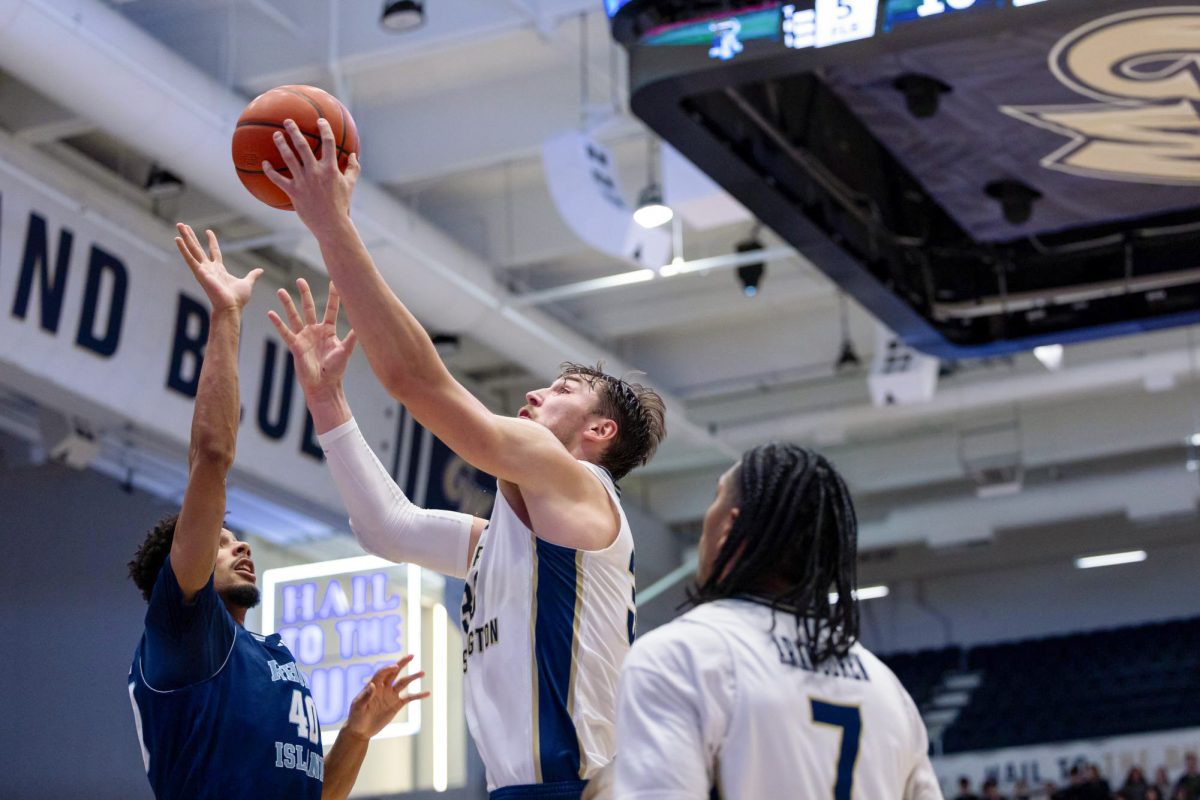
Game after game, Hunger began turning opportunity into production. In the Revs’ win over Rhode Island that snapped a four-game losing streak, Hunger set a career-high in points with 21 in 36 minutes, including some big baskets as the Rams tried to get back into the game.
The surge was impressive, but Hunger’s breakout was only just beginning.
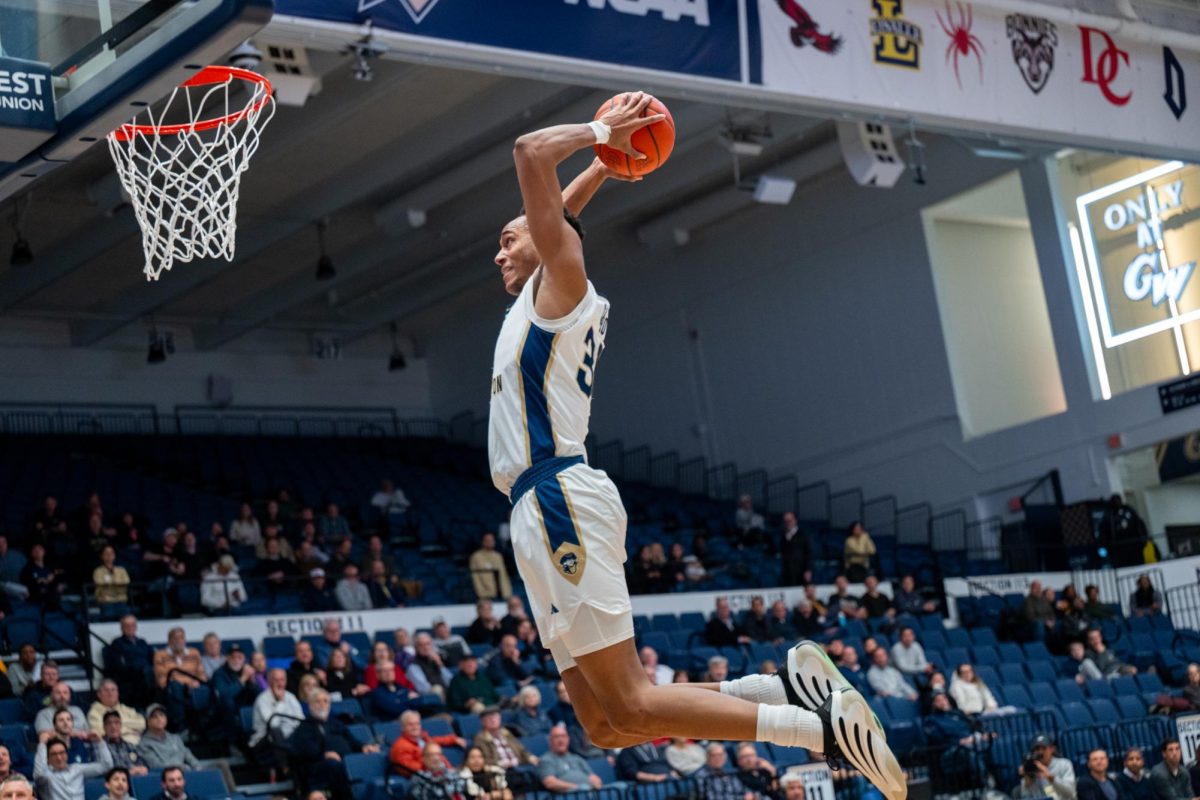
After that win on Feb. 10, the Revs hosted the George Mason Patriots in the season’s second edition of the Revolutionary Rivalry, a team that, in the first leg, they had lost to just a month before. In need of a big performance in Castro’s absence, Hunger stepped up, scoring a career-high 31 points and hauling down 10 rebounds to give the Revs a 72-53 statement victory in a game in which the 6-foot-10 forward could not miss a shot.
His performance garnered attention, including from former Indiana Pacers star Roy Hibbert, the game’s color commentator, who compared him to the NBA’s all-time leading scorer and current Los Angeles Laker LeBron James on live television.
Hunger’s stellar performance would push him to win the A-10 Player of the Week last week, becoming the first Rev since Castro in early January to win the award — an honor he attributed to his teammates and coaching staff for believing in him.
“I think it’s just an accumulation of how hard we played this year,” Hunger said. “We battled through some tough stretches this season, some tough injuries. To see a good stretch of basketball being rewarded is definitely very positive.”
Hunger’s meteoric rise may have looked like the culmination of years in the making, but basketball was never supposed to be the plan.
Long before he was anchoring the paint and carrying the frontcourt, Hunger’s world revolved around a rink in Montreal. Raised in Quebec — where, outside of French, hockey is the first language — he had skates on before he could tie his own shoes.
The ice, not the hardwood, was home. With both sports occupying the winter calendar, Hunger chose hockey over basketball, training on the ice nearly every day and developing to the point where he said he was on track to become an NCAA Division I hockey player.
By age 15, Hunger had a change of heart. The grueling demands of hockey — six practices a week, both physically and mentally — began to take their toll and he realized the ice was no longer where he wanted to invest his energy. Basketball, by contrast, ran in his blood. His father, Rich, had played four seasons at Providence College from 1977 to 1981 and was a member of the Friars’ 1977-78 squad that reached the NCAA tournament, making the court a natural home for Hunger’s own ambitions.
“I never took our basketball seriously until I was 15 years old, when I decided that hockey wasn’t for me,” Hunger said. “I was falling out of love for the game and all the practices and that kind of stuff. I decided to make a switch in life and talk with my parents.”
Hunger’s parents understood that ambition and enrolled him in a boarding school in Gill, Mass., to pursue that passion. There, Hunger thrived, taking home the 2021-22 New England Preparatory School Athletic Council Player of the Year award and earning All-NEPSAC honors. That season, he averaged 17 points per game and 9.7 rebounds, sharing a front court with current Brooklyn Nets power forward Danny Wolf.
Two years after his move to Massachusetts, Hunger committed to Northwestern University, a Big Ten school, making his collegiate debut in the 2022-23 season, though he appeared in just six games as a true freshman. Still, he worked his way up and he saw an uptick in playing time as the second-tallest Wildcat in his sophomore season, with him appearing in 31 games and starting 10. At the time, he was averaging 3.8 points and 2.1 rebounds per game.

During the 2024-25 season — his final year in the windy city — Hunger appeared in fewer games than the prior season, in part because the Wildcats added another 7-foot-0 forward. Hunger did not start any games and averaged 2.8 points and 2.4 rebounds in 12.5 minutes per game.
In light of limited opportunities for growth at Northwestern, Hunger sought a program where he could showcase his abilities fully, which led him to GW — a school he knew of through a family friend, Patrick Steeves, who had played for the Revs in 2016. Pointing to his prior relationship with Caputo from his high school days, Hunger said the decision to come to Foggy Bottom was easy.
“The coaches were awesome and the players are great,” Hunger said. “It was actually a pretty, pretty easy decision.”
Hunger’s strong stretch of play has salvaged what looked like another late-season breakdown, similar to what happened in 2023-24 when the team lost 12 straight league games en route to finishing 4-14 in the A-10. With four games remaining before the A-10 Championships, the Revs are 6-8 in conference play and hold the 10th overall seed, a far cry from their preseason projected finish of fourth.
Even with that, Hunger said the message from coach Caputo and his staff is to continue responding to adversity.
“The key to our success is holding our energy and making sure that we’re always playing hard, no matter what the result,” Hunger said. “It’s really how you play and how you approach the game is what’s important. The key for us is to just stick to what’s our what’s been working for us, which is our energy.”