
Updated: May 18, 2026 at 12:09 p.m.
MS NOW President Rebecca Kutler graduated from GW in 2001, but Sunday’s ceremony on the National Mall marked her first University Commencement.
Kutler, who received a bachelor of arts in political communication from GW and served as the keynote speaker for this year’s Commencement ceremony, said it was “ironic” that she skipped her own commencement because one of the most crucial lessons she learned at GW was the “power of showing up” for those in your lives during hard times because you never know when you will need people to show up for you. She said her husband — who she met at GW — showed up for her during her breast cancer diagnosis by taking a leave of absence from his job, which allowed her to continue in her career, lead the charge of MSNBC’s rebranding to MS NOW and eventually become cancer free.
“When I talk about showing up, I don’t mean for big celebrations like this one,” Kutler said. “I mean think about how important it is to show up for your people when life gets hard, and pay attention to who is showing up for you.”
Kutler encouraged graduates to battle “impostor syndrome” and show up when they are presented with opportunities, even when they feel they are not prepared for them. She said during her sophomore year at GW, she interned for the Hearst Corporation, where she got the opportunity to interview then-Senator John Kerry. Kutler said she pushed through the feeling that she didn’t belong there and showed up even as her hands were shaking to hold the microphone.
“In these moments, a voice in your head may tell you that you don’t know enough to be there,” Kutler said. “Ignore that voice and show up anyways, because if you wait until you are 100 percent ready, you will never stop waiting.”
Kutler said “showing up” also means graduates should give back to their country and participate in democracy by volunteering, advocating and voting in November’s midterm elections. She urged graduates to remember the power they have to shape the future — citing the 2000 election, which was decided by just 537 votes — and reminded them that American democracy cannot function without the voices of the people.
“A government that is of, by and for the people, it only succeeds when we, the people, do our part,” Kutler said. “And, Class of 2026, your chance is now.”
The Class of 2026’s final year at GW was characterized by President Donald Trump’s administration’s encroachment on higher education and D.C., the University’s ongoing budget deficit and the resulting cuts to campus services and programs. Trump federalized the Metropolitan Police Department and deployed the National Guard to D.C. in August and slashed almost $18 million worth of GW’s research grants, threatened international student visas and targeted graduate loan programs, contributing to financial headwinds the University has faced over the last year.
Student speaker Ethan Fitzgerald, a master of professional studies graduate and former Student Government Association president, said the Class of 2026 is living in a moment of profound cultural, technological and political change where education, research, science and free speech are under attack, making it easy to feel “overwhelmed” by the constant headlines. But he said having an education is a responsibility and a privilege, and graduates need to leverage their education to meet the difficult moments ahead by questioning authority and thinking independently.
“What you earned and learned here cannot be taken from you, not by politicians, not by power, not by anyone who fears a generation that knows how to think,” Fitzgerald said. “Moments like today are proof, proof that you can question what’s in front of you, challenge what’s broken and think for yourself.”
Fitzgerald recalled coming to GW from his home city of San Diego as a first-year undergraduate student, not knowing who he was or how to use his voice. He said he was drawn to GW because it was a place where government decisions were not just studied, but made, and that taught him the value of taking initiative rather than waiting for things to happen in his life.
“Life does not give you all the answers,” Fitzgerald said. “Moments do not wait until you feel ready. They show up when least expected and ask something of you.”
Fitzgerald said the first person in his life to “meet the moment” was his mom. He recalled how when he was 5 years old, his dad died of cancer and his father’s responsibilities fell on his mom, and he witnessed as his mom did not hesitate even when she didn’t feel ready to tackle the challenges she was facing. He said this experience taught him not to be a passive observer, but an active participant in shaping his future.
“I know so many of you carry your own version of that story — the moment that felt unfair, the responsibility that arrived too early, the choice to step in anyway,” Fitzgerald said. “That same instinct to say yes to step forward brought us to GW.”
As was the case during last year’s Commencement, audience members responded with a mixture of cheers and boos when Board of Trustees Chair Grace Speights called University President Ellen Granberg to the stage. About 10 pro-Palestinian protesters walked out after Granberg began speaking, with several holding signs reading “Fire Joseph Pelzman, no research for genocide” and “Cut ties with Zionism.”
Speaking before an audience that continued to boo at various points throughout her speech, Granberg encouraged graduates to draw on the strength and friendships they forged at GW in order to stand up for one another and causes they are passionate about.
Granberg, noting that 2026 marks the 250th anniversary of the signing of the Declaration of Independence, said graduates exemplified what it means to be a “revolutionary” during their time at GW. She said being a revolutionary does not mean students will always agree with each other, but that they have the resolve to overcome their differences in pursuit of something “greater than ourselves,” like the Founding Fathers did when crafting America’s founding documents.
“The desire to make a difference defines the spirit I see in GW students every day,” Granberg said. “So many of you feel an enormous responsibility to make the world a better place.”
Granberg said as the country weathers an “unpredictable” economy, rising political polarization and new technologies, graduates should face these uncertainties with the strength and friendships they “forged” at GW. She said their drive to make a difference will make the world a better place.
“Show up for one another and the causes you care about,” Granberg said. “Believe in yourself and stay true to your vision.”
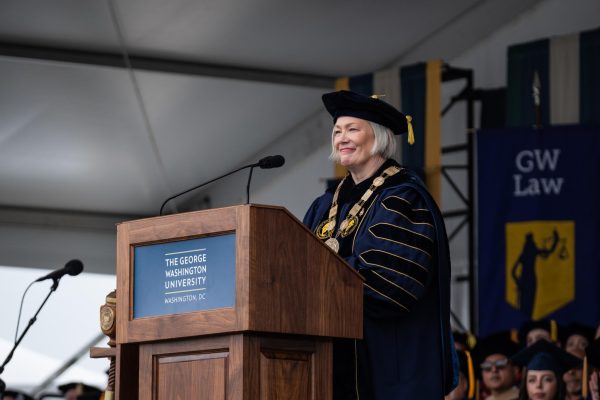
GW Alumni Council Chair Madeleine Jacobs welcomed graduates to a global network of over 350,000 alumni around the world. During her speech, she highlighted that graduates can one day join the group of “monumental” alumni by making an impact on the world with their service and contribution.
Jacobs said she wants graduates to stay involved with GW, help support the next generation of students and contribute to the “enduring legacy” of the University.
“On behalf of the entire GW alumni community, congratulations Class of 2026 and raise high,” Jacobs said.
Granberg and four students bestowed honorary doctoral degrees to three GW alumni, including Kutler, Universal Music Group Executive Vice President Michele Anthony and Willie Hensley, a former Alaskan politician and Alaska Native Rights activist. Granberg also bestowed Virginia Ali, the longtime owner and co-founder of Ben’s Chili Bowl, with a doctorate of public service.
This post has been updated to correct the following:
The Hatchet incorrectly spelled Michele Anthony’s first name. It is spelled Michele. We regret this error.