
Students say GW’s relative silence on President Donald Trump’s policies targeting higher education, immigrant communities and D.C. has left vulnerable students unsupported and sent the message that officials are tailoring their actions to the administration’s priorities.
Over 30 students said GW has remained too quiet on Trump’s controversial policies aimed at D.C., vulnerable communities and higher education, including his continued deployment of National Guard troops across the city, crackdown on diversity, equity and inclusion initiatives and heightened Immigration and Customs Enforcement operations near campus and across the country. Students say they want the University to take stronger action, like joining lawsuits other universities have signed onto, issuing specific public statements rebuking Trump’s policies and providing stronger protections for students and communities directly targeted by the administration’s policies.
“GW has the power to be doing a lot, and I am disappointed by how little they truly are doing,” said sophomore Rhiannon Novick.
Universities nationwide have navigated unprecedented challenges since Trump returned to power a year ago, including federal funding cuts, crackdowns on diversity, equity and inclusion initiatives, national debates over “wokeness,” tax changes, reductions in federal loans and stricter visa and travel policies. At GW, officials are battling a budget deficit that faculty and experts partly attribute to Trump’s higher education policies, with federal research funding cuts, University-wide layoffs and shifting policies hurting international student enrollment and graduate funding options.
Officials over the last year signed onto an open letter demanding Trump restore slashed federal funding and condemned the federal government’s “undue” overreach into higher education. They also joined a lawsuit supporting federal funding restoration, confirmed they are not considering Trump’s higher education compact and launched a student loan task force to provide students with additional options to finance college after the Trump administration slashed the Grad PLUS program.
But officials in recent months have faced mounting criticism from left-leaning community members who say the University is curtailing to the Trump administration, evidenced by officials quietly rolling back DEI initiatives, refusing to disinvite ICE from a GW Law career fair and sponsoring a trip for students to see Melania Trump’s documentary.
Students said Trump’s administration is targeting vulnerable communities, and by failing to directly condemn these actions, officials are signaling a lack of support for students under attack.
Novick, the sophomore majoring in political science and Spanish, said as a university in the heart of the nation’s capital, GW’s response to Trump administration policies “sets a tone” for colleges nationwide. They argued that officials should be more explicit in rejecting the administration, particularly given the University’s repeated expression of support for free speech, as Trump is challenging students’ rights at other schools.
In deals with other schools to restore frozen federal funding or conclude investigations, members of Congress and civil liberties groups accused Trump of coming after the academic freedom and freedom of speech of college students as administrators prioritize safeguarding federal funding. A deal the administration made with Columbia University last year requires the school to, among other things, adopt a contested definition of antisemitism some faculty at the institution allege restricts their freedom of speech.
“We should really be not taking any of the nonsense that he’s pushing onto campuses,” Novick said.
Novick said they were frustrated with the University’s response to international student visas last spring, when the State Department briefly revoked a “small number” of visas. They argued officials did not do enough to publicly support students affected by the revocations, as their only communication to the community was in the four Weekly Federal Updates officials mentioned the revocations.
GW launched a Weekly Federal Updates email in March to keep the community informed about changes in federal policy and their effects on the University, where officials frequently mention Trump.
“The Federal Updates email is developed each week with input from a broad group of campus stakeholders, including students, faculty, and staff,” University spokesperson Kathleen Fackelmann said in an email. “Other offices with responsibility for certain areas, including the International Services Office and the Office of the Vice President for Research, also communicate with their respective constituencies.”
Granberg and then-Provost Chris Bracey both addressed the revocations at April 2025’s Faculty Senate meeting, where Granberg told the group officials are doing “everything we can” to support those who lose their visas. Bracey called the revocations “very disappointing.”
ICE restored most students’ visas in roughly two weeks, but Novick said they know an international student who chose to transfer from GW because they felt officials weren’t supportive enough of international students during that time.
“There wasn’t enough clear understanding of what was going to go on and what protections there were in place that GW was willing to offer,” Novick said.
Novick said GW Law’s refusal to disinvite ICE from a public interest law career fair last week points to the University’s broader pattern of “complacency” with the Trump administration, mixed with an occasional statement alluding to condemnation of the president. They said officials need to decide what side of history GW wants to stand on and speak out more vocally about Trump if they disagree with his policies.
“This is the sort of thing where we as an entity, we as an institution, need to decide where we stand and what side of history we intend to be on,” Novick said. “I am not proud of being part of an institution that would support the horrific actions that ICE has taken.”
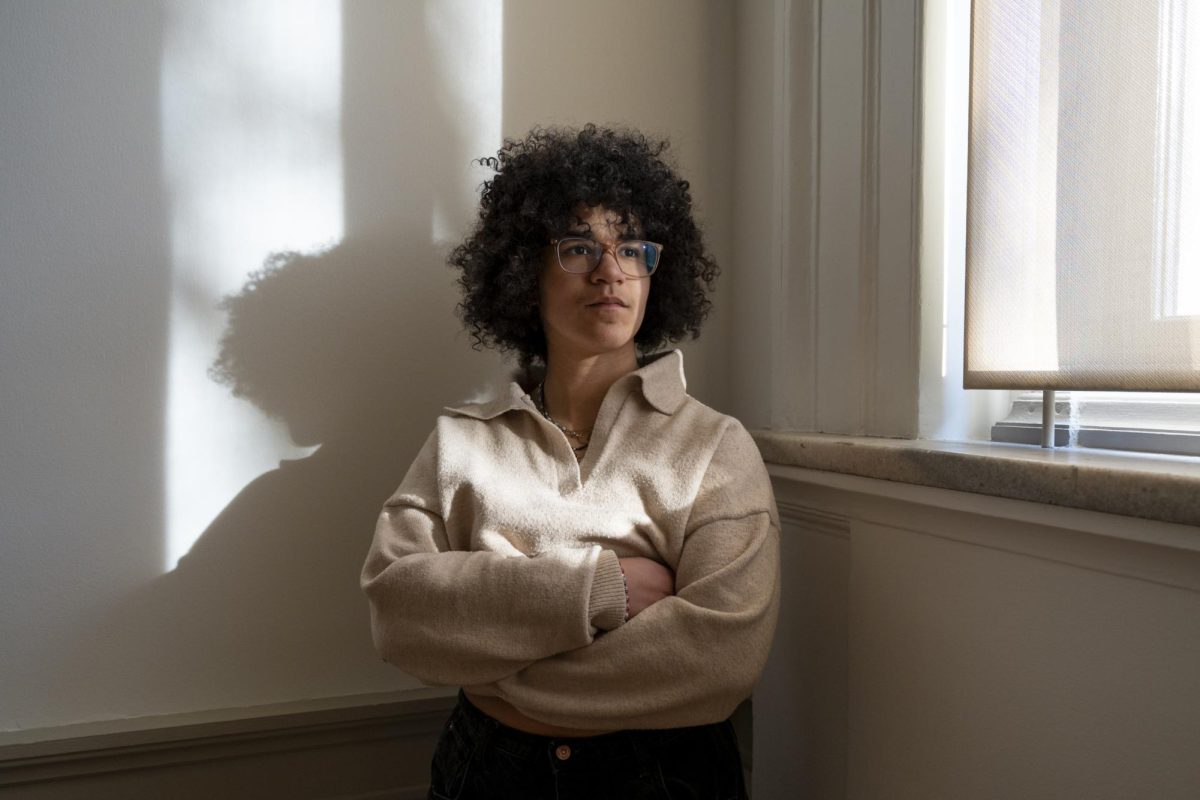
Savanna Jones, a first‑year international affairs major, said officials have positioned themselves as neutral on Trump‑era policies, rarely issuing statements or communicating with the community about the administration’s actions, even after events on campus, like the ICE raid at Circa in September. She added that the administration’s silence on key issues creates the impression that officials may be tacitly supportive of the Trump administration.
“They are a little too neutral when it comes to what he’s doing and when it comes to having people on our campus, having ICE raids in our campus, not really a big enough response to things like that,” Jones said.
Jones said GW’s sponsored trip to a paid screening of Melania Trump’s new documentary on Monday is “problematic,” suggesting to students that officials are aligning with the Trump administration, even though she believes most students oppose its policies.
“If anything, that’s pointing in support of that administration in a way that I don’t think that we should be framing ourselves at all,” Jones said.
A University spokesperson said the “Melania” screening is an optional event available to a limited number of students.

Moriah Musick, a first-year majoring in political science, said officials appear to be doing everything in their power to deflect discussing the Trump administration, like not publicly refuting the September ICE raid at Circa. Officials only confirmed they were aware the ICE raid happened in a Weekly Federal Update and did not issue a GW Alert or notify the community in any other way during or directly after the raid.
“When you have so many students that are so close to where these actions are being carried out, it’s of the utmost importance, I think, to address that head on and protect your students,” Musick said. “I think that GW’s administration has somehow managed to escape that.”
Sirapop Pichitkarn, a senior majoring in international affairs, said the University has been communicative about certain issues affecting GW, like the Department of Justice’s investigation that found GW in violation of civil rights law for acting deliberately indifferent to antisemitism on campus.
He said the University has repeatedly emphasized the school does not stand for antisemitic rhetoric, but the messages felt more like virtue signaling than reinforcing the protection of GW’s students.
“It’s more to serve what the president wants and pressure students that the school wants to step down from the hot spot,” Pichitkarn said.
Adyant Patnaik, a junior majoring in political science, said he feels the University has “conceded a lot” in its lackluster response to the federal government regarding specific actions against higher education and GW, showing that they are willing to accept the Trump administration’s attacks against higher education without a fight.
He said he feels GW has taken steps to rollback DEI efforts, and officials could do more, like publicly promoting and affirming support for DEI policies to protect diversity initiatives as a private institution that is not at the behest of the government in the same way public institutions are.
He said officials still seem committed to DEI in some way, evidenced by the continued support the University provides to the Multicultural Student Services Center and its events.
“If you pride yourself on being an international school where people from, I think they’re like ‘140 countries come here to study,’ then you need to protect the initiatives,” Patnaik said. “You need to make it not only that, you make a forefront of your program and your values.”
Fackelmann said the University regularly reviews its programs to ensure they comply with applicable laws as federal guidance continues to evolve.
“Further, the university reaffirms its commitment to recruiting, retaining, and supporting students, faculty, and staff with diverse perspectives, backgrounds, and experiences while abiding by university policies and applicable laws on non-discrimination and equal opportunity,” Fackelmann said.
Students in November echoed fears that officials are seemingly rolling back DEI initiatives for a myriad of reasons in response to Trump’s DEI crackdown, including halting the search for the leader of the Office of Diversity, Equity and Community Engagement, shuttering GW Law’s DEI webpages and postponing GW’s annual Diversity Summit twice.
Tara Nadkarni, a sophomore studying psychology, said while the federal government’s threats to universities to cut federal funding over campus policies can put GW in a “tricky” situation, she believes officials could still do more to stand up to the Trump administration, like joining more lawsuits.
In April 2025, Granberg signed onto a letter from the American Association of Colleges and Universities condemning “federal overreach” into higher education, which the letter states is “endangering” American higher education. A few months later, in July 2025, GW signed a letter from the Ad Hoc Group for Medical Research calling on members of the House and Senate Appropriations Committee to block cuts to the National Institutes of Health.
“I feel as though GW prides itself on being a very politically active campus and honestly a pretty progressive campus, and I feel like it should do a good job at representing the student body’s backgrounds and values and beliefs,” Nadkarni said.
Allie Maury, Naomi Wu, Paris Albrecht, Shivu Sathe, Zachary Crystal and Zoomel Ghauri contributed reporting.