
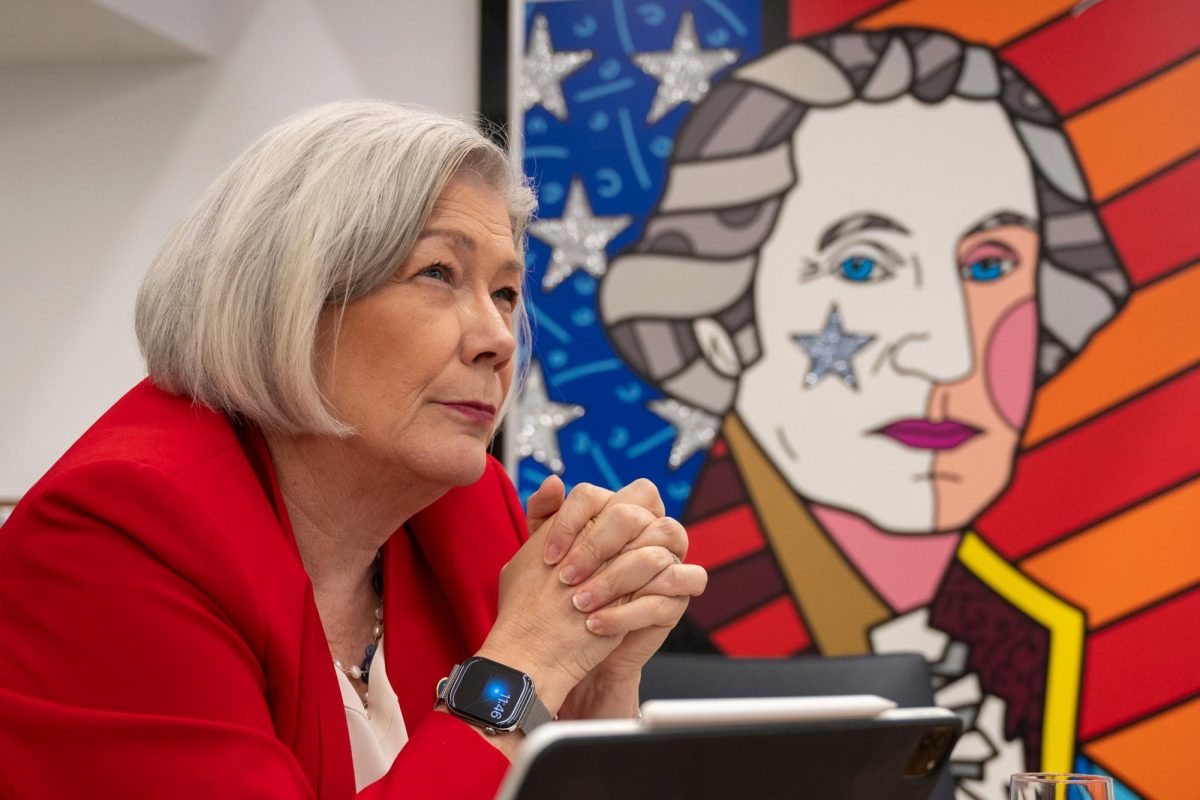
University President Ellen Granberg said when she started her tenure as GW’s 19th president in July 2023, she “couldn’t even have imagined” the number of challenges GW would be facing today.
But in a sit down interview with The Hatchet at the end of her third year in office, she said she sees her newly launched strategic framework as the University’s path toward amplifying the roots of the student experience as GW continues to navigate the financial impacts of a structural budget deficit and President Donald Trump’s overhaul of higher education. Granberg said she often hears students’ desire for improved services like enhanced advising and more D.C. experiences, even as officials continue to cut student services and GW’s cost of attendance nears $100,000, but efforts like the $427 million sale of the Virginia Science and Technology Campus and budget cuts in strategic areas will manifest into measurable improvements to the student experience over the next year and into the long term.
“People are not asking for things that are out of line,” Granberg said of student demands for improved resources. “Part of this is to say, ‘Okay, let’s up the base of what every student can expect,’ and that’s part of what the framework is intended to do.”
Student and faculty frustrations about cuts to dining, academic, transportation and student life services across the University throughout fiscal year 2026 have been a consistent theme of Granberg’s third year in office. She acknowledged in the interview the University will have to conduct additional budget cuts in FY2027 — largely due to continuing declines in international and graduate student enrollment — which she said are necessary to achieve broader goals in the strategic framework, like improving student financial aid and strengthening career and academic advising, both issues she said she often hears from students that officials need to improve.
Still, she expressed optimism at the University’s financial situation given the ongoing challenges it faces.
“We’re in a much better position right now than I thought we might be,” Granberg said. “So I’m feeling pretty good right now.”
Officials announced in April 2025 they would slash the University’s budget by 3 percent in FY2026, causing officials to implement a hiring freeze in July and lay off 43 staff members in September.
While Granberg said officials originally discussed the potential of holding off on creating a strategic framework given “uncertain” times, she said community feedback during town halls confirmed officials were taking the correct steps to build a roadmap for the next several years after lacking a strategic direction since 2020.
Granberg told the Faculty Senate in September she wanted to hold off on “fancy initiatives” until the budget stabilizes — as GW faces a $24 million structural deficit as of July — though officials would focus on the three initiatives they determined are most important to the community, including exploring advancing interdisciplinary research, embedding D.C.-based opportunities into GW and expanding academic and career advising.
Granberg said making strides in meeting students’ demonstrated financial need, a goal in the strategic framework, has always been a top priority for her, which is why she decided to dedicate the “bulk” of the proceeds from the February VSTC sale to Amazon Data Services to fund the Revolutionary Promise officials announced this month, which fulfills cost of tuition for students with household incomes less than $100,000 a year. She said officials’ original timeline for accomplishing the Revolutionary Promise was at least seven years away, though the VSTC sale allowed it to come to fruition this year.
“That was a great day, I have to say, when we got to to make that public,” Granberg said.
When asked about student frustrations regarding cuts to resources throughout the fiscal year, Granberg acknowledged that the University could be doing more to enhance the student experience, like bolstering academic and career advising for students, the aim of one of strategic framework’s three working groups. But she also pointed to renovations to Mitchell Hall and officials moving Associate Vice President of Business Services Seth Weinshel to the Division for Student Affairs to be in a better position to hear student feedback on the dining and residential experience as evidence that officials are centering students in budget decisions.
“It’s not just about cutting, it’s also about how do we make sure that we’re spending our money in the places that are going to have this impact?” Granberg said. “So also part of where the investment dollars will come from and I have to admit we’re not gonna have gigantic amounts of money for next year.”
Student Government Association President-elect MJ Childs, who won this month’s election on the platform of challenging officials to increase transparency on budget decisions and make the GW experience worth the nearly $100,000 price tag, said the University’s top priority should be investing in the student experience. He said officials should expand and tailor advising services, like those the School of Buisness’ F. David Fowler Career Center currently offers, to students in schools beyond GWSB, to improve the academic and professional experience for students.
Childs added that officials should increase their in-person interactions with students to solicit feedback on decisions, so they have a better understanding of student life on campus and so students can better understand officials’ decision-making.
“When there are cuts being made, I call on officials to carefully consider how it will impact its current student population and what benefits it will bring them,” Childs said in an email.
Outgoing SGA President Ethan Lynne said Granberg has shown him during their monthly meetings that she cares about students by asking “deeply detailed” questions about the student experience and how officials can improve. He said SGA leaders have provided Granberg advice on areas to improve, like when it comes to communicating with students.
“What I really like about working with her is that it’s never just a ‘no,’ or if it is a ‘no,’ in the initial kind of concept, she tries to come up with a compromise that we can still move forward on and work on throughout the rest of our tenure,” Lynne said.
Faculty senator Katrin Schultheiss said it’s “absolutely essential” that officials bring student and faculty voices into conversations surrounding decisions on where to reallocate funds. She said it will be tough to make decisions, though it’s necessary for community members to understand why the cuts are happening and why officials are prioritizing certain resources over others.
“If we can’t provide a positive student experience that students think is worthwhile, then we’re really in trouble,” Schultheiss said. “If students, current students, feel that they are not getting the support that they need, then we absolutely need to work on that because they’re not going to come, it’s not like other universities.”
Granberg said officials are looking holistically at budget decisions to ensure they aren’t making too many cuts in one specific area, like student resources or GW’s academic enterprise. She said officials in FY2026 asked the academic units to cut less than the non-academic side, though she doesn’t yet know the balance of FY2027 cuts, as officials continue to make adjustments to the budget, which the Board of Trustees will approve at their May meeting.
She said she couldn’t comment on whether she anticipates additional layoffs in FY2027, though one of her top priorities is securing merit-based salary increases for faculty and staff after officials halted them in FY2026. Granberg added that she understands the reality of inflation and D.C. being an expensive place to live, though she can’t say “for sure” the increases will happen until the Board approves GW’s budget in May.
“What I’m going to be doing is asking myself, what’s the greatest value to or impact to cost ratio so that we can get as much good out of the investments that we make in the near term, and then some of the fancier things can wait until we’ve got a little more discretionary money,” Granberg said.
While still focusing on the strategic framework, Granberg said she acknowledges students’ calls for officials to make more public statements addressing political issues affecting GW. At the same time, she said she will only release messages to the community after considering three factors, including maintaining the safety of the campus, the environment of academic freedom and officials’ ability to execute its educational and research mission — rather than feeling the need to call out Trump by name.
Over the past year, community members have said GW’s relative silence on Trump’s policies targeting higher education, immigrant communities and D.C. has left vulnerable students unsupported and sent a message that officials are more concerned with avoiding retaliation from Trump than advocating for their students. Students called on officials in February to take stronger action, like issuing specific public statements rebuking Trump’s policies and providing stronger protections for students and communities directly targeted by the administration’s policies.
Granberg added that just because officials are not putting out many public statements does not mean they are not working behind the scenes.
Granberg said she has already released “some” statements in the past addressing community concerns, but did not say she would release additional statements about protecting international students and Immigration and Customs Enforcement on campus, as students have repeatedly called for. She added that she tries to stay in touch with students to see what messages they are looking for to address student concerns, and pointed to a recent video she released encouraging students to reach out for help.
Granberg in October sent a community message outlining the unprecedented convergence of financial and political pressures confronting GW, marking the first time the University has publicly discussed staff layoffs, reductions in campus services and the findings of the Department of Justice’s antisemitism investigation with the full community.
“If I’m thinking about whether or not to say something publicly, I’m asking myself ‘Does it make our students more or less safe? Does it enhance or degrade the environment of free expression on campus? And does it affect our educational mission?'” Granberg said.
Granberg also said in the interview officials are “very close” to finalizing a deal with Universal Health Services to end GW’s financial ties to the debt-ridden Medical Faculty Associates — which has racked up more than $444 million in debt to GW and other entities — and officials want to sign agreements by the end of the month.
“That’s the part that we’re in now, and the biggest risk right now is what’s called deal fatigue,” Granberg said. “It’s getting frustrated and getting impatient and saying, ‘No, no, no, we’ve just got to get it done.’ We are trying very, very hard to not fall victim to deal fatigue.”
Granberg said the MFA will undergo a transition, adding that the new Foggy Bottom Physician Group is the “replacement” for what happens with the MFA and that the medical enterprise won’t look “anything like” how it functions today.
She first teased officials were in negotiations with UHS to end its financial support for the MFA at a September Faculty Senate meeting.
Officials in November first announced UHS will establish a new non-profit physician practice group to directly hire MFA employees. They provided an additional update on new agreements between GW and UHS earlier this month, which outlined that the new physician group will serve both GW Hospital and Cedar Hill Regional Medical Center GW Health, UHS will employ a “majority” of the MFA’s clinical providers and staff and UHS and GW will terminate existing agreements between the parties related to licensing, clinical operations and research at Cedar Hill.
Tyler Iglesias contributed reporting.