
Updated: April 27, 2026, at 12:14 p.m.
The SGA and Faculty Senate contrast in their recommendations for the University’s artificial intelligence policy, with the bodies both passing resolutions this month encouraging officials to implement their approach.
SGA senators passed a resolution earlier this month urging officials to reframe the University’s AI policy, emphasizing AI’s potential as an educational resource and accessibility tool, and encouraging faculty to view students’ AI usage from a less critical lens and reduce rising academic integrity cases by clarifying guidelines. But members of the Faculty Senate Educational Policy & Technology Committee, which passed a resolution earlier this month recommending the University consult EPT before implementing technological decisions — including AI policies — opposed the SGA’s resolution, saying it ignores decreased student engagement with course material stemming from increased AI usage and provides simple solutions for deeper issues that require restructuring curricula and further research into AI.
The Office of the Provost released its current generative AI guidelines three years ago, suggesting faculty adopt one of three options to generally permit, forbid or allow the tools in classes at a faculty’s discretion, declaring students could use AI to find ideas, but not submit AI-generated content for evaluation. The University’s non-binding guidelines have led professors to adopt a wide range of policies and attitudes towards AI.
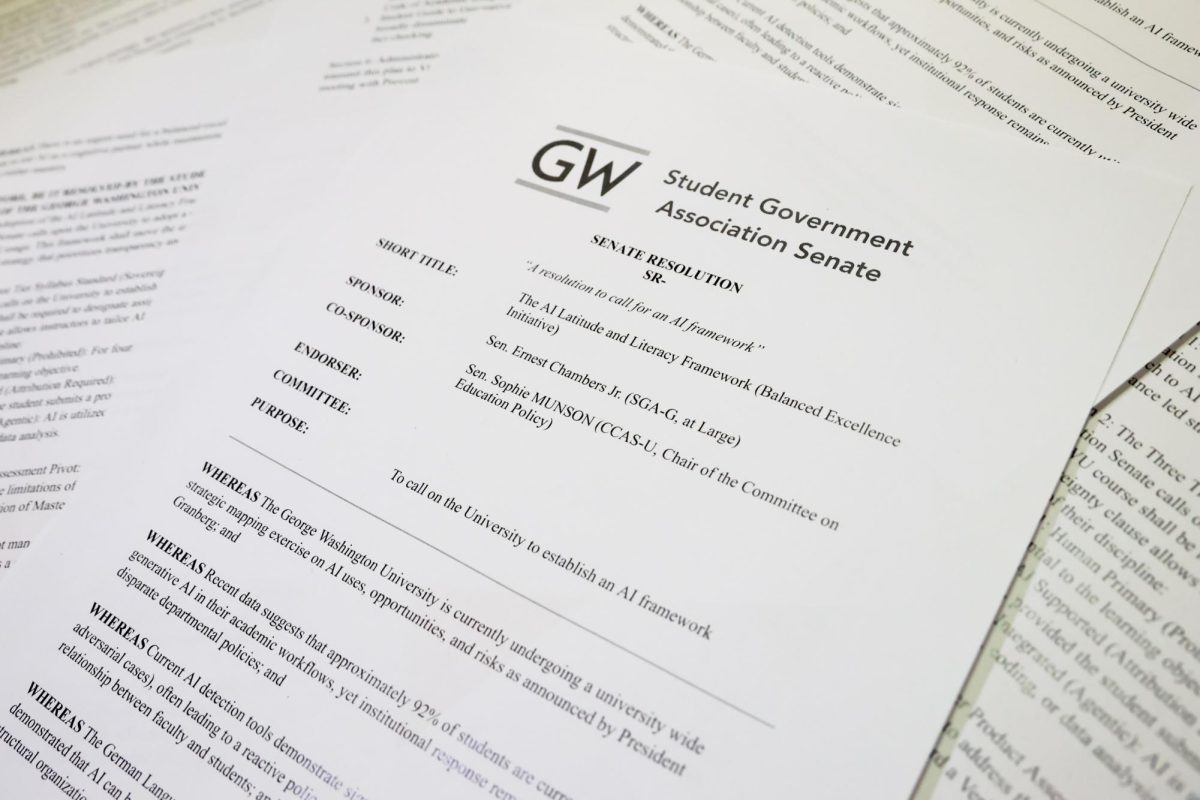
The SGA’s AI Latitude and Literacy Framework Resolution, passed on April 13, proposes requiring professors to categorize assignments into one of their pre-established tiers, distinguishing between assignments where AI tools are required, where AI can be used to brainstorm and research or completely prohibited. SGA Senator Ernest Chambers Jr. (G-At Large), who sponsored the SGA resolution, said under their framework faculty would still decide which tier assignments fall under, but the policies associated with the chosen tier would be consistent for students University-wide.
Chambers said he was inspired to write a resolution framing AI in a more positive light after seeing a GW Law student leave the University after GW Law professors falsely accused him of using AI without an opportunity to appeal last semester, with hope faculty would come to see misconduct cases as “not that serious” to prevent another “tragedy” from happening in the future. He acknowledged some students do use AI with the intention of cheating, but he said students’ AI usage should not inherently be seen as cheating, which he said is how many faculty members currently view the tool.
“I was prompted by wanting to advocate for students that were likewise situated, because my understanding is that that happens increasingly more with the onset of AI use and the non-standardized use,” Chambers said.
SGA Senator Sophie Munson (CCAS-U) said she interpreted the 47 percent increase in academic misconduct cases from spring 2023 to 2025 that Conflict Education & Student Accountability reported last month as the University needing clearer and more consistent AI policies, attributing some violations to students not understanding a course’s AI policies.
“If we reduce the confusion and make it clear in syllabi that AI can be in three tiers usage, then there will be less confusion and hopefully less academic integrity violations due to people not reading the syllabus,” Munson said.
Munson said she plans on asking the SGA’s Student Advocate’s Office, where students dealing with misconduct cases can seek assistance, for data on the quantity of AI cases and specific use of AI in them to inform the SGA of whether they should take further action on AI if their current resolution fails to effectively combat rising cases. However, Ben Wieser, the director of SAO, said he was uncertain how much information he could provide Munson given the office’s strict privacy guidelines to protect students.
Munson, who graduates this semester, said she hopes future SGA senators host events such as SGA-hosted panels or town halls between students, faculty senators and officials as part of the University’s AI strategic mapping exercise to jointly develop AI policies to recommend to the University.
University President Ellen Granberg said at this month’s Faculty Senate meeting she expects the faculty researching AI’s uses, opportunities and risks since December as part of the University’s AI strategic mapping exercise to present their findings at next month’s meeting. She said the exercise’s findings, which officials will use to inform the University’s AI policies, will likely include reports on the pedagogical impacts of AI.
University spokesperson Julia Garbitt said officials in the AI strategic mapping exercise were aware of the SGA’s resolution, but declined to comment on whether officials supported the SGA’s approach to developing AI policies. She said officials used a student-specific survey sent out earlier this year that received more than 130 responses and a focus group for students to inform the mapping process on student perspectives.
The Faculty Senate passed their AI resolution, which the EPT introduced, on April 17, declaring the EPT as the body leading discussions on how technology shapes professors’ pedagogical choices and consulting with administrators about institution-wide technology decisions given the significant ways in which AI shapes students’ ability to learn.
Jamie Cohen-Cole, an EPT co-chair, said the committee’s resolution ensures faculty, particularly those in the EPT, have a say in what policies regarding technology, including AI, the University adopts.
“What the Faculty Senate passed was only the statement ‘The faculty should have a role in decisions about education, deployment of technology,’” Cohen-Cole said. “That’s the main point.”
Alexander Dent, an EPT member and anthropology professor, said he “applauded” the University’s mapping exercise for its efforts to research AI before implementing policy, and said the EPT’s resolution will allow faculty members’ opinions on AI formed through their own research and experience teaching students who use AI to inform the University as well.
“What the resolution avoids is creating a centralized mechanism that could dictate a one-size-fits-all policy across the University,” Dent said.
Dent said he was hesitant about the SGA asking the University to formally consider AI as an accessibility tool as research about its impacts is incomplete.
“There is lots of research to suggest that AI can be helpful,” Dent said. “There is lots of research to suggest that it creates cognitive deskilling and burnout. It is simply too early to be able to say that it’s definitely good or bad – we should be cautious, experiment and evaluate.”
John Warren, an EPT member, said many professors struggle to keep students engaged as they often rely on AI instead of learning. Warren said the SGA’s framework will be ineffective in reducing students’ academic integrity violations from using AI because it overlooks the issue of faculty not knowing how to design assignments that force students not to use AI.
Warren said he thought the EPT’s call for increased faculty input may inspire the University to pursue further research into pedagogical effects of AI, a measure he said the University needs to consider when moving forward with AI policies if they want to lower rising AI-related academic integrity violations.
“Teaching and learning need to be transformed to encourage students not to use AI to ‘cheat’, to cheat themselves from learning,” Warren said in an email.
Phil Wirtz, an EPT member, said he opposed the SGA’s resolution because students could resolve confusion about AI policies by asking professors directly, making the proposed standardized policy unnecessary. He said he had “wouldn’t have a clue” how to classify assignments within the SGA’s proposed tiers because of their vague descriptions without examples, rendering the framework a useless template — though SGA senators said broad categories made the framework adaptable to AI’s ongoing developments. Wirtz said the EPT’s resolution had a “very real” purpose, unlike the SGA’s, which he said was determining a specific faculty body to be responsible for AI policy amid interested groups with “competing visions” for AI policies the University should adopt.
“If a student thinks a policy should be reviewed, they should take it up directly with the professor,” Wirtz said in an email. “I may be totally oblivious, but it seems to me that the SGA resolution is anticipating trouble where none currently exists.”
This post was updated to correct the following.
An earlier version of this article included information that was not given on the record. The information has been removed. We regret this error.