
The Student Government Association Senate passed seven resolutions at a meeting Monday, including calling on the University to grant students two mental health days per semester and adopt a University-wide framework governing how students and faculty use artificial intelligence.
The mental health resolution, which senators unanimously passed calls on officials to allow students to use two mental health days without any impact to their attendance or participation grades — similar to an accommodation already extended to students observing religious holidays. SGA Vice President Liz Stoddard said the measure would also push faculty to include more personalized mental health guidance in their syllabi beyond standard references to GW’s Counseling and Psychological Services.
“Students often face mental health challenges during the academic year due to a variety of personal circumstances, and it is critical that students have a resource within classes,” Stoddard said.
The SGA’s Mental Health Assembly in 2023 advocated for mental health days and collaborated with the Faculty Senate to request professors add the days to their syllabi, but ultimately did not gain enough support. Former SGA President Ethan Fitzgerald, the assembly’s then-chair, said in 2024 he received “pretty strong indications” from faculty senators that they would be willing to move forward with the initiative but still had to “work out the details.”
The AI resolution calls on the University to adopt a tiered framework distinguishing between assignments that must be completed without any AI usage, those where AI assistance is allowed with disclosure and those where AI tools are fully integrated into the work. SGA Sen. Sophie Munson (CCAS-U), chair of the Education Policy Committee who co-sponsored the resolution, said the current absence of a consistent University policy about AI has left students without clear guidance on acceptable AI usage and how to properly integrate the tools into the classroom.
GW’s current AI policy leaves most decisions up to individual instructors, who must spell out in their syllabi whether AI tools are permitted, prohibited or allowed only for certain assignments. By default, submitting AI-generated content for evaluation without explicit instructor permission counts as cheating under the University’s academic integrity code.
The resolution calls on the University to formally recognize AI as an accessibility tool, where non-native English speakers or neurodivergent students who use AI to bridge language barriers or educational gaps would not violate GW’s academic integrity code, as long as they disclose its usage.
“Students are already using artificial intelligence in their academic work,” Munson said. “The issue is not whether AI should be used, the issue is that we currently have no clear, consistent system for how it should be used. This resolution creates that system.”
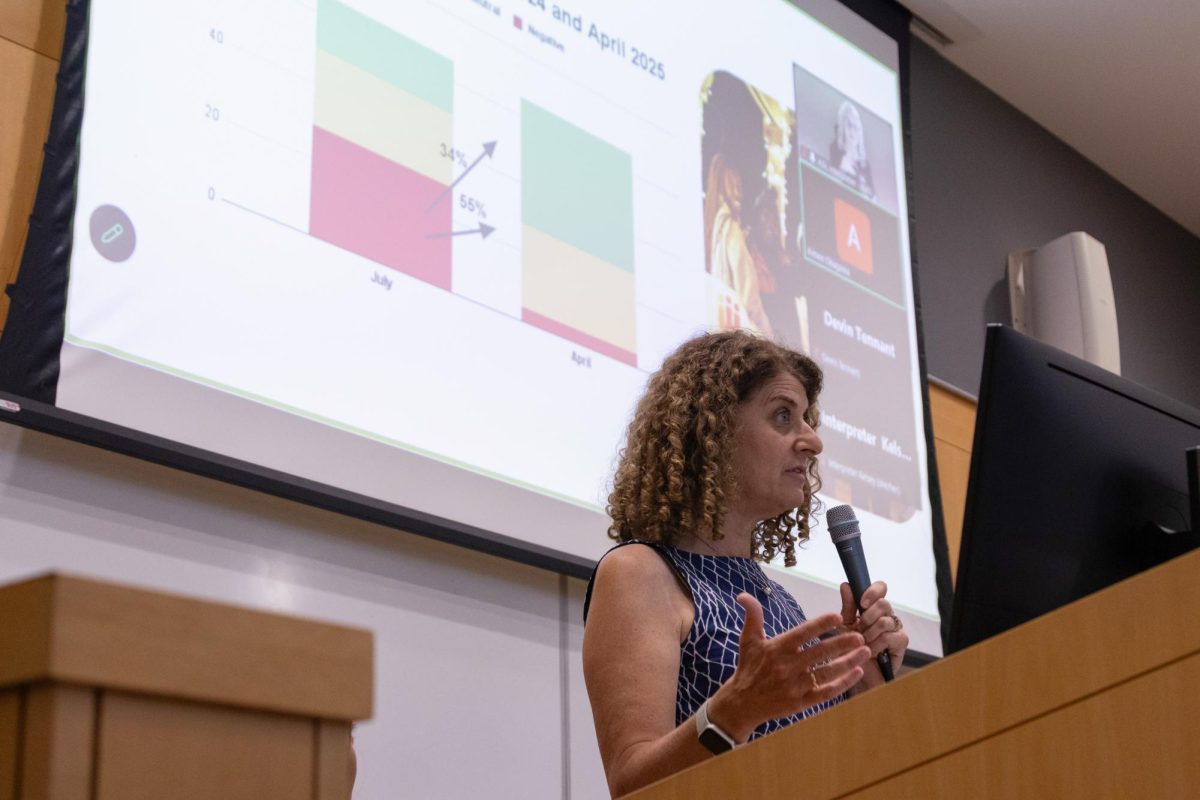
Senators also heard from Assistant Dean of the Mount Vernon Campus Betsy Shimberg who presented survey data showing that nearly 30 percent of students assigned to the Vern arrive with a negative impression of what their experience will be like. Shimberg said 34 percent of those students moved to feeling positive about the campus after spending most of two semesters there, and another 55 percent shifted to feeling neutral.
“In July, these students were not part of a community, and in April, they absolutely were,” Shimberg said. “So sometimes people are unhappy when they talk about the Vern, but for the vast majority, that changes.”
The SGA held its meeting in Ames Hall, fulfilling an annual bylaw requirement to hold at least one Senate meeting on the Vern.
Shimberg said she acknowledged that students who live on the Vern may miss out on social scenes that students living on Foggy Bottom have, like going to parties and clubs, but she said officials have attempted to create other opportunities for students on the Vern, like holding campus-wide dinners and discussions where they can connect with officials like her.
“The Vern is not Foggy Bottom,” Shimberg said. “There is no way we can recreate the club scene in Dupont Circle, but what we offer students is an experience rooted in connection, belonging and pride.”
Shimberg also announced that a new textile maker space, named Stitch Studio, will open on the Vern on April 25, offering sewing, knitting and crochet resources to students.
Shimberg said administrators are largely unable to address students’ frustrations with the Mount Vernon Express shuttle due to the physical constraints of transporting students between campuses. She said she has heard complaints this year about longer wait times due to reduced frequency of Vex shuttles, but there is “nothing” she can do about the commute between the Vern and Foggy Bottom.
Officials in the fall reduced shuttle frequency from every five minutes to every 10 minutes and cut the number of buses in circulation from nine to seven, a decision University spokesperson Julia Garbitt said the University made because of a new shuttle model that holds 30 instead of 25 passengers.
“Until GW is willing to build me my monorail that goes over Georgetown between campuses, this is what we have,” Shimberg said.
Senators also passed a resolution formally recognizing March 31 as International Transgender Day of Visibility at GW — a measure its sponsor SGA Sen. Jivan Ramesh (Law-G) said was written with the help of the vice president of GW’s transgender and non-binary students association. Ramesh said the resolution was intended to show visible support for transgender, non-binary and gender diverse students at a time of heightened national attention on transgender rights.
A separate resolution senators passed, sponsored by SGA Sen. Cheydon Naleimaile-Evangelista (CCAS-U), recognizes April as Sexual Assault Awareness Month and affirms the SGA’s commitment to standing with survivors. Naleimaile-Evangelista said he decided to write the resolution in response to a 21 percent increase in Title IX complaints last academic year.
“This resolution recognizes April as sexual assault awareness month and affirms the SGA’s commitment to standing with survivors to break the cycle of silence and stigma that they often experience,” Naleimaile-Evangelista said.
Senators also passed a bill to amend the bylaws to add non-voting seats on SGA committees for representatives from the Faculty Senate, Staff Council and Student Bar Association and would similarly designate SGA members to sit in on those bodies’ committees. Stoddard, who sponsored the bill, said the SGA is the first body to pass the resolution, but she hopes the Faculty Senate, Staff Council and SBA members will sign onto it too.
Stoddard said she has spoken to the leaders of the bodies, including SBA Vice President Quinn Biever, who were receptive to the idea.
“Right now it seems that GW is prioritizing their own interests over students,” Stoddard said. “We are not stronger when we are separated.”
The SGA’s final meeting of the term will take place April 27 at 7 p.m. in the University Student Center Grand Ballroom.