

GW is negotiating with Universal Health Services in an attempt to end its financial support for the Medical Faculty Associates, a spokesperson confirmed after University President Ellen Granberg teased the arrangements at a Faculty Senate meeting Friday.
Granberg said negotiations with UHS — GW Hospital’s owner and operator — are “progressing in earnest,” marking the first time officials have publicly revealed talks between the two parties over the MFA and detailed efforts to cut financial ties from the medical enterprise, which has racked up more than $400 million in debt to GW and other entities. Officials have pledged for years that they are making progress to bring the MFA back to profitability, but the medical enterprise has continued to incur tens of millions of dollars per year in additional debt since fiscal year 2020.
Granberg said officials anticipate providing a “substantive” update on the negotiations at October’s Faculty Senate meeting. She did not clarify that the negotiations with UHS concerned the MFA until Faculty Senator Phil Wirtz asked about the medical enterprise’s ongoing financial losses, prompting her to explain that her earlier reference in the presidential report pertained to the MFA.
University spokesperson Julia Garbitt said officials, UHS and the MFA are working to chart a “sustainable path forward” for all parties to eliminate the University’s financial support for the medical enterprise.
Garbitt’s comments indicate GW is planning to restructure its relationship with the MFA for the third time over the last thirty years. Most recently, GW under then-President Thomas LeBlanc in 2018 brought the MFA — which previously operated as an independent entity — under its governance, giving the University control over its budget and leadership. LeBlanc justified the restructuring as an attempt to strengthen the School of Medicine & Health Sciences’ national ranking, as the MFA’s physicians now teach its students, residents and researchers.
“Our goal is to ultimately eliminate GW’s financial support of the MFA to cover its operating losses while preserving high quality medical education and health care for the communities we serve,” Garbitt said in an email.
Garbitt declined to comment on when negotiations between the parties began and when the University plans to conclude talks.
The negotiations with UHS further entangle the University with the healthcare management company, which became the sole owner of GW Hospital in May 2022 after the University sold its remaining 20-percent stake. As of early July, UHS and the MFA were continuing negotiations around an agreement regarding the MFA’s staffing of Cedar Hill Regional Medical Center GW Health, which opened in April and is also operated by UHS.
UHS and the MFA also settled a lawsuit in July that the medical enterprise filed last year over allegations that UHS “properly withheld” Medicare reimbursements from the MFA.
Officials have remained guarded this year about the steps they were taking to manage the MFA’s financial losses, often citing that officials were making progress that they could not talk about it publicly. Officials offered glimpses into their ongoing efforts to combat the MFA’s financial losses with their decision to hire MFA CEO Bill Elliott in May 2024 and his subsequent efforts to increase patient access, lower wait times and renegotiate cleaning and real estate contracts.
Granberg said at a May Faculty Senate meeting that officials have discussed “real decisions” regarding the MFA but said they could not talk about what the solution was.
During a report to the Faculty Senate in March, GW Chief Financial Officer Bruno Fernandes and MFA CEO Bill Elliott said they were working to fix the group’s operational issues through renegotiated contracts and methods to grow revenue but declined to specify a timeline for a solution, despite pressure from senators.
Granberg also said during her presidential report officials are waiting to hear back from the Justice Department after they reached out by the Aug. 22 deadline the department gave them to indicate interest in conversing about entering a voluntary resolution agreement over its antisemitism findings. The DOJ on Aug. 12 determined that GW failed to adequately combat campus antisemitism, and officials late last month confirmed they were “in contact” with the DOJ.
Granberg said officials developed a three-part plan to engage faculty in conversations about the DOJ, including creating a faculty work group on “federal matters,” a workshop for Faculty Senate subcommittees on DOJ-related issues and a special meeting with Board of Trustees Chair Grace Speights and FSEC.
She said the Faculty Work Group on Federal Matters will review and provide feedback to the University on recently signed resolution agreements between both Brown and Columbia universities and the Trump administration regarding alleged violations of federal anti-discrimination laws. She said the group will work privately under privilege, which legally protects the group’s communications and documents from forced disclosure in court, due to its “highly sensitive” nature.
Granberg said this privilege is a new level of involvement for faculty to engage in private discussions and will allow the University to utilize faculty expertise. She said the committee will engage in “genuine consultation” rather than officials ratifying a “predetermined outcome.”
“The goal will be for committee members to review resolutions, weigh them thoughtfully and produce recommendations that reflect the breadth of this group’s deliberation, not any single person’s preferences,” Granberg said.
Granberg said officials will hold a workshop for Faculty Senate subcommittees to review the same publicly available documents of Brown and Columbia universities’ resolution agreements with the federal government and offer their views. She said Speights agreed to hold a special meeting with the FSEC, University leadership and the Board of Trustees to provide FSEC members an opportunity to share their views on the DOJ matter directly to the Board but did not specify when the meeting will take place.
Granberg also confirmed the Board of Trustees approved the University’s fiscal year 2026 budget after officials in July directed each school and unit to make budget cuts to address a budget gap and years-long structural deficit. Granberg said officials are forming a faculty and staff working group on budget matters to advise senior leadership on the “additional measures” the University may need to take to address its financial struggles.
Granberg said officials will publicly launch the University’s new strategic framework in October and will begin by implementing the three major ideas the community supported most — enhancing GW’s interdisciplinary research ecosystem, better leveraging D.C. experiences as part of student learning and improving academic and career advising.
She said she wanted to hold off on “fancy initiatives” until the University’s budget stabilizes, but officials will focus on the three initiatives they determined are most important to the community. She said officials launched three separate working groups that will focus on exploring advancing interdisciplinary research, embedding D.C.-based opportunities into GW and expanding academic advising.
“This is at a point, with in terms of our budget, where I don’t want to fund a lot of fancy initiatives, and so we get our budget worked out, and we get our merit back in place, but that doesn’t mean that there isn’t plenty that we can do,” Granberg said.
Granberg said the University is launching two additional initiatives in conjunction with the three working groups for the strategic framework, including a community review to update GW’s mission statement, which officials last updated in February 2019.
Granberg said officials are accepting applications for the provost position through the end of this semester and will begin interviews early next year. Officials announced in August the search for a new provost, including the appointment of a search committee, after former Provost Chris Bracey resigned in June.
Interim Provost John Lach said during his first official report to the Faculty Senate that officials are making progress on GW’s new budget model, which they expect to phase in during FY2027 to resolve potential issues before fully implementing the new model by FY2028. He said officials have established a faculty advisory group with representatives from the University’s 10 schools and colleges to recommend best practices for implementing the budget model, including increasing transparency, modernizing analytics tools and detailing revenue and expense allocations.
Lach said the University’s next steps in the implementation of the budget model include convening the faculty advisory group in September and fielding feedback from Granberg, her cabinet and deans in October. He said the feedback from community members will be incorporated into the budget model over the next several months.
FSEC Chair Katrin Schultheiss said in her report officials created a new administrative committee for faculty and students to discuss issues concerning faculty and students. Chief of Staff Scott Mory said the joint student and faculty committee existed for decades until the COVID-19 pandemic and is used to discuss “issues of common interest.”
“The administration sees value in the committee, and as we engaged FSEC on the topic as well, we’d like to be able to convene it this fall,” Mory said.
Faculty senators spent a significant portion of the meeting voicing concerns regarding officials’ plans to begin “right-sizing” the Graduate School of Education and Human Development. Officials announced in June that in order to combat declining enrollment at GSEHD, they would be considering layoffs for staff and contract faculty, cutting programs and consolidating classes in a move faculty said lacked community input.
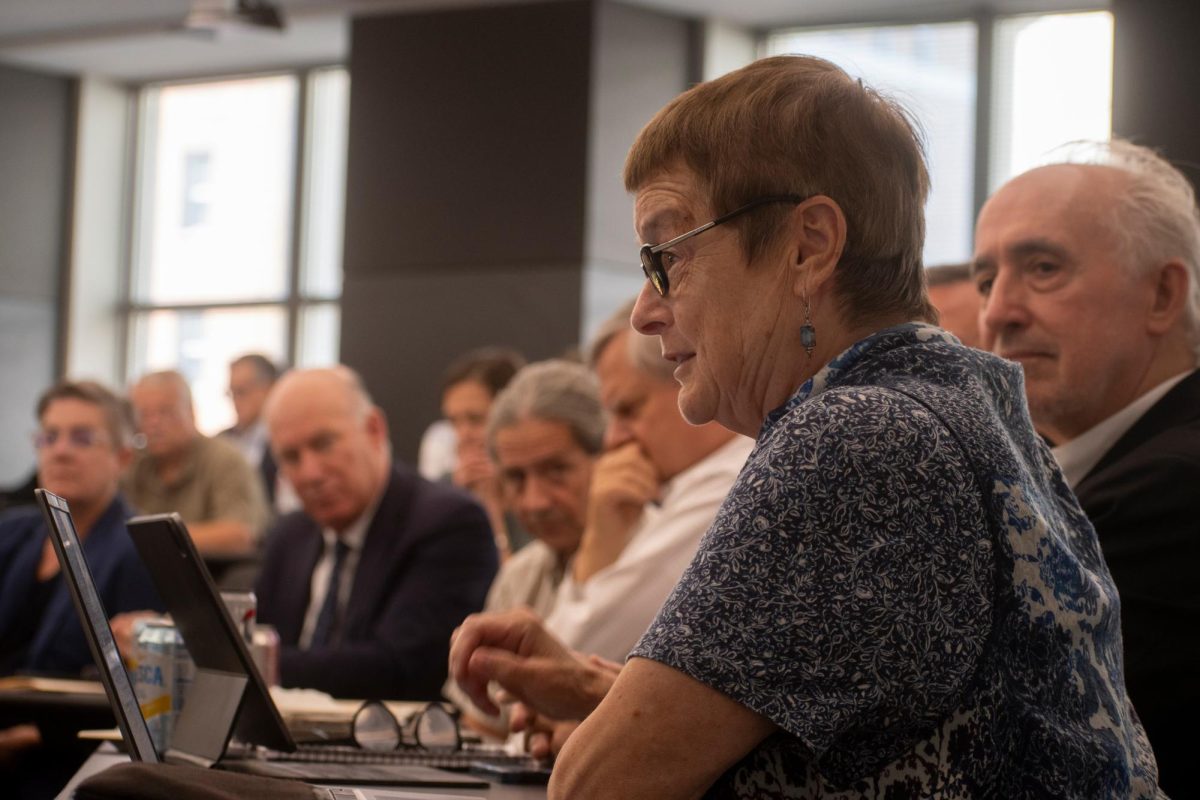
Faculty Senator and GSEHD Representative Maria Cseh said she was “flabbergasted” that about 25 percent of GSEHD’s faculty received letters of possible termination from the administration without consulting experts or faculty. She also criticized the announcement for coming a week before then-Dean Michael Feuer and Bracey stepped down from their roles.
At least 15 faculty members received an email from officials notifying them that they could see “changes to their employment status,” Dwayne Kwaysee Wright, a professor of higher education administration, told The Hatchet in July.
Granberg said officials considered layoffs because of the “urgency” of GSEHD’s situation, where enrollments suddenly plummeted following a long, slow period of decline. GSEHD’s enrollment decreased from 1,479 in 2014 to 958 in 2024, a more-than-500-student decrease. Enrollment has also dropped 29 percent since 2020, when the school had 1,341 students, according to enrollment data.
Faculty Senator Jennifer Brinkerhoff, a professor of international affairs, said what happened to GSEHD was “heartbreaking” and urged officials to have more “systems in place” to prevent considering layoffs in the future.
Lach said officials are also working on increasing transparency with faculty on where money is going as they work on the new budget model. He said officials are moving towards making multiyear budget models to plan further ahead in order to prevent scenarios like GSEHD’s downsizing.
Lach also said he hosted a town hall with GSEHD community members a few weeks ago, where he had “productive” conversations about how to best support the school’s students and faculty due to the enrollment changes making it “very difficult” to support existing faculty.
He said aside from specific budget parameters, he wants to give GSEHD autonomy in deciding how programs are staffed to ensure the school is positioned more “strongly” in the future.
“My consistent message to Dean Howard is that GSEHD knows what’s best for the future of GSEHD,” Lach said.
Lach also provided an update on the University’s partnership with Gallup, which officials hired to survey faculty and staff in 2020, asking for recommendations on how to improve GW’s culture. He said officials worked with Gallup from 2020 through 2024, and the contract was paid off in 2024.
Jamie Cohen-Cole, the chair of the American studies department, introduced a resolution recommending that in the future, officials consider conducting surveys using in-house experts instead of outside contractors like Gallup, which cost more. The Faculty Senate approved Cohen-Cole’s resolution unanimously without amendments.
Lach said officials selected a steering committee to guide the University’s reaccreditation process, which is engaging groups like the Student Government Association and Staff Council to draft a self-study for Middle States. He also said officials created seven working groups focused on the standards for reaccreditation.
Schultheiss withdrew a resolution in appreciation of Bracey from the meeting agenda, citing a rule that resolutions must come from a committee and be sponsored by eight senators or be a request from the president, requirements the resolution failed to meet.
Dylan Ebs, Jenna Lee and Tyler Iglesias contributed reporting.