

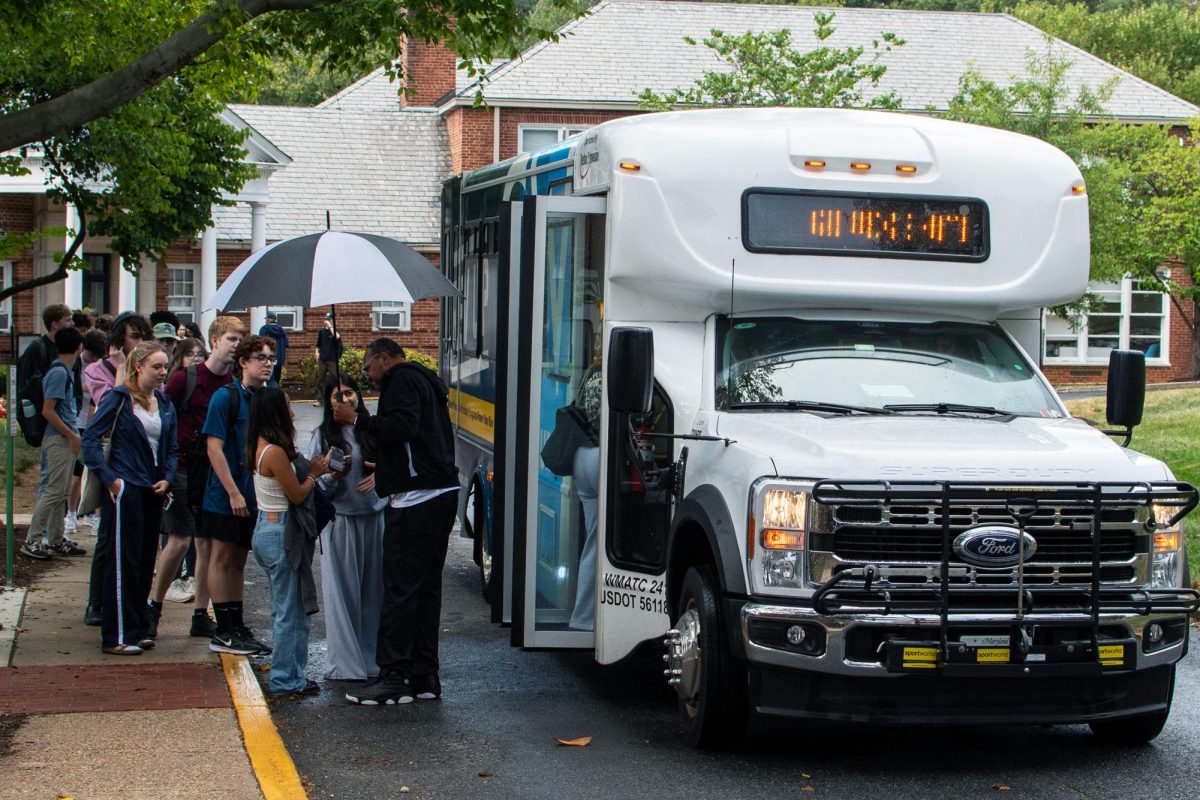
GW cut the frequency of the Mount Vernon Express shuttle service by 50 percent and eliminated two buses, a move students say is worsening their yearslong reports of long lines and delays.
Vex drivers and supervisors said the University reduced shuttle frequency from every five minutes to every 10 minutes and cut the number of buses in circulation from nine to seven, a decision University spokesperson Julia Garbitt said officials made because the University acquired a new shuttle model that holds 30 instead of 25 passengers. Garbitt said officials are now permitting students to stand on the shuttles to accommodate “surges” in riders, but students say they’re still facing longer waits in line.
“The number of shuttles for GW was adjusted to coincide with our change to 10 minute departures this fall for The Vern Express,” Garbitt said in an email.
Monday through Friday the Vex now shuttles students from the Foggy Bottom to the Mount Vernon campuses every 10 minutes from 7 a.m. until 8 p.m., compared to every 5 minutes last year, according to current and past versions of the University transportation website. The shuttles run every 20 minutes from 8 p.m. until 12 a.m. and every thirty minutes until the next morning. On weekends, the Vex runs every 20 minutes from 7 a.m. till 12 a.m. — up from every 15 minutes last year — and every 30 minutes from 12 a.m. to 7 a.m., compared to every hour last year, according to the website.
The change comes after years of student reports of high wait times and unreliable shuttle schedules that date back to 2021, when students complained that long lines caused them to be late for class, work and plans on the Foggy Bottom campus. Officials launched a program last year to collect feedback on the Vex wait times, driver friendliness and shuttle safety in response to persistent student complaints of long lines and delays.
Ten students said this semester they’ve faced longer lines at peak hours during the morning and afternoon, which has caused some to arrive late to class and adjust their schedules to build in additional transportation time. Other students said they haven’t faced major setbacks due to longer lines but often wait or stand on shuttles during peak hours.
Grace Satter, a sophomore who takes the Vex from Foggy Bottom each morning to attend two classes, said lines this semester have been especially long, forcing her to add an extra 30 minutes to her commute to account for long waits.
“I had to wait 20 minutes, and the line literally wrapped around the academic hall building all the way down to the curb,” Satter said.
Garbitt said the University recommends students budget “extra travel time” during peak hours and said the University’s new Vex tracking app allows students to track the shuttles’ real-time locations and arrival times. Driving from Tompkins Hall, where the Foggy Bottom Vex stop is located, to the Vern takes about 10 minutes, according to Google Maps.
Ethan Duffy, a sophomore and former Vern resident who takes the Vex every other week for running club, said he’s noticed more students riding each shuttle. He added that the five-minute pickup schedule helped curb long lines and said he doesn’t understand why officials reduced the frequency.
Meghan Joyce, a first-year who lives on the Vern, said she arrives at the Vex stop an hour before her class in Foggy Bottom to account for long lines and delays. Joyce said while the hour-long buffer time has prevented her from being late to class, long lines to board the shuttles caused her to miss out on multiple events during the University’s Welcome Week.
“By the time you get there and you get on the Vex, it’s over,” Joyce said.
George White, a Vex driver who has driven for the shuttle system for two years, said the schedule change means there are fewer buses on the road at once, and drivers are making fewer round-trip rides. He said the number of “loops” he makes dropped from eight to four during a six and a half hour shift.
Garbitt said officials previously paused students’ ability to stand on the Vex last year because a temporary fleet of shuttles were “not fully equipped” to allow passengers to stand. Garbitt said the University launched a new batch of buses this summer, swapping out the temporary buses used last year and upping the capacity per bus from an average of 25 passengers to 30 passengers. The new line of shuttles is “equipped to allow standing,” and officials green-lighted up to 10 passengers standing on the bus, Garbitt said.
“The policy is returning to allow up to 10 standing passengers to accommodate surges of riders or when additional shuttles are not at or near the stop,” Garbitt wrote in an email.
Tarlony Joseph, a bus driver who has driven the Vex for the past year, said she thinks students standing while the bus is in motion is unsafe, but she still allows students to stand on her bus in accordance with the new policy.
Reva Bavipati, a first-year living on the Vern, said she has only had to stand on the Vex once because there are usually enough seats. She said she had to hold onto the bus but she safely made it to her destination.