
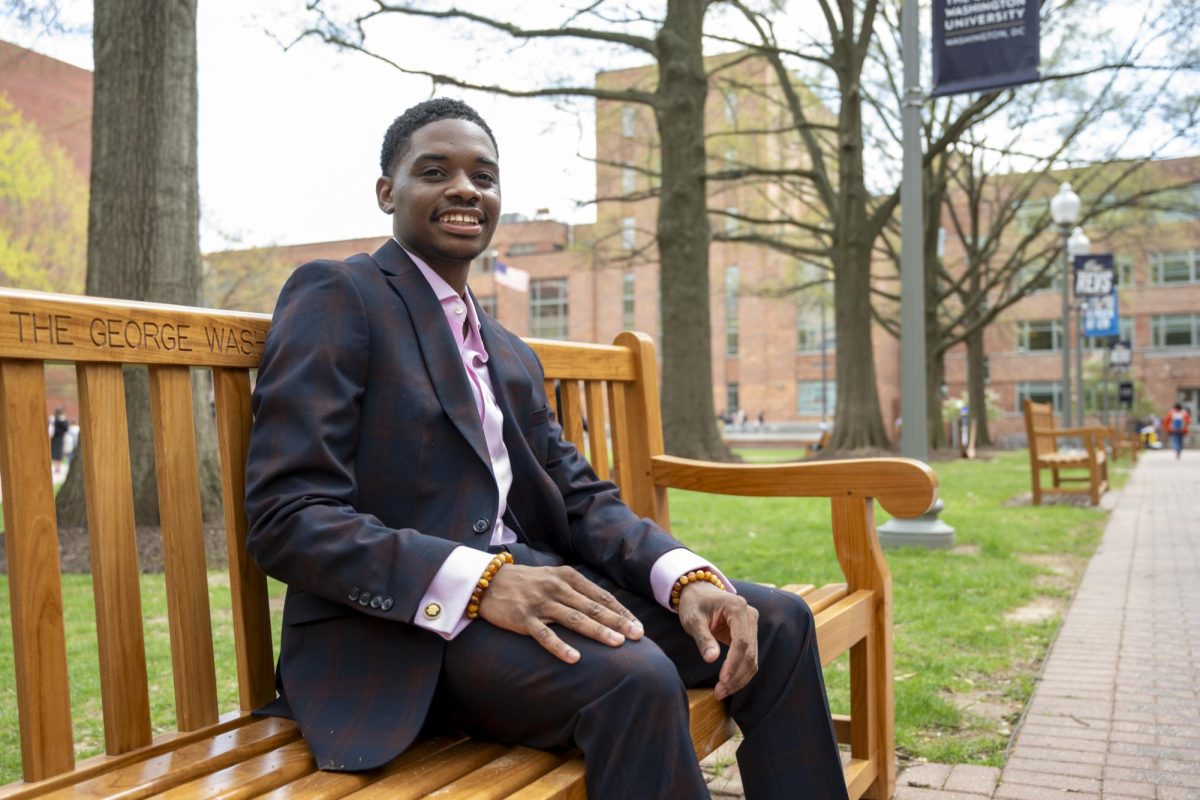
A junior transfer student in his first semester at GW announced his candidacy for Student Government Association president Thursday.
Alfred Lewis Jr., a philosophy major who transferred to GW this spring from Bergen Community College in his home state of New Jersey, said he is running for SGA president to “amplify” students’ voices in the University’s governing bodies, including pushing for a voting student member on the Board of Trustees and further standardizing student organization funding guidelines in the SGA. Lewis said officials’ recent decisions, like selling the Virginia Science and Technology campus in February and raising undergraduate tuition by 3 percent next academic year without consulting community members, indicate students’ voices are not being “adequately heard” by administrators.
“Student voices deserve a seat at the table,” Lewis said. “Student voices deserve to be heard. Student voices deserve to be properly allocated in funds. So I just ran because I feel based on what I hear, I want to continue to amplify the voice of students through my campaign.”
Lewis said although it is his first semester at GW, he is qualified to serve as president because of his past experience in student government at Bergen — serving on the student government’s diversity committee — and in high school, where he served as student body vice president as a sophomore and president his junior and senior years. Lewis said if elected, he would spend his first 30 days in office on a “listening tour,” setting up meetings with student organizations to develop a list of policy priorities and working to solve issues students bring to him.
“If you see that there is things within your school that deserve change, and people are going to you and they’re telling you about it, I don’t care if you’ve been here for a day, a week, half a second, your first thought as a leader should be, ‘What can I do about this?’” Lewis said.
He said one of his top priorities as president would be advocating for the Board to add a voting student representative. The SGA in 2023 passed a resolution asking the Board to add the SGA president and vice president as full voting members — which former SGA President Ethan Fitzgerald pushed for as an SGA senator and in his 2024 presidential platform — but the Board promptly rejected the proposal, stating it would not consider student representation “at this time.”
The SGA in the spring 2024 elections put forward a referendum gauging student opinions on adding the SGA president and vice president as voting members of the Board, to which almost 85 percent of students voted “yes.”
Lewis said although the Board rejected a proposal for a student trustee, he still sees a path forward for student representation by attempting to reopen talks with trustees. He said students have not pushed hard enough for an explanation from the Board about why it rejected the proposal, and pressuring officials publicly to explain their decisions would be one way to mount pressure.
“I believe it’s really important to understand the institution is here to serve the students, it’s really not negotiable,” Lewis said.
Lewis said in high school he served as the student liaison for his district’s board of education, which gave him the ability to hear and advocate for students’ concerns to the school district’s superintendent.
“If it wasn’t for the voices of those students to get the input and share it to the board of education, they may have not heard it,” Lewis said.
Lewis said the trustees shutting down the SGA’s proposal with little consideration indicates a broader “disconnect” between student voices and the administration since students so broadly supported the idea. He said as president he would hold public conferences with SGA leaders and Board officials where students could ask them specific questions about why they are denying students a role on the Board.
“They didn’t say that it can’t happen,” Lewis said. “What they merely said is not at this time, and they declined to give answer. That tells me, if we just pushed a little bit more, they’re going to have to give an answer.”
Lewis said he mounted his presidential campaign in the final two days of the signature collection period, collecting more than the necessary 359 signatures to appear on the ballot by traversing the Foggy Bottom and Mount Vernon campuses and talking to students to learn about the issues facing them at the University. He said student organization leaders he met with complained about confusion with the SGA’s finance system, which switched funding models three times in two years, and insufficient explanations from the SGA’s Legislative Budget Office when their funding requests were denied.
“When I was getting the signatures, and even before then, when I would just talk to people around the school, something that I noticed is students often felt disillusion of SGA,” Lewis said.
He said as president he would work with the vice president, who oversees the SGA Senate, to establish firmer criteria for how the SGA’s finance committee decides whether to fund organizations’ requests and also require the committee to better explain why it denies or alters funding requests. Lewis said he does not have an exact vision of what the new criteria would look like, but he would work together with SGA members and student organization leaders to develop a new, more agreeable model.
The SGA finance committee currently utilizes a “tier system” as guiding criteria for its funding decisions, which includes factors, like the number of students expected to benefit from the funding request, the alignment of the funding category with the organization’s “core identity” and cost-effectiveness of the proposal, among others. The SGA’s LBO also issues statements to student organizations explaining the reasoning for denying or lowering funding requests.
Lewis said from what he has heard from student organization leaders, the current tier system is not uniform enough, and the LBO’s explanations are insufficient.
“I just want to make sure that student voices are properly allocated, that if students say, ‘Hey, we need this much for a club,’ in the event that there is a denial, there should be clear communication from the SGA on why that club was denied,” Lewis said.
Lewis collected the required 359 student signatures and will appear on the ballot for the April 16-17 elections, pending verification from the Joint Elections Commission.