

Readers’ pick: Ronald Reagan survives assassination attempt (GW Hospital)
Down the unassuming hallways of the Hall of Government offices lies a barren room that hosted an event that changed the course of scientific discovery.
Unknown to most of the GW community, in 1939, Danish physicist Niels Bohr announced in room 209 that Otto Hahn, a physicist in Germany, had successfully disintegrated uranium into barium by releasing approximately 200 million electron volts of energy per disintegration.
In other words, Hahn had split an atom through the process of nuclear fission.
Though Hahn split the atom across the Atlantic Ocean, Bohr made the historic announcement that nuclear fission was born — paving the way for the development of the atomic bomb and nuclear energy — in our very own Hall of Government.
This random, world-altering event happened at GW because, in the 1930s, then-University President Cloyd Heck Marvin was determined to improve GW’s physics department after the University’s failed accreditation, in part due to inadequate science laboratories. In an effort to build up the department and regain accreditation, Marvin allocated funds to hire distinguished scientists to conduct impactful research, strengthen lab infrastructure and reorganize the department’s graduate programs.
To advance this initiative, Marvin recruited two influential physicists, George Gamow and Edward Teller, who began hosting an annual conference on theoretical physics at GW in 1935, bringing together the brightest minds to share their latest discoveries.
This brings us back to Bohr’s fateful announcement in room 209, where physicists began discussing what the news could mean, ushering reporters out of the room, realizing the potential impact of their conversations on future military use. The next day, hearing reports in the press of the announcement, the future “father of the atomic bomb,” J. Robert Oppenheimer, called Gamow to understand what Bohr had revealed.
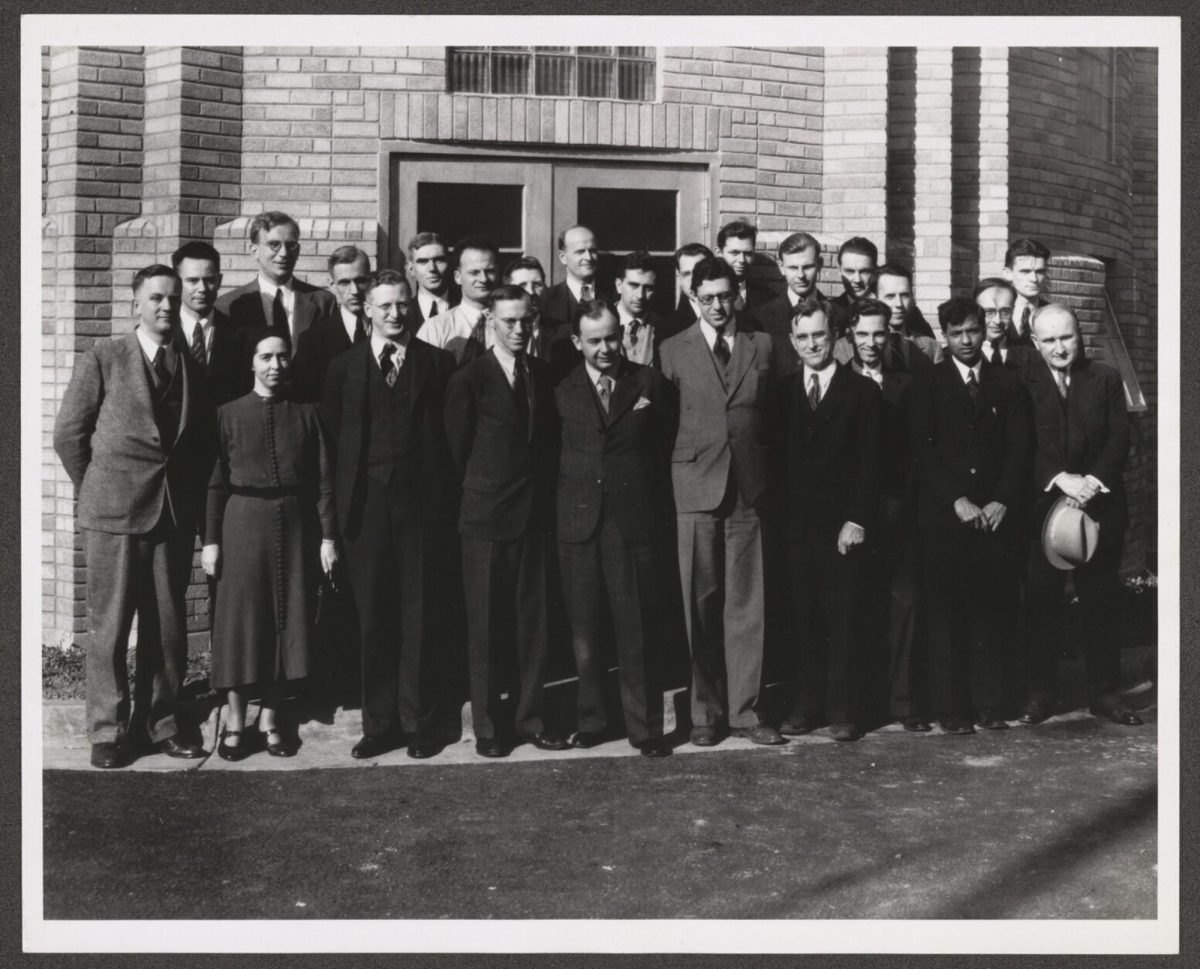
Though the proclamation changed the course of humanity, the only memorial of the event that remains today is a modestly sized, rectangular silver plaque around the corner from room 209, commemorating the conference and Bohr’s announcement of nuclear fission, listing the names of the 24 physicists in attendance.
Many of the scientists at the conference, some from GW like Teller, and experts invited from around the world, would go on to join the Manhattan Project and develop the first nuclear weapon, changing warfare forever and influencing the next eight decades of global tensions and conflict. The discovery of nuclear fission also led scientists to use the process as a source of energy, paving the way for a boom in nuclear power plants around the world in the mid-to-late 20th century, a trend that continues to influence energy policy debates today.
Many of the legendary scientists at the 1939 conference have also now been immortalized in pop culture history through Christopher Nolan’s Oscar-winning movie “Oppenheimer,” which featured Benny Safdie’s portrayal of Teller and Kenneth Branagh’s depiction of Bohr. Though GW has been home to numerous moments of remarkable history, including President Ronald Reagan’s life-saving surgery at GW Hospital after an assassination attempt or the former Howard Johnson hotel — turned The George apartment building — which burglars used as the lookout and planning site for the Watergate break-in, no other moment of campus history has had as world-changing of effects as this one.