
Two GW alums took the spotlight at the 2026 Tony Awards, taking home the award for Best Play with their production of Liberation after it won the Pulitzer Prize last month.
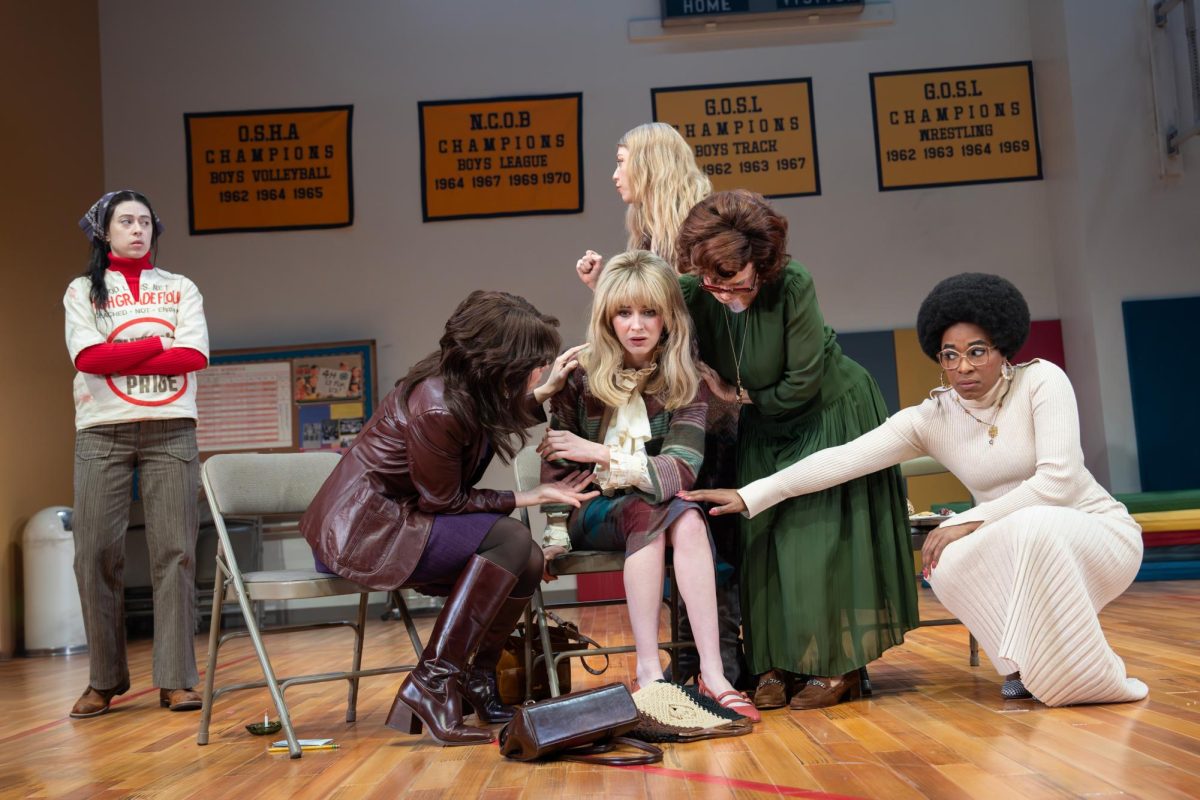
Eva Price and Jenna Segal produced the Tony Award-winning play Liberation, a story that follows a group of six women as they navigate feminism and societal norms in 1970, exploring themes of how their youth will go on to influence the future of their family life. Each awards season, Best Play, one of the most coveted awards of the night, goes to a new play that hasn’t previously been on Broadway and is presented to the producers and writers of the original production.
The play premiered at the Roundabout Theater Company in January 2025 and later made its way onto Broadway at the James Earl Jones Theater in October of the same year. Though the show ended its nearly yearlong Broadway run February 1, 2026, it will premiere onstage in Los Angeles at the Geffen Playhouse at the beginning of 2027 and will show in London later that year.
Price, a lead producer and a 2000 GW graduate who studied political communication, said that after believing in the show the way she did, winning a Tony was an “incredible” and “gratifying” experience.
“To have it happen for a play that not only you know you’re so proud of, but actually believe it to be the best of the year, to have the Tonys actually also say it is the best of the year, it feels remarkable,” she said.
While Price and her co-producer Jenna Segal both attended GW and had similar friends and professors throughout their time at the University, they only formally met once they had both become theatre producers in New York after graduation.
“Getting to produce Liberation with her and have it be successful in this way is really gratifying, because it helps you realize that what you think are shared interests and shared values from the periphery actually are really true when you’re honored like this,” Price said.
Price said she became involved with Liberation after working with the show’s playwright, Bess Wohl on Wohl’s play Small Mouth Sounds, and later viewing a showing of Liberation in February 2025 as a friend and fan of Wohl. Price said she went in not knowing what the story was about, but was “completely transformed” by the art, motivating her to help produce the piece.
“I had felt like I had possibly witnessed the greatest play of my generation, and by the end of the play, I knew full stop, I had witnessed the greatest play of my generation,” Price said. “I was so taken by its depth, its humor, its message, its importance, its emotional weight, its storytelling acumen.”
She said her role as a producer is similar to that of being the “CEO of a company,” as she is in charge of finances, strategy, marketing and ensuring the show is running smoothly from both a logistical and fiscal standpoint.
At GW, Price said held roles like general manager at WRGW, took part in the music department’s production of “Company” as an actor in 1998 and co-founded the Jewish Theater Company at GW Hillel, where she directed a production of Lost in Yonkers in Mitchell Hall’s theater.
Despite her creative extracurriculars, Price said she was largely focused on politics and communication during her time at GW, pursuing broadcast journalism in internships and her coursework. She said School of Media & Public Affairs professor Steven Roberts was “influential” during her time at GW, and former adjunct professor Steve Rabinowitz became her first employer post graduation at QRS Newmedia, a media and technology firm.
She said her experiences in D.C., exploring neighborhoods with varying personalities allowed her to develop her own sense of self as she lived in different areas of the District, took part in internships and attended events — all of which taught her how to exist in a “larger world” — something she said she wouldn’t have learned if she had attended a college in a small town.
“I took my ways of communicating, my ways of growing, my ways of interacting, my ways of finding myself, I took all those lessons and put them into my life in my 20s and made my choices and my decisions about where to live and where to work and what drove me and what inspired me,” she said.
Price said she characterizes her career path in a “nonlinear trajectory,” transitioning from politics to television news at ABC and now to Broadway. She has now been the CEO and co-founder of Maximum Entertainment Productions since 2006, helping to produce and manage plays, musicals, touring productions and live events that range from one person shows to international plays and musicals like Titanique, a jukebox musical featuring the music of Celine Dion.
Price said the most fulfilling part of being a producer is seeing how productions can move audiences and how they experience the story as one — no matter the size of the theater.
“I love being in that room and witnessing that happen to an audience and to myself, and Liberation is a play that did that in spades,” Price said.
Segal, a 1998 GW graduate, said she became involved with the play after Price had asked her to join as a co-producer this past year. She said she had previously collaborated with Price and the playwright, Wohl, on the production of Small Mouth Sounds.
She said as a co-producer for the show, she acted as a higher-level investor to ensure the show had enough money to make it onto Broadway and sustain ongoing productions.
Segal, who studied international communications and media studies in the Elliott School of International Affairs, said although she did not know Price personally while at GW, having attended the same University was beneficial in a professional sense because of the shared values they each developed in their undergraduate careers.
“I think it’s very helpful, because we speak the same language, and in a lot of ways have been trained in the same way, and have the same kind of background in holistically thinking through a work product,” Segal said.
Segal said she was “proud” not just to be a part of a Tony and Pulitzer Prize-winning play about women’s history, but also because this year’s win was the first time a female playwright won in the “Best Play” category in 40 years.
“I’m excited that the money I invested in the show, it gets one more woman on the list of having accomplished winning a Tony for what they wrote,” she said.
Jessica Rowe contributed reporting