
Updated: October. 23, 2025, at 2:47 p.m.
Three GW programs collectively lost over $1 million in funding this year after the Department of Education canceled foreign language grants that supported research and courses in Middle East studies, East Asian studies and international business education.
GW was among more than 50 universities hit by grant funding cuts for Federal Language and Area Studies fellowships and National Resource Centers announced by the Education Department in September, both of which are federally-backed programs to encourage language learning and research at universities. Program leaders and students said the cuts threaten the future of certain language classes and eliminate grant-supported language study scholarships that some students received for the current academic year.
Three GW institutes and centers faced cuts, including the Institute for Middle East Studies, which has been designated as the Middle East NRC since 2010 and the GW Institute for Korean Studies and the Sigur Center for Asian Studies, which both serve as the East Asia NRC and received NRC designation in 2018. GW’s Center for International Business Education and Research has also been one of 16 nationally-designated centers since 2006.
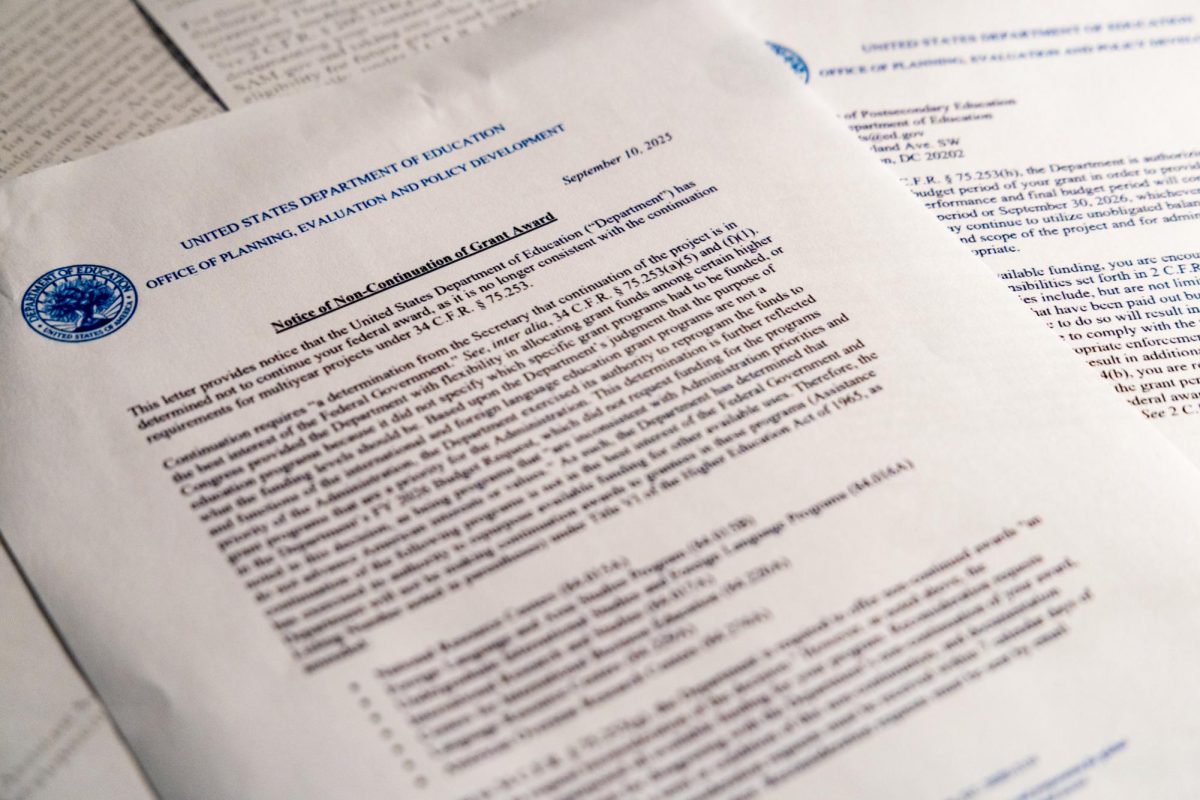
Murray Bessette, a principal deputy assistant secretary in the Department of Education, sent a letter to all three programs on Sept. 10 that was obtained by The Hatchet, informing the University that the previously awarded grants would no longer be distributed, as the program was not part of President Donald Trump’s administration’s interests and did not advance “American interests or values.”
“Based upon the Department’s judgment that the purpose of and functions of the international and foreign language education grant programs are not a priority of the Administration, the Department exercised its authority to reprogram the funds to grant programs that are a priority for the Administration,” Bessette wrote in the letter.
The grants funded language courses like Mandarin, Korean and Arabic, six academic-year scholarships for graduate students and classes focused on emerging challenges in East Asia and the Middle East, according to program faculty. GW is still teaching the classes this academic year, but it is unclear if GW will continue to offer all the courses in later years, according to program faculty.
The East Asia NRC and Middle East NRC – both housed within the Elliott School for International Affairs – and the Center for International Business Education and Research, which is a part of the School of Business, were set to receive $214,312, $241,429 and $314,193 for the 2025-26 academic year, respectively. GW was set to receive $226,449 and $578,978 in 2025 for FLAS fellowships in East Asia and Middle East studies, respectively, according to Department of Education data.
A University spokesperson did not return two requests for comment.
The Department of Education did not return a request for comment.
GW filed an appeal on Sept. 17 in which the University argued the funding cut was unconstitutional because Congress had already allocated the funding. The Department of Education denied the appeal on Sept. 30, according to Celeste Arrington, a professor of political science and international affairs and the co-director of the East Asia National Resource Center.
Arrington said GW was in its last year of the four-year grant cycle that funded the fellowships for students studying foreign languages.
Arrington said the loss of the grant programs will hurt the East Asia NRC’s ability to sustain graduate research and coursework on East Asian countries and the number of faculty doing research. Melani McAlister, the director of the Institute for Middle East Studies, said GW is trying to make a “real commitment” to offering the courses affected by the grant cuts next year but said it’s unclear if that will happen.
Arrington said the grants helped fund courses in Mandarin, Korean, Arabic, Hebrew, Persian and the Uyghur language.
“A lot of this is building a pipeline for experts, language and regional expertise to serve in the U.S. government,” Arrington said. “And apparently that’s not in the national interest anymore.”
Arrington said the cuts left five graduate students studying advanced Korean, Japanese and Chinese uncertain whether their $40,000 FLAS awards to pay for their tuition and housing would be honored, as the program had to pool resources with other centers to find money for the students.
Arrington said the Sigur Center for Asian Studies, Taiwan Education and Research Program, GW Institute for Korean Studies and the Elliott dean’s office all scrambled to find money for the students who lost their FLAS grant but were only able to offer each student around half of their $40,000 scholarship for this year.
“We’ve spent the last month, kind of scrambling to put together different money from this money-poor environment, to try to help them out, in part because they wouldn’t have had a way to put food on the table,” Arrington said.
Arrington said all five students are still enrolled at GW and the East Asia NRC decided to award the FLAS scholarships to second-year master’s students so the students could finish their programs.
“Historically, we’ve used the FLAS to attract the top applicants, first-years but because we kind of saw the writing on the wall, we decided to make it only for second-years,” Arrington said.
Eric Schluessel, a professor of history and co-director of the East Asia NRC, said the funding cuts threaten the Uyghur Studies program because the East Asia NRC supported the program by funding language classes and outreach events open to the GW community. He said teachers, non-governmental organization workers and people from the State and Justice departments would attend the events.
“A lot of people from the government come and take those classes because they want to develop special skills that are useful in understanding security and geopolitics in China and Central Asia,” Schluessel said.
Schluessel said the Uyghur Studies Initiative’s $1 million endowment pays for the beginning-level Uyghur language classes, and the East Asia NRC pays for intermediate-level Uyghur language classes at GW. He said without the grant funding from the NRC, the initiative will have to cover the costs for the intermediate-level classes from the program’s endowment.
McAlister, the director of the Middle East NRC, said her program has had to reduce the hours of its community outreach official from full time to part time, as part of their salary came from NRC grants. She said the person who did outreach primarily worked with local high schools to help teachers design curricula around Middle East education and also designed online educational resources for the program.
“We intend to keep it up as best we can, but it will be a major loss for us, and we are losing our full time coordinator,” McAlister said.
Tim Duvall, a former senior program officer for the Department of Education who ran the FLAS and NRC grant programs in the international foreign language education office from 2012 until the entire office was laid off in August, said eliminating the grants will hurt national economic competitiveness and national security as FLAS and NRC students often took up key roles in the federal government, like in economics and national security after graduating.
He said the elimination of the grants means there is less of a monetary draw for the “brightest” students to work for their country. Duvall said there are around 2,000 FLAS students nationwide.
The federal government established FLAS grants and NRCs during the Cold War in 1958, in response to the United States’ need for foreign language expertise to compete with the Soviet Union and later became part of the Higher Education Act of 1965.
“The students were fantastic scholars and students, and we wanted to make sure that we had people like that who were trained in these languages and world areas, so that we could have people available in critical government roles,” Duvall said.
This post has been updated to correct the following:
The Hatchet incorrectly reported that the three programs lost nearly $1 million in funding. The programs lost over $1 million. We regret this error.