
Tax experts predict that cuts to charitable contribution deductions taking effect Jan. 1 could trigger a short-term spike in donations to GW this fall, followed by a decline in the new year — further shrinking a revenue stream already hit by reduced giving in fiscal year 2024.
More than half a dozen tax law experts said while tax provisions in President Donald Trump’s One Big Beautiful Bill Act may incentivize GW’s donors to give more before the new year, officials will likely see a drop in overall contributions to the University in FY2026 as wealthy donors and companies grapple with reduced tax benefits. The anticipated drop in donations comes as officials grapple with a $25 million drop in total contributions to GW in FY2024 and work to combat a yearslong structural deficit that prompted University-wide FY2026 budget cuts.
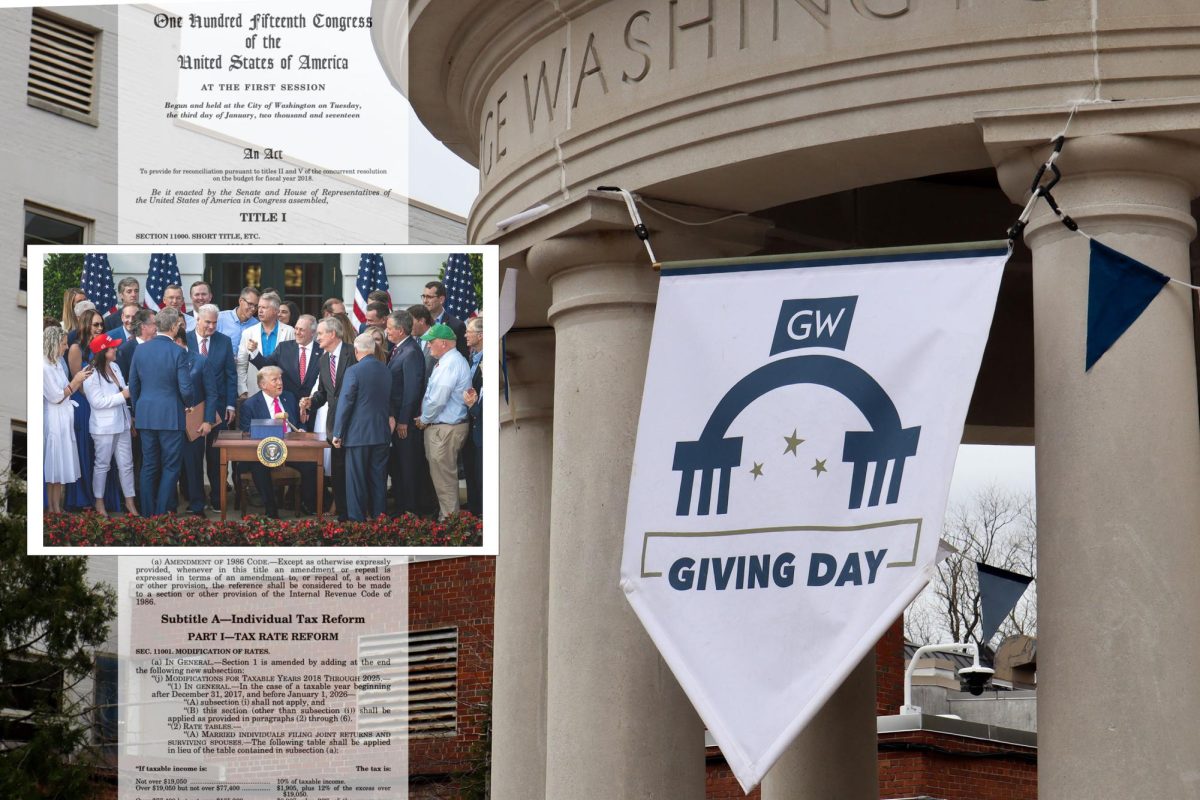
The University’s non-governmental donations — which include gifts from families, alumni and faculty — fell $36.8 million in FY2024, coinciding with threats from alumni to withhold donations if officials failed to address campus activism following Hamas’ Oct. 7, 2023, attack on Israel. Contributions to GW made up 4 percent of its operating revenue in FY2024, down from 6 percent in FY2023, though the University received more than $2 million from 3,596 donors during its annual Giving Day this year, the most revenue generated since its conception in 2020.
The OBBBA’s tax code changes make permanent the individual, estate and business tax provisions of Trump’s 2017 Tax Cuts and Jobs Act — most of which were set to expire at the end of 2025 — to prevent what Trump described as the “largest tax hike in history.” The changes also add new provisions to allow individuals who don’t itemize deductions or don’t subtract eligible expenses they can claim on federal income tax returns to reduce the amount of taxes they owe, to get a tax break.
GW issued guidance to donors on its planned giving website following the passage of the OBBBA in July, stating that those in the top tax bracket should consider donating more this year to maximize tax benefits, which experts said could result in top earners giving less after the bill’s enactment with fewer tax incentives. The guidance also outlined the new tax deduction for smaller donors, adding that smaller donations still make an impact on the University.
University spokesperson Kathy Fackelmann said it’s too early to know how changes to the tax code will affect donors or donations to the University, given they go into effect Jan. 1. She said officials have been evaluating the OBBBA since its July enactment to understand its potential impacts on students, higher education and charitable donations to the University.
The Office of Planned Giving and GW Alumni will host a webinar next Monday on navigating the new federal tax law, which will be led by two alumni certified in financial planning, Fackelmann said.
Several other universities, including the universities of Kentucky, Wisconsin-Parkside, Michigan and Massachusetts Boston, along with American University, issued the same guidance — down to the same wording — following the bill’s passing, although it’s unclear who provided universities and other nonprofits with the templates on how they should advise their donors.
More than half a dozen tax law experts said the new tax laws may disincentivize some corporations and individual donors from giving both large and small amounts to the University.
They said taxpayers can currently choose to itemize deductions to maximize their tax break or take the standard deduction, which typically doesn’t allow for additional deductions like charitable contributions. Roughly 90 percent of Americans opt for the standard deduction and therefore don’t receive a tax break for donations, per the IRS.
Under the new tax law, high-income individuals only receive a tax break on charitable donations that exceed 0.5 percent of their income, while corporations must donate more than 1 percent to qualify — limits that replace the previous system, which offered deductions regardless of the amount given. Additionally, individuals in the top tax bracket will now receive 35 cents in tax relief for every dollar donated, down from 37 cents prior to the passage of Trump’s tax reform, reducing the overall incentive for large donations.
Starting Jan. 1, the new provision will allow those who don’t itemize to claim a tax break of up to $1,000 for individuals and up to $2,000 for married couples filing jointly. Experts say while the change could encourage more small-scale giving, the boost won’t counteract an expected reduction in contributions from wealthy donors.
Ben Kershaw, the director of public policy and government relations at Independent Sector, said top earning donors only receiving 35 cents off their taxes for every dollar donated — compared to the previous law of 37 cents — is “unequivocally harmful” for charitable giving in future years, as donors will be less incentivized to make gifts. He said while the change may seem minuscule, donors are “really tax sensitive” and research from Indiana University found the changes could result in a $4 to $6 billion loss from donors across all nonprofits annually.
“If you’re thinking about this year versus next year, it’s much more advantageous for a corporation or a high income individual to be giving this year,” Kershaw said.
Joann Weiner — an economics professor at GW and a former senior economist in the Office of Tax Policy at the U.S. Treasury Department — said corporations’ donations to GW could drop after the tax law changes go into effect because companies that tend to give less than 1 percent of their taxable income will no longer get a deduction.
Weiner said the impact on corporations could be “bigger than expected” because companies are a large source of funds for charitable organizations and often sponsor events, like conferences and sports games.
Weiner said individual donors who take the standard deduction when filing taxes — which about 90 percent of taxpayers claim — can receive a $1,000 charitable deduction that would reduce donors’ taxable income. She said the changes are designed to encourage lower-income individuals to donate who otherwise wouldn’t because they didn’t receive a tax benefit.
The number of Americans who donate plummeted from 66.2 percent in 2000 to 45.8 percent in 2020, according to an Indiana University study, due to shifting demographics, economic uncertainty and shifts in public policy that were exacerbated by the COVID-19 pandemic. The OBBBA could help reverse the trend of declining giving among lower-income Americans by boosting donations from them because it provides them with a tax break.
Brian Flahaven, the vice president of strategic partnerships at the Council for Advancement and Support of Education, said the bill could have a “strong positive” effect on giving before the end of the year because there is historically a spike in giving before tax laws change, and the new limitations mean higher income donors will be “incentivized” to give before Jan. 1. He said he is encouraging institutions to make sure they maximize the opportunities before the end of the year while strategizing how to communicate to donors once the law takes effect.
“Most donors are motivated for a passion of giving back and why they’re giving in the first place. So the tax policies just impacts the timing and the size of the gift, not the decision to give in the first place,” Flahaven said.
Richard Schmalbeck, a professor emeritus of law at Duke University, said universities like GW rely “pretty heavily” on “very large contributions” from wealthy donors, but wealthy individuals don’t have much of a tax incentive to make donations due to long-standing tax laws that do not allow individuals to get a tax break for more than 50 percent of their donations.
“At the moment, there’s no clear resolution of those two different strains of academic work on this,” Schmalbeck said. “Probably the best summary of the various studies is that tax features have some impact but not a huge impact.”