
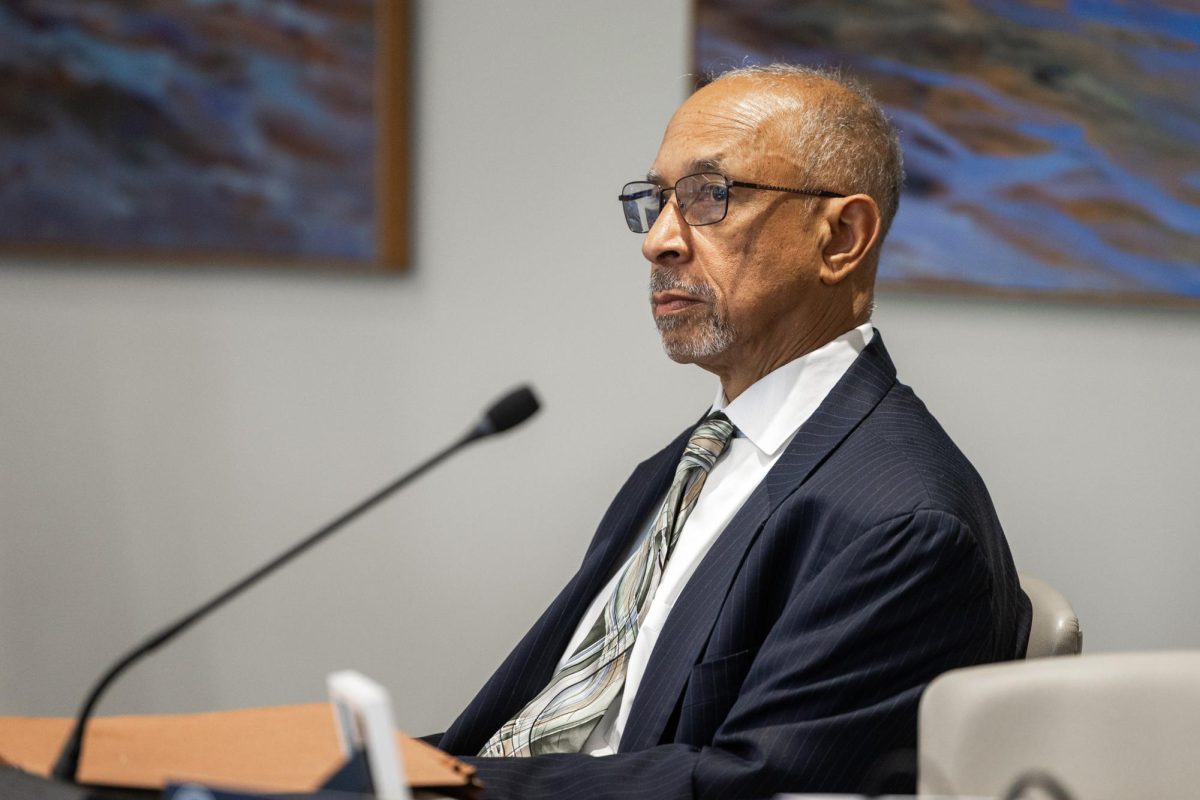
As Vice President and General Counsel Charles Barber prepares to depart from his role at the end of June, he said he is proud of building a legal team that has supported the University through a constantly-evolving higher education legal and regulatory environment.
Barber, who former University President Mark Wrighton appointed to the permanent vice president and general counsel position in May 2022 after he served in the interim role for nearly a year and as deputy general counsel for nearly 14 years, said in a statement to The Hatchet that legal difficulties the University faced during his tenure “invigorated” him to help GW grapple with those challenges. Amid heightened legal challenges, including Department of Justice probes into the University, the impacts of President Donald Trump’s policies on higher education and lawsuits filed by community members, Barber said he provided “candid” advice to help officials navigate constraints while remaining steadfast in the University’s mission and obligations.
“My office works hard to monitor legal developments in higher education generally, select knowledgeable outside counsel to assist in addressing issues most relevant to GW and present guidance that responds to the moment for University leadership,” Barber said in an email.
Barber said his decision to step down had nothing to do with the growth in legal challenges GW is experiencing and he made the decision based on personal and professional timing in order to ensure a “thoughtful handoff” to new leadership. He said he will transition into a short-term advisory role assisting University President Ellen Granberg and administrators as needed to oversee a “smooth” transition to his successor until Dec. 31.
“This transition is less about any singular moment and more about ensuring continuity and positioning the office well for what comes next,” Barber said.
Barber has aided the University in navigating wide-ranging legal matters during his lengthy tenure at GW, including being part of the legal team that challenged the D.C. Board of Zoning Adjustment’s enrollment and zoning restrictions on the University as it developed its Foggy Bottom Campus Plan in 2000. After the city imposed an enrollment freeze and ban on new academic buildings until 70 percent of undergraduate students were housed on campus, the University — following years of disputes and lawsuits — gained the right to build about two million square feet of additional campus space.
As the University’s chief legal officer, Barber steered GW through a resolution agreement with the Department of Education’s Office for Civil Rights in January 2025, which ended investigations into Title VI complaints alleging anti-Palestinian discrimination and antisemitism at the University. Barber has also guided the University’s legal response to the Trump administration’s policies, including its diversity, equity and inclusion crackdown, revocation of international student visas, student loan reform and withholding of federal research grants.
Barber said that supporting the University’s adaptation to the changing legal climate amid heightened federal pressure on GW required close coordination with his team in the Office of the General Counsel. He said he has also learned from colleagues at other universities facing similar challenges to GW, allowing him to better advise officials.
“Our role has been to help the University stay informed, remain in compliance and adapt as needed,” Barber said.
Barber said at the April Staff Council meeting he anticipates further actions by the Trump administration will continue to change the legal environment for higher education institutions, and that the University has only complied with federal actions rooted in law rather than the Trump administration’s policy preferences. Barber said at the meeting he had to learn how to respond and advise the University on federal changes in Title VI and Title IX policies, along with research funding restrictions, since Trump took office again in 2025.
Barber said he and his office have worked closely with outside counsel to help GW present “strong and principled” responses to the DOJ’s investigations into campus antisemitism and diversity, equity and inclusion in its admission practices to show that GW is meeting its legal obligations.
“In both matters, the University has responded to requests for information, including providing documentation as part of the review process that demonstrates GW’s compliance with the law,” Barber said.
Barber said lawsuits — like students and alumni suing the University over alleged mishandling of campus antisemitism and a 2025 alum’s lawsuit accusing GW of retaliation and discrimination over their disciplinary action after her 2025 graduation speech — are not out of the ordinary for a large institution like GW, and are “expected” as a part of daily operations. He added that the general counsel team approaches litigation with the “utmost care,” coordinating communication with GW stakeholders and consulting outside counsel to align the University’s interests with the law.
GW has hired outside counsel from the multinational law firm Gibson Dunn to represent the University in the student and alum lawsuit and DOJ investigation involving campus antisemitism.
“While we cannot comment on specific cases, and with the understanding that a complaint in a lawsuit only presents one side of the story, our focus is on ensuring a fair and appropriate legal process,” Barber said.
Barber also served as general counsel during the 2024 pro-Palestinian encampment when the Metropolitan Police Department cleared the demonstration in University Yard on its thirteenth and final day, arresting at least six GW students. The U.S. District Attorney for the District of Columbia issued stay-away orders — legal directives requiring individuals to refrain from visiting a specified location or contacting certain individuals — to five arrested students, barring them from spaces on the Foggy Bottom campus.
A Faculty Senate Education Policy & Technology subcommittee report presented in December 2024 states that impacted students and their legal counsel claim the U.S. Attorney’s Office said that GW requested the orders to be brought against the students. Barber told EPT, according to the report, that GW did not “have a position” on the stay-away orders or on charges brought against students, but would consider requests for exemptions to stay-away orders that the U.S. Attorney’s Office brought to them.
When asked about why there was a discrepancy between students and officials accounts about how GW handled the stay-away orders, Barber said in the statement differing interpretations of how decisions are made occur “on occasion” in situations with “multiple entities,” like the disciplinary response to the encampment, but said he stands by the comments he made to EPT.
“I spoke, at that time, as a representative of the University administration that has the responsibility to act in the best interests of the entire institution,” Barber said. “The administration strove for a compassionate approach that balanced the competing interests presented.”
As he spends his final few weeks in the role, Barber said he would advise his successor to work closely with colleagues across the University and understand GW’s mission to provide “clear, principled” legal guidance in a complex environment.
Officials initiated the search for his successor in January, seeking a general counsel who brings legal “rigor” and effective communication while balancing the University’s long-term interests. Granberg said in her report to the Board of Trustees Friday that she expects to announce the University’s new general counsel by early June.
“I leave my successor with a strong legal team that is ready to continue the Office of the General Counsel’s tradition of service,” Barber said.