
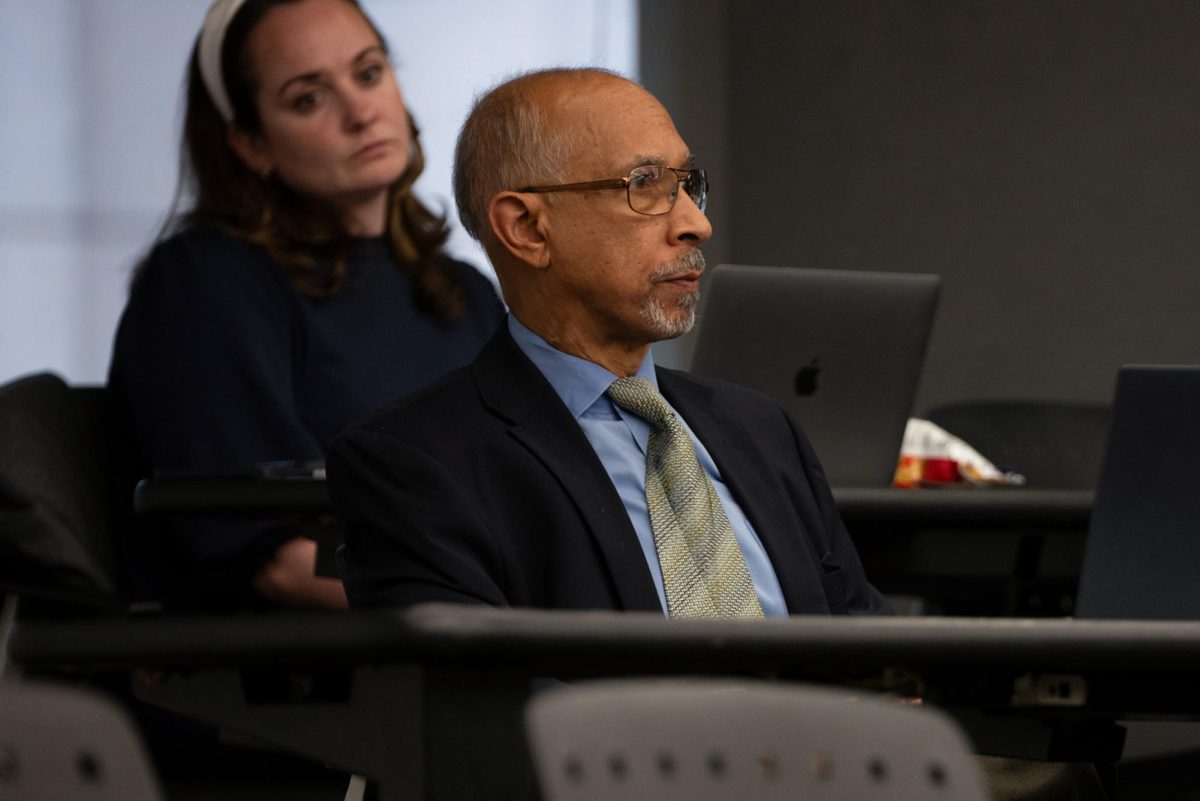
Outgoing Vice President and General Counsel Charles Barber told the Staff Council Friday the University must continue to balance upholding its values and its risk tolerance as it navigates ongoing federal legal pressures from President Donald Trump’s administration.
Barber, who will depart from his role as the University’s top legal advisor in June, said while fielding questions from councilmembers the University has only complied with federal actions rooted in law, rather than expressions of the Trump administration’s policy preferences, as GW has worked through ongoing federal scrutiny on higher education. He said as his successor takes the helm this summer, the University must continue to balance upholding its values and its risk tolerance, as he expects the Trump administration to continue to use federal actions to influence higher education policies in areas like diversity, equity and inclusion, discrimination, visa policy changes and federally funded research.
“I expect that that kind of thoughtful assessment will need to continue with respect to federal actions,” Barber said.
Barber announced in January that he intended to step down from his role in June, but said at the meeting will stay on as a special advisor to University President Ellen Granberg until Dec. 31. Staff Council Vice President Andrea Johnson said Staff Councilmembers have recently been invited to interview candidates for the role after officials announced the search for Barber’s replacement in January.
Granberg said at the Faculty Senate this month officials interviewed semi-finalists for general counsel on April 4 and brought finalists for the role to campus on the second week of April. She said officials expect to announce the new general counsel by the Board of Trustees meeting in May.
Johnson asked Barber what lessons he’s learned about the legal landscape of higher education during his tenure that have helped him navigate Trump-era policy changes.
Barber said he has learned that the federal government and its initiatives have become increasingly impactful on various institutions of higher education since Trump returned to office in 2024, especially regarding Title VI and Title IX policies, which prohibit discrimination based on race and gender respectively. He said he had to learn how to navigate advising the University on how to comply with these changes, whether through legislation or executive action.
Over the past year, GW has had to manage increased scrutiny of higher education by the Trump administration, including Justice Department probes into campus antisemitism and DEI and “related matters” in GW’s admissions practices. Officials last July also assessed the impact of a DOJ memo on DEI programs to institutions that receive federal funding, which warned “significant legal risks” for institutions that engage in what the Trump administration defines as discriminatory practices.
Barber also said changes to research compliance, like restrictions on researching certain topics, has affected the types of research that can be done at GW. He said the University’s status as an Association of American Universities member may be challenging to maintain in the future, given ongoing cuts to federal research funding.
The Trump administration cut $18 million worth of federal research projects at GW in 2025 amid the Trump administration’s regulatory changes and cuts to federal research projects.
“We pride ourselves on being a member of the AAU, but that will become more challenging as research funds dry up to some extent and the focus of research may change,” Barber said.
Johnson asked Barber to explain the legal barriers officials face when sharing information about major University transactions, like the recent Virginia Science and Technology Campus sale to Amazon Data Services in March for $427 million. Faculty and staff operating out of VSTC said in March officials failed to consult them on the deal, while Chief Financial Officer Bruno Fernandes said officials hadn’t spoken to community members prior to the sale’s announcement due to confidentiality issues.
Barber said it’s normal for parties in negotiations to enter into non-disclosure agreements to prevent “disruptive” potential competitors and government regulators, and to avoid “generating unnecessary concern” before a deal is solidified.
“They need that freedom to have those candid discussions and see if there’s a real deal that can be done,” Barber said. “To talk about it prematurely risks jeopardizing the deal.”
Barber said GW’s use of confidentiality isn’t new, citing the University holding off on speaking with Mount Vernon Seminary and College faculty and staff about their employment status after the University acquired the Mount Vernon Campus in 1999. Barber said officials waited until they had sufficient knowledge of how the acquisition would be implemented to address faculty and staff concerns, though they were “extremely concerned” about what it would mean for them.
“Had we been required to do that during the transaction, the negotiators would have been so busy trying to respond to external questions that they couldn’t really focus on the candid conversations they needed to have to reach a deal,” Barber said.
Staff Councilmember Ian Jenney asked Barber how First Amendment rights apply to University employees, given that many people in higher education faced disciplinary action or termination because of their speech regarding the assassination of conservative activist Charlie Kirk last September.
Officials confirmed in September that a GW staff member was “no longer employed” at the University after calling Kirk’s assassination “fair” in a personal social media post, as the post impacted his job performance.
Barber said while the First Amendment technically does not apply to GW as it is a private institution, the University is still committed to “robust” free speech principles and wants to encourage civil discourse. He said there are limits to free speech for staff in terms of disruption, time, place and manner of the speech.
“At the end of the day, we as administrators and staff have jobs to do that we need to be able to do effectively, and the University needs to be able to count on us,” Barber said.
Staff Council President Mindy Galván said Staff Councilmembers met with Board of Trustees Chair Grace Speights and incoming chair Mark Chichester this month to discuss the Staff Council’s goals and avenues for collaboration. Galván added that she will be sharing her first report as the president of the Staff Council to the Board of Trustees on May 15.
Justice, Equity, Diversity and Inclusion Committee Chair Tricia Greenstein said in her report the committee created five employee resource groups for staff to bond around shared interests. Currently approved groups include the Rainbow Resource Group, the Veterans Resource Group, the Access and Ability Alliance, the Caregiver Employee Resource Group and the Remote Employee Resource Group.
Staff Development and Recognition Chair Allene David said her committee is partnering with Human Resource Management and Development to host career mapping workshops for staff, which she hopes to host in June. She said the workshops will help staff figure out their career trajectory working in higher education, both in GW and at other institutions.