
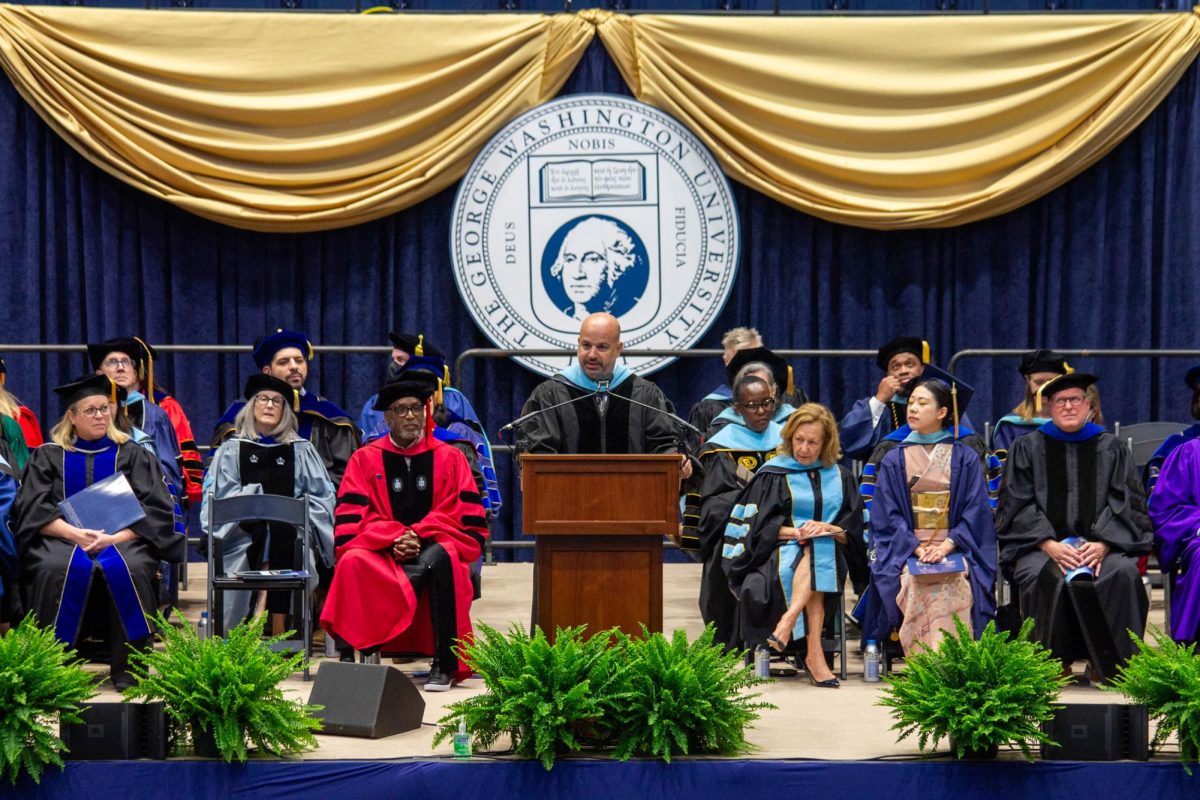
Speakers told the Graduate School of Education and Human Development’s Class of 2026 to prioritize optimism and continuous growth at the school’s graduation celebration in the Charles E. Smith Center Saturday.
Keynote speaker and Principal of South County High School in Fairfax, Virginia, Samuel Kambar Khoshaba, Interim GSEHD Dean Lionel Howard and student speaker Nanako Tojo encouraged over 330 graduates to remember that professions in education will bring positive impacts to future generations despite current uncertainty or difficulties. The speakers urged students to remember that they chose a profession in education because it motivated them and to carry that motivation into their future career pursuits.
Khoshaba, who earned his doctorate of education from GSEHD in 2004, encouraged graduates to “seek the joy” in difficult situations. He said while students may not have chosen an easy path, they should see the struggle to achieve their goals as part of the joy of life. Khoshaba added that many of the graduates likely want to enter the education profession because of an experience they had with a mentor or teacher that gave them joy and showed them that they mattered, and now graduates have the opportunity to provide that experience to others.
“The struggle is not separate from the joy,” Khoshaba said. “The struggle is the pathway to difficult conversation, a problem without a need, a student who is struggling.”
Khoshaba urged graduates to face difficult situations by believing improvement is possible and focusing on making people feel like they belong. He said work in education is about connection, and that students will succeed in having impacts on future generations if they learn to listen to others and open themselves to changing their perspectives.
“Go make an impact, lift others, see people, help them along, challenge assumptions, lead change, be disciplined in your optimism and along the way find your joy because you will see it in the moments right in front of you, and you will feel it in the moments that return to you years later,” Khoshaba said.
Howard said GSEHD has grappled with exploring “uncharted” pathways — but did not specify what those alternative methods were — in order to sustain the school’s resources. He added that GSEHD faced an “unprecedented year,” but GSEHD leadership and officials’ internal assessment and evaluation of the school has emphasized its “full potential.”
GSEHD has faced budgetary issues, like years of declining enrollment and recent layoffs of several GSEHD faculty as part of the school’s “right-sizing” initiatives, sparking student advocacy and faculty pushback to urge officials for more transparent communication about the school’s future. July 1 marks the end of Howard’s first year as interim dean after former Dean Michael Feuer stepped down and returned to a tenured professor position last year.
Howard charged students to consider the current challenges within human education and development that students aspire to address and to identify areas they seek to “elevate.” He encouraged students to reflect on their motivation and desires during periods of change in order to carve a path forward.
“Remind yourself of good, remind yourself of your resolve, capacity and your intentions,” Howard said.
Tojo, who earned her master of arts in education and human development in higher education administration, said students’ challenges may have seemed “endless” during “drastic” changes in the job market and higher education, but thanked GSEHD graduates for being fellow learners and praised their insights that “broadened horizons.”
“We not only survived, but also thrived on the journey,” Tojo said.
Tojo challenged students to use their knowledge to develop an inclusive and equitable world by emphasizing marginalized voices, adding that unheard voices can transform the world. She said graduates’ diverse knowledge will drive them to pave their future.
“I believe every one of us is a leader today,” Tojo said. “We have the potential and responsibility to critically lead changes with our accumulated knowledge.”