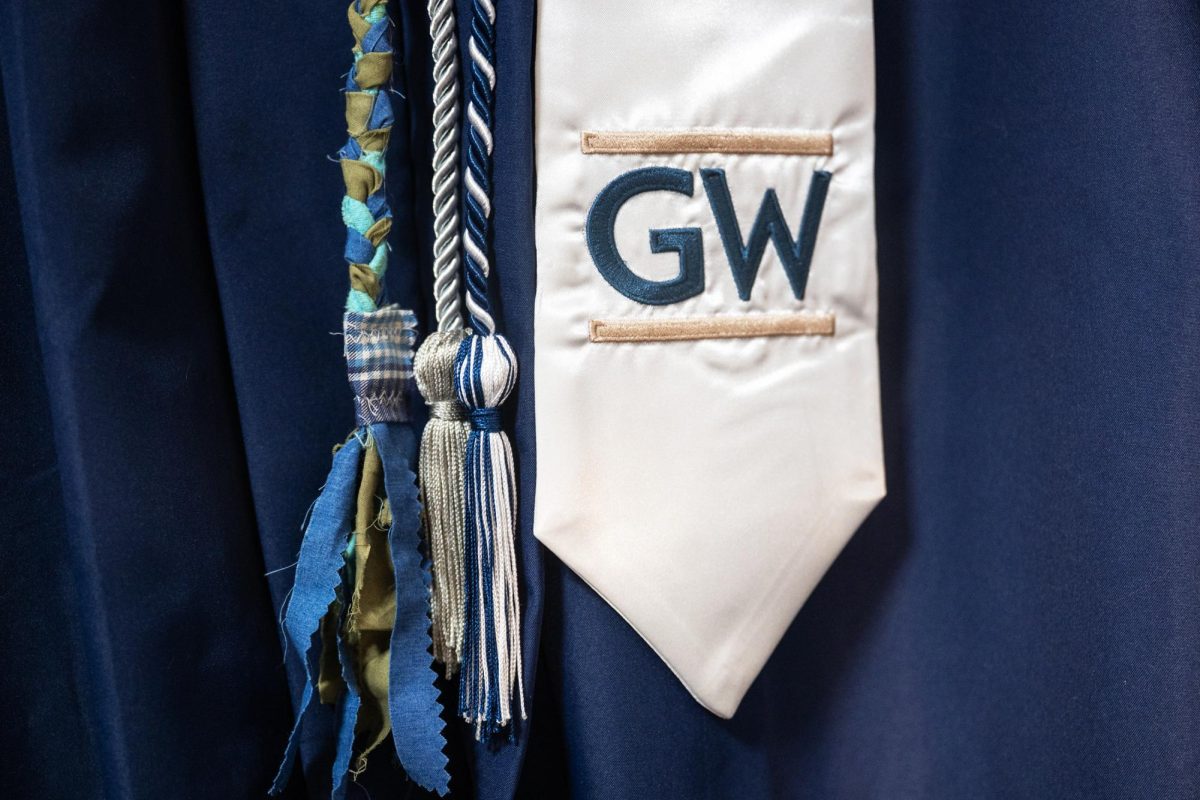


While most 18-year-olds are starting their first year of college, finding roommates and changing their Instagram bios to add where they’ll spend the next four years, Shahab Gharib is preparing to walk the stage at GW Law’s commencement ceremony this weekend.
Gharib, who graduated from Pace University summa cum laude in two years at the age of 14 with a bachelor of arts in history, started his law school career at GW at 15 years old and completed his degree by the age of 18. He said he chose GW Law because he felt as though the faculty and administration were “genuinely excited to have him,” not focused on his young age, and instead embraced having the value of a young mind in the classroom, a “personal touch” distinctive from other law school programs that he appreciated.
Gharib said he had a “normal” school experience until sixth grade at the age of 12, when increased free time during the COVID-19 pandemic encouraged him to seek out further academic pursuits in chemistry, biology, physics, math and history at an accelerated pace. He completed 7th grade through senior year of high school in one and a half years, which he said involved taking required courses online, including math, science and history classes, to get his high school diploma through the Florida Virtual School and College Board CLEP exams.
“Because I was so bored, I just took more and more and more, and I just didn’t have anything to do,” he said. “I was stuck inside all the time. It was either do school work, don’t do anything or do more school work.”
Throughout middle school, Gharib said his parents encouraged him to slow down, offering support every step of the way by making sure he wasn’t pushing himself too hard, telling him to take breaks and not overwork himself. In 2022, at the age of 13, Gharib said his family moved to New York, where he enrolled in Pace University as one of their youngest undergraduate students ever, and then to D.C. in 2024 where he began law school.
Though Gharib said he missed out on certain aspects of the typical high school experience, like school dances and football games, after completing four years of education in less than two years, he doesn’t feel “socially stunted,” instead he’s glad to have taken advantage of pursuing his education at an accelerated pace.
Gharib said he knew he didn’t want to enter the workforce immediately after graduating from Pace with a degree in history at such a young age and, because he enjoyed academia and knew he had time to learn more about topics of interest like law, he ultimately decided to pursue another degree.
“I could have just taken a year off, but I wanted to stay active,” he said. “I wanted to do something. I said to myself, ‘Well, I like talking a lot. I’m pretty good at arguing, and I like reading. So I guess I should go to law school.’”
At 15, Gharib enrolled in GW Law, where he would attend classes for the next three years. After applying to several institutions, like Columbia University, Yale University and Villanova University, he said he applied to GW because his family friend attended GW Law and spoke highly of his experience.
Gharib said he is grateful for his parents’ support throughout his educational career, especially his mother, who moved locations and jobs from Florida to New York and finally to D.C., so he could pursue his academic goals.
“My parents were like, ‘don’t you want to slow down?’ and I was like, ‘Why? Why not keep going, I have energy now,'” Gharib said.
Throughout his time at GW, Gharib said he did not have any negative interactions with students and faculty as a result of his young age, despite some normal first day jitters like fearing he’d forget a book, and he has felt accepted and integrated into the University community.
“They just seemed genuinely happy to want me to come to the school and that meant more than some fluff or anything, there was a real connection there, and I felt really supported.”
Though he still lives with his parents, Gharib said he has an active social life and finds time outside of studying to spend time with friends, from both undergraduate and graduate communities. Apart from being a full-time student, Gharib participated in several law student organizations like the GW’s Military Law Society and the Iranian American Bar Association throughout his time at GW Law.
He said he also took part in GW Law’s Moot Court in his second and third years, competing in the first-year competition and eventually making it onto the organization’s executive board as the technology chair in his second year and serving as a member in his third year, combining his passion for law and debate.
Gharib said he has had the opportunity at GW to take a variety of classes apart from required courses, like Law of War, where he learned how international conflicts continue to evolve and shape law. He said his professors have been supportive to his educational career and never treated him differently from his older classmates.
“The thing with GW is they have a lot of classes that you wouldn’t think you would take in law school,” he said. “I’ve taken classes with professors who have had the most interesting careers, and that’s helped me figure out what I want to do.”
Gharib said he is currently studying for the bar exam in D.C., which is scheduled for July, and has a job lined up in Germany for a technological device company called Disconnect, which involves consulting, drafting and advising on contracts and employee relations. Originally from Bruchsal, Germany, he said he is looking forward to returning home and having the opportunity to be with family.
Gharib said that while being the youngest person in the room can have its challenges, like not being taken seriously in professional environments or having less experience than older colleagues, having a long future ahead of him puts his mind at ease, allowing him to explore careers in varying sectors, and giving him time to change his mind about what he wants to do in life.
“I can spend three years doing whatever I want and I’ll only be 21 and I can come back,” he said.