

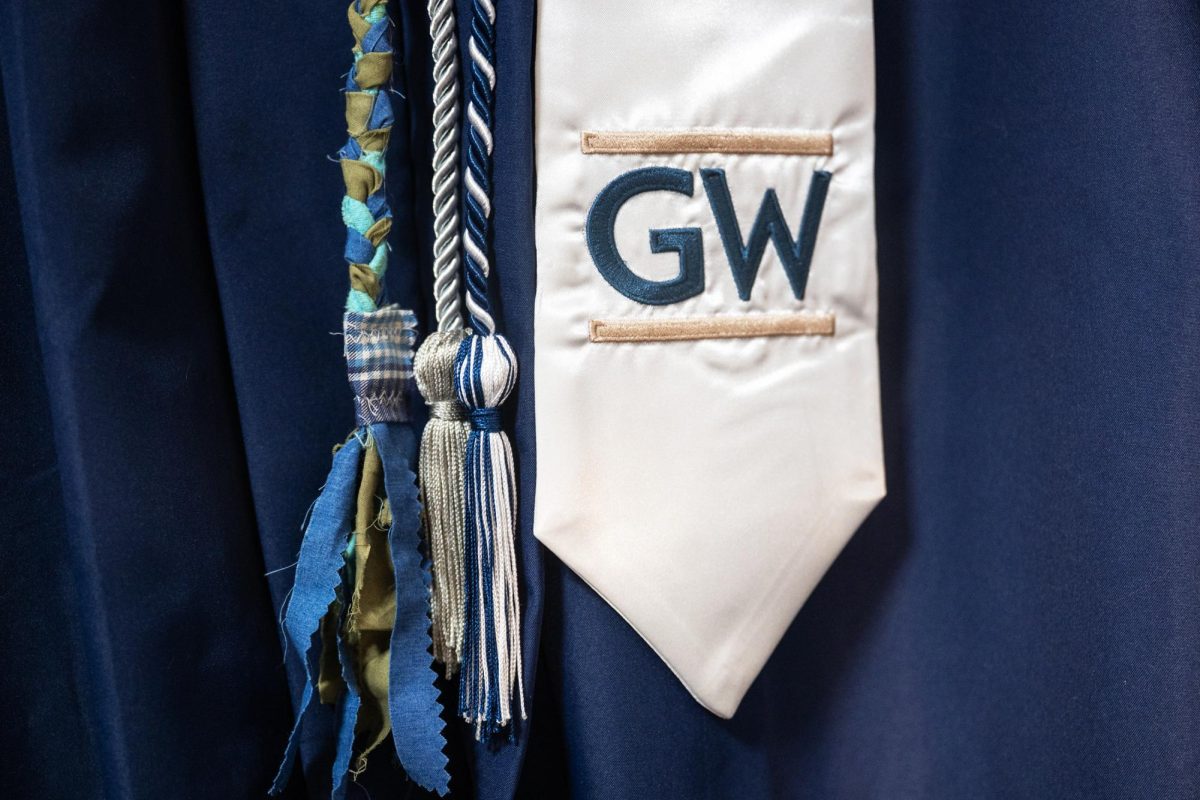
For many GW graduates, cords and stoles don’t simply accessorize a cap and gown — they’re representations of achievements, identity and involvement on campus draped around their neck as they walk the stage during Commencement week.
From old climbing rope to colorful silver and burgundy, GW Club Climbing, the Honey W. Nashman Center for Civic Engagement and Public Service, the Black Student Union, Alliance for a Sustainable Future and Organization of Latin American Students are just some of the campus groups that have created personal cords and stoles for their students and members to wear on graduation day. Seniors said having unique cords allow them to showcase their involvement at GW, highlights from their collegiate journeys and what their campus community meant to them.
Lauryn Schumann, a political science and criminal justice double major, said she will graduate wearing the Nashman Center’s silver service cord, in recognition of her more than 100 hours of community service, including her work as the lead tutor with Math Matters, a tutoring program for public schools in the D.C. area.
Schumann said she originally joined the Nashman Center in her freshman year through a federal work-study job after looking for a hands-on volunteer role with children since she grew up around the schools where her parents worked. Schumann said her experiences in Nashman shaped her college experience, allowing her to find community at GW and make lifelong friends through volunteering.
“It just really represents my career path,” Schumann said. “I’ve always prioritized community service and community engagement and all of my jobs and everything that I do, and this is really just another opportunity to show that it’s a cause that I stand for and that I love to do.”
Erin Carlin, a program manager for academic sustainability programs at the Alliance for a Sustainable Future, said students in the sustainability minor program began wearing handmade cords made from recycled materials last year to reflect the work students are doing to study environmental issues and challenges at GW. Carlin said the cords are handmade from recycled textiles sourced through donations from staff and the Office of Sustainability, such as plaid shirts used as cord ties.
The cord incorporates four colors – light blue, dark blue, green and beige – representing the program’s pillars: ecosystems, economies, communities and practices, with no two cords’ color compositions or designs looking exactly the same since they use recycled materials, Carlin said.
“This was a really cool thing to be able to see come to fruition in a lot of ways, since I had been working on it for so long,” Carlin said. “And just being able to see students’ reactions last year was great.”
Henry Scriven-Young, a political communication major and sustainability minor, said he wanted to wear the cord on graduation day to represent the hard work he put into completing the minor. He said the cord represents a “badge of honor” for his hard work in numerous projects and classes, as well as the people he met, who shaped his college experience and the minor he earned.
Scriven-Young said the cords are made by an Anacostia-based artist from Black Squirrel Company. He said the sustainability program was connected to the company through the Chesapeake Fibershed network from The George Washington University Museum and The Textile Museum after searching for a locally made supplier.
“This cord is one-of-a-kind, much like my college experience,” Scriven-Young said. “Each color of the cord represents the unique classes and experiences that I had throughout my college career.”
Kamila Andujar Lora, a sociology major, will adorn a burgundy stole during commencement week to represent her time in the Organization of Latin American Students. She said the organization was one of the defining parts of her college experience, as it helped her come out of her shell as a shy first-year student, eventually leading her to join the group’s executive board.
“I feel that I’m wearing and I’m carrying on my shoulders the weight of the impact that OLAS had on me personally,” Andujar Lora said.
Andujar Lora said this year’s OLAS stoles feature the organization’s signature burgundy color, each member’s name, the group’s logo and each member’s position. She said that one of the most meaningful aspects of the organization was the sense of community that developed among Latinx student groups on campus, something she is proud to carry with her through graduation day as she wears the stole.
“Now as a senior, I can look back and I literally hold it close to my heart, just my time at OLAS and all the work that I have done in that org,” Andujar Lora said.
Sophomore Eli Sheahen, GW Club Climbing’s president, said the group’s seniors will graduate wearing cords made from retired climbing rope, repurposed from equipment previously used for lead climbing and outdoor trips. He said members of the organization shaped ropes that would have otherwise been thrown away into graduation cords as part of an effort to revive a club tradition that had faded in recent years.
Sheahen said the club wanted to revive the tradition to celebrate the sense of community it fosters as the process of making the cords by hand became a meaningful project for the group’s seniors ahead of graduation, including cutting the rope, burning the ends and tying figure-eight knots.
“It was more like a symbol of the community that we’ve created that’s both accessible and really engaged with a lot of different kind of people, and all who really love climbing or have grown to love climbing through people they’ve met,” Sheahen said.
Senior Devin Tennant, a public health and criminal justice major, will wear a red, black and green kente cloth stole on graduation representing his time in the Black Student Union. He said BSU became a source of community and connection throughout his time at GW, allowing him a space to connect with other Black students.
Tennant said BSU executive members wear Kente cloth stoles — a traditional Ghanaian textile — featuring black, red, green and gold colors traditionally associated with Black history and culture. He said active members in the group who attend at least one event a month receive gold cords.
“To me, it really feels like I’m wearing the weight of my ancestors on me, especially with me being Black American, with my roots being next to slavery and there being no opportunity for education, it really just means a lot for me,” Tennant said.
Jessica Rowe contributed reporting