
Updated: May 7, 2026, at 5:46 p.m.
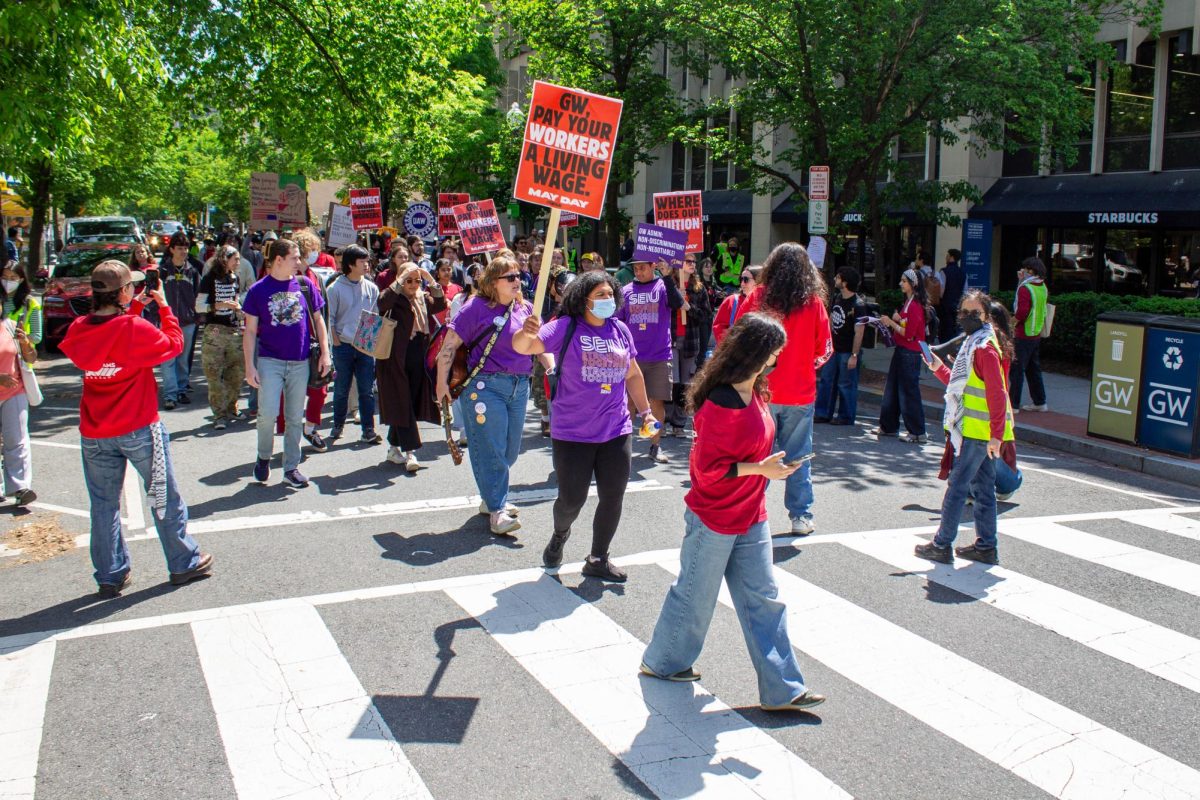
Nearly a hundred students, faculty and staff marched through campus Friday to call for better wages and working conditions for the University’s graduate students, facilities workers and faculty members in honor of May Day.
The Socialist Action Initiative and GWU Graduate Workers United hosted a rally at 11 a.m. Friday, starting at Kogan Plaza before the group of nearly a hundred demonstrators marched to the Graduate School of Education and Human Development, University Yard and 1922 F Street. Organizers said the march aimed to pressure officials to improve wages and working conditions for graduate students and facility workers, end budget cuts and increase student and worker involvement in University decision-making.
The rally was one of many demonstrations nationwide to honor May Day, or International Workers’ Day, a holiday celebrating the working class, which labor unions and socialist movements have traditionally used to protest income inequality and advocate for worker protections.
Demonstrators held signs reading “Where does our tuition go?” and held a large banner that read “GW, pay your workers a living wage” as they marched through campus while Metropolitan Police Department officers closed off sections of the streets they were walking down. Protesters chanted calls for collective action and solidarity, including “students and workers all unite, one struggle one fight” as marchers stopped outside University buildings to hear speeches from student and labor organizers.
Emily Gomez, a junior political science student and representative for the Socialist Action Initiative, said in an interview organizers held the demonstration to fight for students, faculty and staff to have a larger voice in the University’s tuition spending and setting of worker wages. She said the group is also calling for the University to halt its austerity measures, including layoffs and budget cuts, as the reductions have worsened working conditions and limited support for students and employees across campus.
“We’re here for a student and worker university, specifically a popular university,” Gomez said. “So advocating for democratic governance for students, faculty and staff.”
Gomez said she believes students and workers should be able to advocate for workplace issues and political causes without administrative interference, citing a March incident where the GW Police Department removed GWU2 members who were staging a sit-in outside a collective bargaining session with officials.
“There’s a reason so many people are out here and collected today because they believe that to be true,” Gomez said.
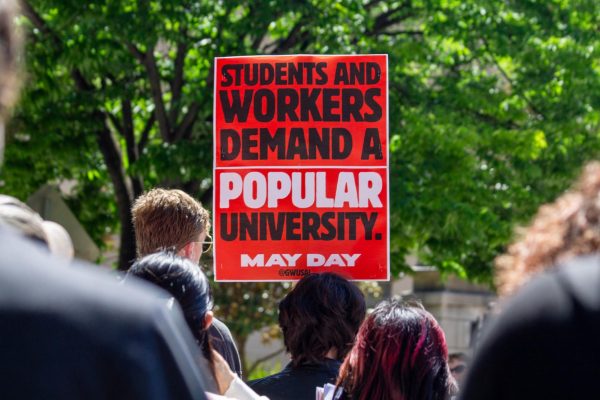
The rally made its first stop in front of GSEHD’s office on the corner of 22nd and G streets to protest officials sending out imminent termination notices to GWTeach faculty members last month as part of their “right-sizing” initiative. Brian Casemore, an associate professor in GSEHD who spoke on behalf of the SAVE GSEHD Coalition — a group of students, alumni, faculty and staff protesting GSEHD’s faculty layoffs and restructuring efforts — said the University’s recent terminations and restructuring decisions in the school reflect a broader pattern of austerity that is weakening its academic mission.
Casemore called for solidarity among GSEHD faculty members, especially those with job security through tenure, to combat the “austerity logic” that produced terminations within GSEHD and continues to “dismantle” the school. He said a popular university where students, staff, faculty and alumni have a say in officials’ actions — as opposed to the “corporate university” he said GW currently is — protects faculty members’ and students’ freedoms to teach, learn and think.
“If we retreat into our offices while colleagues are fired, while student workers and contingent faculty are denied living wages and while staff are denied safe and equitable working conditions, we are not protecting the educational project, academic integrity and the freedom of thought,” Casemore said.
Megan Davis, an adjunct professor of philosophy and member of GW’s part-time faculty union, said the University must provide faculty and staff safe working conditions and anti-discrimination protections as instructors cannot provide students with the best learning environment while facing financial instability and inadequate workplace support.
“They say this is a prestigious institution, a community of scholars, but you can’t build a community on poverty wages, you can’t claim excellence when your instructors are grading papers and writing letters of recommendation on the train between multiple campuses, making poverty wages and going without healthcare,” Davis said.
The crowd then walked to the entrance of U-Yard on H Street where students from Georgetown University, Howard University and the University of Maryland spoke about their own struggles with securing fair wages for graduate student workers and facing administrative pushback against student and labor organizing efforts.
Outside the protest’s last stop at 1922 F St, Maddie, a GWU2 member, said the fight for improved conditions for graduate workers was also tied to advocating for democratic practices and increased protections for workers across D.C. She said GWU2 must also fight for other “vulnerable” groups on campus like advocating for increased protections for international students.
“A better life for graduate work and for work on campus requires fighting for democracy across the city,” Maddie said. “From here, we are merging with a larger contingent which represents how our fight parallels and intersects with ongoing fights across D.C.”
The protest ended after the group marched to Franklin Park to join a larger May Day rally at 2 p.m., hosted by We Are CASA — a Maryland-based working-class and immigrant advocacy organization — and several other D.C.-area labor and immigrant rights organizations.
This post has been updated to clarify the following:
This post was updated to clarify Casemore’s definition of who has a say in officials’ decisions in the popular university, which he said included students, staff, faculty and alumni, not just faculty. We regret this error.