
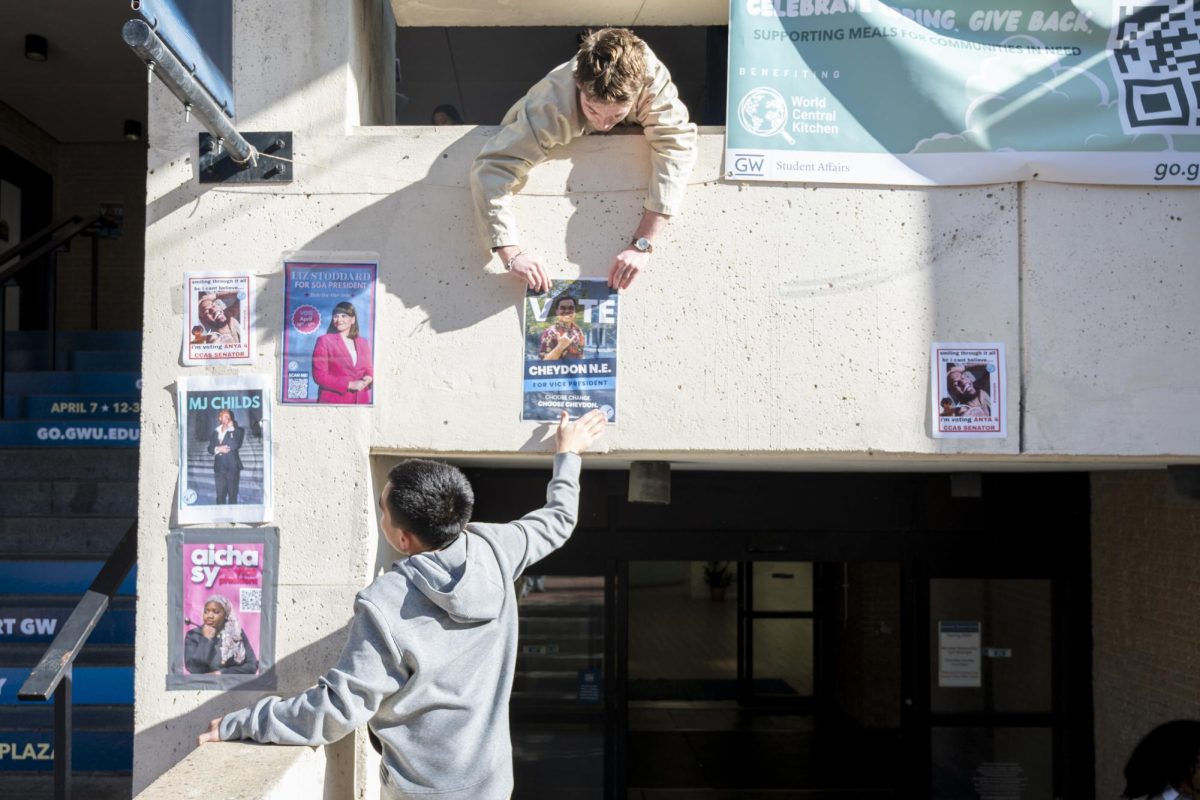
Candidates running in the Student Government Association elections plastered campus with posters Monday, officially kicking off the campaign period ahead of voting next week.
Top candidates for SGA president, vice president and senate and dozens of their campaign volunteers assembled in Kogan Plaza just before 9 a.m., equipped with rolls of colored duct tape, stacks of their carefully designed posters and their best running shoes, before racing out of the plaza at the sound of Joint Elections Commissioner Eric Gitson’s whistle to display their campaign materials on the walls of University buildings. The annual postering day marked the start of the SGA campaigning period, which runs from Monday through the April 16 and 17 elections.
Candidates and their volunteers split up to tape up posters in the highest-foot-traffic areas of campus, like the plaza cutting through Rome and Phillips halls and the University Student Center entrance on H Street. Several candidates also planted volunteers on the Mount Vernon Campus to put up signage at its only designated postering location, Ames Hall.
The Joint Elections Commission limits presidential and vice presidential candidates to 40 total posters no larger than 18-by-12 inches — 20 total posters for senate candidates — in only four Foggy Bottom locations: the USC’s H Street side, the exteriors of Rome and Phillips halls and Smith Hall of Art and any building facing University Yard except GW Law and The George Washington University Museum and The Textile Museum.
The JEC states it will charge any candidate who violates the postering rules with two penalty points. If a candidate accumulates six or more penalty points at any point during the campaign period, the JEC will disqualify them from the ballot.
Anya Srivastava, a first-year running for a Columbian College of Arts & Sciences senate seat, said she decided to start postering promptly at 9 a.m. because she’s “competitive” and wanted to claim the spots most visible to students before other candidates got to them. She said postering helps candidates reach students who might not be paying attention to social media posts or following dedicated campaign accounts.
Srivastava’s posters feature a popular meme of NBA star LeBron James rather than a large image of herself, as other candidates’ posters display. She said she’s using the meme as a way to reach students by making them laugh and showing off her personality.
“I’m a very serious person when I need to be, but my campaign is all about bridging the gap between the administration, and it’s also about making sure the quality of life is accessible,” Srivastava said. “Doing that would be just to show my true self.”
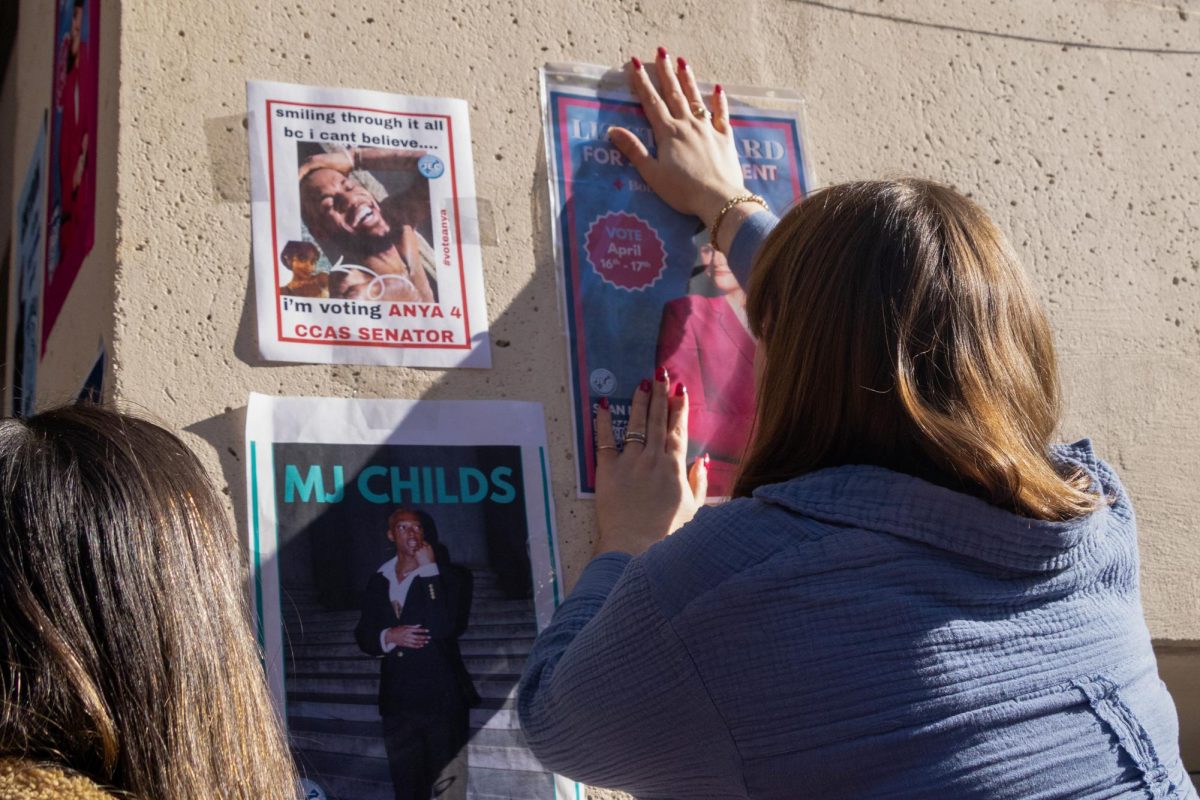
SGA Vice President Liz Stoddard, who is running for the body’s top post, plastered her posters on the outside of Lisner Hall facing U-Yard and the stairway leading into the USC from H Street. She said postering helps create opportunities for campaign slogans, like her “Bob for the Job” catchphrase, to stick in students’ minds. Stoddard, who was putting up her posters with bright-pink duct tape, said using the colorful tape is one of the ways she tries to stand out on a wall of dozens of other posters — lessons she learned from her previous two years of postering when she ran for an SGA Senate seat as a first-year and for vice president last year.
“I think postering is really effective, like put a face to the name,” Stoddard said. “I think that’s the reason why people know what ‘Bob for the Job’ is.”
Blaize Larson, a first-year running for a CCAS seat, said he decided not to put up posters during the kickoff and instead went to scope out what designs other candidates used so he could draw inspiration and decide how to present himself best to students.
MJ Childs, a sophomore running for SGA president, said he was postering to spread his campaign’s message and uphold the tradition of postering day, which has served as the kickoff for SGA elections for decades.
SGA Sen. Aicha Sy (CCAS-U), a sophomore vice presidential candidate, said her campaign will be more focused on social media than traditional postering because she thinks that’s a better way to engage students, since it creates a forum for students to interact with her campaign materials and get to know her as a person through campaign videos. Still, she said she still decided to put up posters to reach students in as many ways as possible.
“I think a poster is just really a photo, you can’t know much about me from that, but I think it’s still fun to have that as a symbol of my campaign,” Sy said.
Alayna Kadarusman, communications director for vice presidential candidate SGA Sen. Cheydon Naleimaile-Evangelista (CCAS-U), said postering is a good way to reach a “different demographic” of students. She said some students likely will not engage with social media posts over posters from candidates because they are not interested in the elections.
One of Naleimaile-Evangelista’s two poster designs features him wearing a bald cap posing like rapper and singer Pitbull, who goes by the nickname “Mr. Worldwide.” The poster tells students Naleimaile-Evangelista is the best choice for vice president “worldwide.”
“The designs are fun as well,” Kadarusman said. “I think it also creates awareness for the other students to see who’s actually running.”