
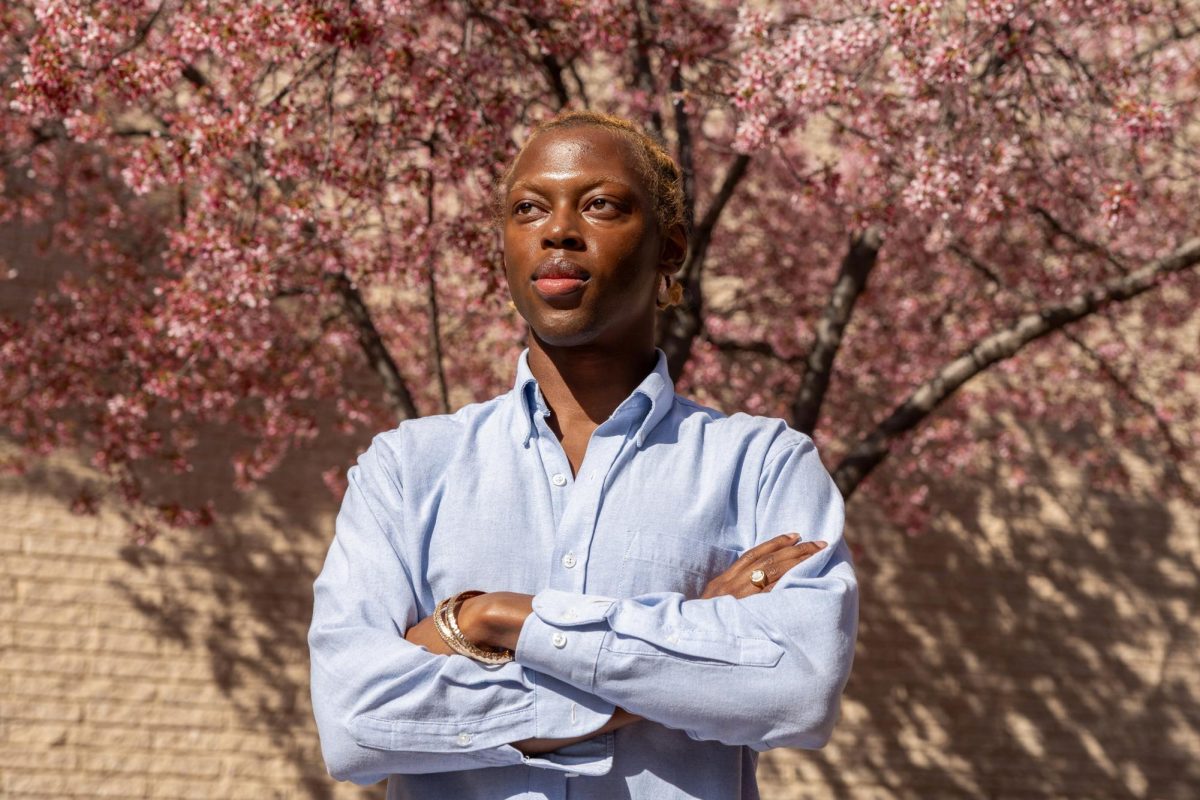
MJ Childs, the Black Student Union’s vice president of marketing, became the first to announce his bid for Student Government Association president last week.
Childs, a sophomore from Philadelphia studying creative writing and marketing, said if elected, one of his top priorities would be including student perspectives in University policies by creating advisory committees that work with GW officials on topics like diversity and responsible artificial intelligence usage. Childs, who has not previously served in the SGA, said he sees the SGA president as an advocate for community members, and his experience with advocacy, especially through running BSU’s Instagram — which he has used to speak out against President Donald Trump’s administration’s perpetuation of racial stereotypes — qualifies him for the role.
“At the end of the day, all of us are students, and I think that I’m very involved in campus, and I also talk to so many people every single day, so many different types of people, and I am presented with new information all the time,” Childs said.
Childs said he plans to increase campus safety through advocating for more detailed and frequent alerts notifying students of law enforcement and immigration enforcement presence, saying the current updates often lack detail, and officials do not always issue them when law enforcement is present on campus. He said he would also ask officials to provide more specific language about how certain federal actions will directly impact GW in their weekly federal updates emails, which he said can be “very vague.”
“It is alarming to a lot of us here, especially a lot of us are seeing what’s unfolding in front of our eyes in our country,” Childs said.
Childs said he worked last year as a staffer for the West Hall Fitness Center, but officials eliminated his position last spring due to what he suspects were University-wide budget cuts and relocated him to the Lerner Health and Wellness Center. He said officials did not tell him they would also reduce his hours as part of the change, and the experience made him feel like the University did not consider all students when making budgetary decisions, inspiring him to run for SGA president to expand transparency.
Officials announced in July they would cut GW’s fiscal year 2026 operational budget by 3 percent, implementing a hiring freeze in July, cutting student services throughout FY2026 and laying off 43 staff members in September.
Childs said he wants GW officials to engage in more “honest communication” with students by explaining their reasoning for making budget cuts. University President Ellen Granberg sent an email to community members in October discussing recent challenges facing the University, marking the first time the University publicly discussed layoffs and reductions in campus services with the full community.
“The throughline was that students are not connected to the governing bodies of the University, not just SGA, but also Board of Trustees, President Granberg, and so I really wanted to be that force and that connection, as in bridge that gap,” Childs said.
Childs said he also wants to conduct more in-person surveys and outreach to students instead of trying to reach them through social media or email, like the SGA currently does to solicit feedback, because in-person interaction makes students more willing to be involved and respond to surveys.
“I think we have a lot of infographics and a lot of emails, and people typically get email fatigue and infographic fatigue,” Childs said. “I think you should always humanize everything that you do.”
He said he also plans to create a 20-to-50-person coalition of student advocacy, political and affinity group leaders, SGA members and GW officials under the SGA’s Community, Advocacy, and Inclusion Committee, which would meet three-to-five times per semester to host round-table events for students to hear each others’ perspectives and discuss potential initiatives to help students of diverse backgrounds feel more welcomed and included on campus. He said the events could help students outside the SGA feel like they have more advocacy and are included in University decisions.
“Students who may not typically be involved in those types of orgs would be able to then come, and they would be able to voice their opinions,” Childs said.
Childs also said he would encourage the University to continue its search for a vice provost to lead the Office of Diversity, Equity and Community Engagement, a search which the University confirmed it paused last October, so the vice provost could be involved with the coalition. ODECE has been without a vice provost to lead the office for 19 months, after the previous director left in July 2024.
Childs said he would create an advisory committee of humanities and computer science students — fields he said are most subject to changes caused by AI — that would meet with GW officials to provide recommendations about AI policy revisions two-to-three times a semester.
“I would like to have a task force with students as well as officials who are reviewing AI policies right now to discuss how students are using AI so that we can better develop policies that don’t punish students, but support students in their use and their AI literacy as well,” Childs said.
Childs said through talking to students, he has heard many concerns about the presence of Immigration and Customs Enforcement agents on and near campus, and wants GW alerts to include notifications about immigration enforcement activity.
Officials issue GW Alerts during emergencies or when an incident requires “timely notifications” that impact GW’s campuses, according to the Division of Safety & Operations website, though officials did not send a GW Alert to community members when Immigration and Customs Enforcement agents raided a Foggy Bottom restaurant in September and have declined to provide specific criteria they use to decide when to send alerts.
“There’s a lot of student concern about what legal resources there would be and what support would look like, especially with potential visa revokes and things like that, and I think providing more legal resources and support like that would be really beneficial,” Childs said.
The SGA candidate registration opened Thursday and will remain open until 5 p.m. on March 25. Childs must collect at least 359 student signatures before he will officially be on the ballot for the April 16-17 elections, pending Joint Elections Commission verification of his signatures.