
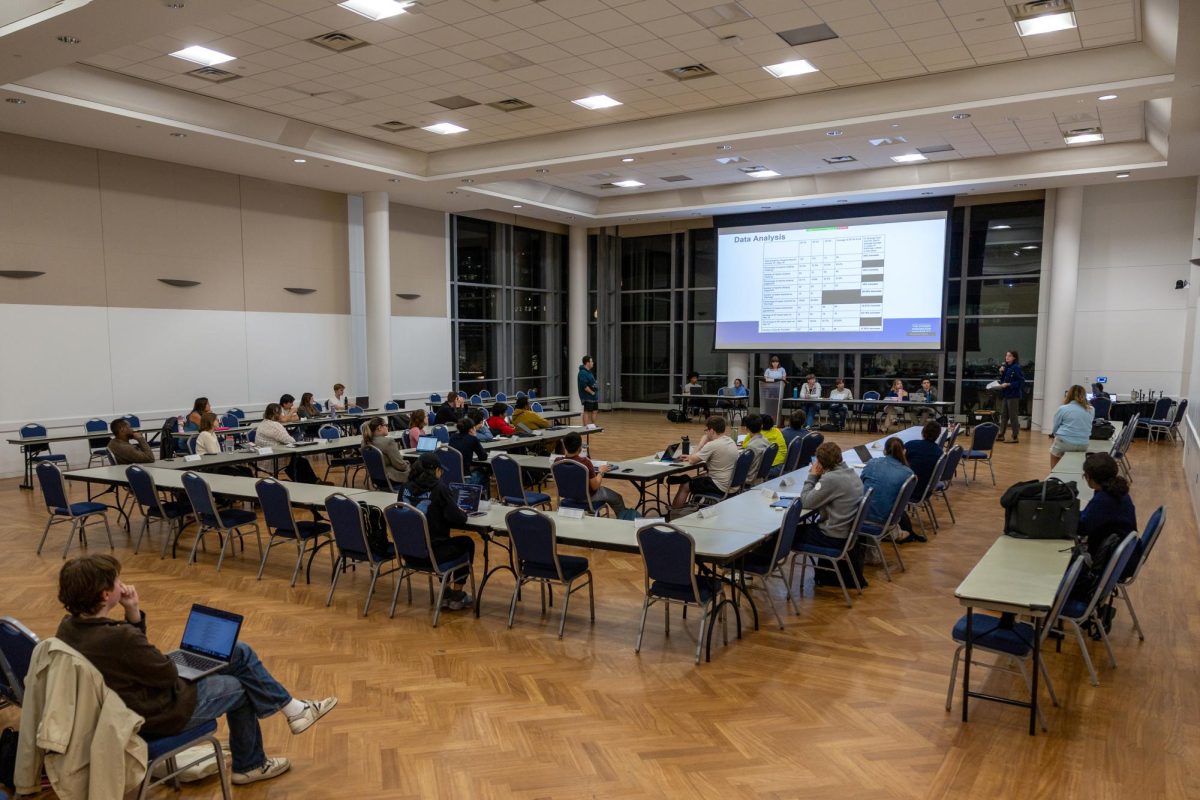
Student Government Association senators passed a resolution calling on officials to bargain fairly with GW’s graduate student union and pay graduate workers a living wage at their meeting Monday, days after administrators rejected the union’s contract demands during a bargaining session.
The resolution, which senators unanimously passed at the meeting, calls on officials to engage in more “productive and equitable” negotiations with GWU Graduate Workers United and protect them from overworking and discrimination. Senators at the meeting also passed a resolution calling on officials to restore diversity references on the Elliott School of International Affairs’ website after the school quietly took down the webpage for its diversity action plan and other diversity-related materials earlier this academic year.
Matt Martinez — an economics Ph.D. student and co-chair of GWU2 who spoke during the public comment period of the meeting — said the University’s strategic framework, launched in October, prioritizes growing GW’s research enterprise, but officials will struggle to achieve that goal if they continue underpaying the graduate students who drive that research. He said the University underpaying its graduate student workers indicates to him that officials do not value their graduate students or their research contributions.
GWU2 members claimed officials refused to meet the union’s compensation and healthcare demands during a rally outside a bargaining session between the union and the University last week. Union representatives said officials only offered to increase graduate workers’ compensation from $28,000 annually to $30,000 and said workers’ healthcare plans would not change despite the union requesting $54,000 a year and full health insurance coverage.
The session marked the first time officials responded to their compensation demands since the union began bargaining last May, union leaders said.
Martinez said GW graduate students are paid “very little” relative to other schools in the area, which creates incentives for graduate students to study elsewhere.
The resolution states graduate workers at Georgetown University are paid a minimum of $23.34 per hour, compared to GW’s pay of $22 per hour.
“We should not be underpaid only because we love doing what we do,” Martinez said. “I commend, and I thank the student government for bringing this up because paying and valuing your graduate student workers is something that helps us all.”
SGA Sen. Levi Todd (CPS-G), the resolution’s sponsor who was absent from the meeting, wrote in a statement supporting the legislation that graduate student workers are “essential” to the University’s mission because they teach, conduct research and support academic departments. Todd said GW is at risk of losing top graduate researchers because other institutions are offering higher wages, stronger benefits and “more consistency” in standards.
“GW should be competing at that level,” Todd said in the statement. “This resolution reaffirms that graduate student workers deserve fair compensation, equitable treatment and a university that engages with them in good faith.”
SGA Sen. Aicha Sy (CCAS-U), chair of the SGA’s Community, Advocacy and Inclusion Committee, sponsored a resolution asking Elliott to restore diversity references on its website, saying the SGA should be pushing the University to uphold its diversity initiatives rather than yield to federal pressure. She said the University’s diversity commitments are especially relevant as students fear for their safety due to immigration enforcement agents’ presence near campus and probes from President Donald Trump’s administration regarding alleged diversity, equity and inclusion practices in GW’s admissions.
Elliott removed its webpage for its annual diversity action plan, renamed a scholarship for underrepresented students and edited student testimonials to remove references to diversity and equity over the last three months. The diversity plan’s webpage, which officials launched in 2019 to outline the school’s goals and strategies for advancing DEI, now says it “cannot be accessed.” University spokesperson Julia Garbitt confirmed in February officials deactivated the page.
The resolution urges officials to restore the Elliott webpage to its “previous state” and for both the Elliott school and the University as a whole to uphold its commitment to diversity and equity.
“Through a time of uncertainty for many students that call GW home, it’s important that the University dedicates itself to the greater diversity of students in our campus,” Sy said.
Senators voted unanimously to pass a resolution calling on officials to bar Immigrations and Customs Enforcement from participating in the GW Career Exploration Expo, all future career fairs and University-sponsored events. The resolution, which the SGA passed jointly with the Student Bar Association, also urges officials to ban ICE and all external law enforcement agencies working with immigration officials from private campus areas without a judicial warrant.
The GW Career Exploration Expo has not hosted ICE, the Department of Homeland Security or related agencies in at least the last two years and did not include those agencies this spring, according to the expo’s website, but earlier records of what employers participated in the fair are unavailable.
Vice President for Student Affairs and Dean of Students Colette Coleman and Vice President for Safety and Operations Baxter Goodly sent a University-wide email in late February reminding students that law enforcement agents must have a judicial warrant to access campus buildings, following an incident at Columbia University where ICE agents allegedly misrepresented themselves to enter a campus building and arrest a student. Officials also posted signage in several buildings like the University Student Center last November stating certain areas were restricted to GWorld cardholders and their escorted guests.
The SGA’s passage of the joint resolution comes after months of coordination with the SBA, where leaders from both bodies worked on agreeable language. The SBA in late January signed on to a petition urging GW Law Dean Dayna Bowen Matthew to disinvite ICE recruiters from a public interest career fair jointly hosted by the law school and Georgetown University Law Center, though Matthew ultimately did not disinvite the agency.
SGA Sen. Avery Boyd (CCAS-U), who sponsored the resolution, said student leaders in the SGA are responsible for protecting students when they feel unsafe and have a responsibility to speak up against actions like the University’s refusal to bar ICE from career fair events. He said students at the University feel unsafe due to the presence of immigration agents in D.C. and that administrators are not adequately defending students against federal intervention.
“Now more than ever, students at this University feel unsafe,” Boyd said. “They feel like the people in power are not speaking up for them. They feel like they cannot be themselves or express themselves freely.”
Senators at the meeting heard updates and reports from several top University leaders, including Faculty Senate Executive Committee Chair Guillermo Orti, who answered senators’ questions about how the body functions and potential areas of collaboration between the SGA and Faculty Senate, like on joint committees.
Officials revived the Joint Committee of Faculty & Students earlier this year — a body made up of seven student representatives from undergraduate and graduate schools, seven faculty members and seven administrators — that went dormant after the COVID‑19 pandemic. Orti said the committee has so far discussed issues like lowering textbook costs and open access programs for course materials.
Senators also held a closed-door meeting with Vice President and Dean of Enrollment Management and Student Success Jay Goff for about 40 minutes but did not disclose the topic.
The SGA will hold its next meeting April 13 at 7 p.m. on the Mount Vernon Campus.