
Updated March 26, 2026 at 2:40 p.m.
GWU Graduate Workers United claimed officials refused to meet workers’ compensation and healthcare demands during a rally outside a bargaining session between the union and the University Wednesday.
Union representatives said their bargaining representatives told them during the negotiations officials only offered to increase graduate workers’ compensation from $28,000 annually to $30,000 and said workers’ healthcare plans would not change, despite the union requesting $54,000 a year and full health insurance coverage. Union leaders said the session marked the first time officials responded to their compensation demands since the union began bargaining last May.
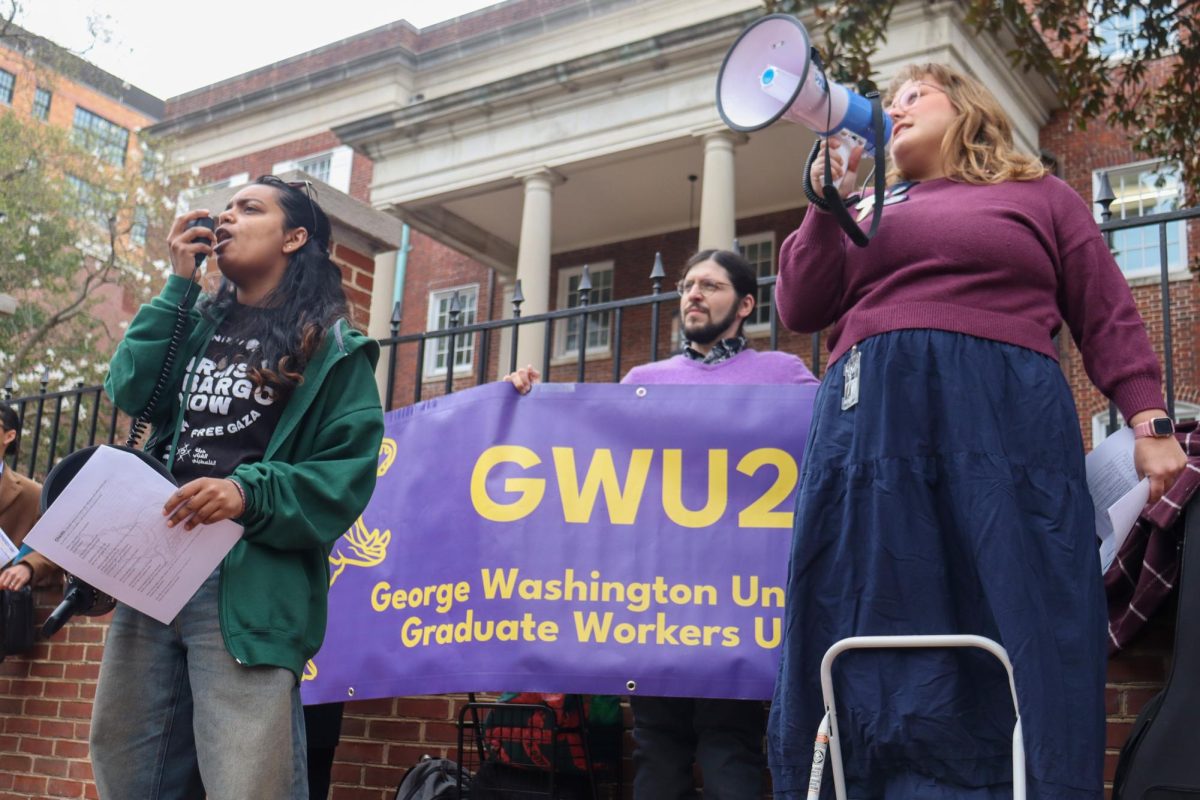
About 50 students, faculty and staff rallied outside 1922 F St., where the bargaining session took place, in a rally co-hosted by the GW Labor Council, the GW chapter of the American Association for University Professors, Service Employees International Union Local 500, the GW Socialist Action Initiative and the SAVE GSEHD Coalition.
Matthew Martinez, an economics Ph.D student and union representative, said in an interview he felt “insulted” when he heard officials’ proposal for graduate worker compensation, considering the University just made $427 million on the sale of the Virginia Science and Technology Campus to Amazon Data Services last month.
He said graduate workers at Georgetown University make significantly more — 9-month Ph.D stipends are currently $39,924 and 12-month Ph.D stipends are $43,517 — which shows that GW does not care about bolstering its research and teaching compared to its peers.
“They say they want to do great research and great teaching, and you want to attract the best people to do that,” Martinez said. “If you’re going to offer so much less than your peers, you are not taking yourself seriously as a University.”
University spokesperson Julia Garbitt said officials participated in a bargaining session, which included “annual compensation increases” and “meaningful benefits” specifically requested by the union.
A University spokesperson said officials’ proposal made clear graduate assistants will be “fully eligible” for the health care, U-Pass and child care benefits that are currently available to graduate students.
Graduate students are currently eligible for a subsidy covering 80 percent of health insurance costs under the Student Health Insurance Plan and can pay $100 for access to a U-Pass. Graduate students currently have access to pregnancy support services through the Title IX office.
“GW’s benefits proposal appears to be a simple restatement of current policy for PhD students, not an actual offer of any additional benefits,” Martinez said in a message.
The meeting was the sixteenth bargaining session between the union and the University since May 2025 in an effort to negotiate a contract after graduate students voted nearly unanimously in November 2024 to unionize. Both GW and the union have agreed to make bargaining sessions open to all union members since August.
GWU2 held their last bargaining session with officials March 5, where GW Police Department officers cleared a “grade-in” in the lobby of 1922 F St., where union members watched the session via Zoom and did teaching assistant work on their laptops. Garbitt said at the time officers asked the group to leave because they did not have “prior authorization” to occupy the space for that purpose.
The union’s proposed contract articles include annual compensation of $54,000, non-discrimination articles, full health insurance coverage and child care subsidies — none of which the University agreed to during Wednesday’s bargaining session, according to union representatives.
The crowd gathered on the 1900 block of F Street around 12:30 p.m. while Metropolitan Police Department cars blocked traffic as protesters moved onto the street. Representatives from GWU SAI led demonstrators in chants like “1, 2, 3, 4, austerity is at our door” and “GW we’re at your gate, fair contract no debate” with organizers encouraging the crowd to get loud so officials could hear the chanting from inside the negotiations.
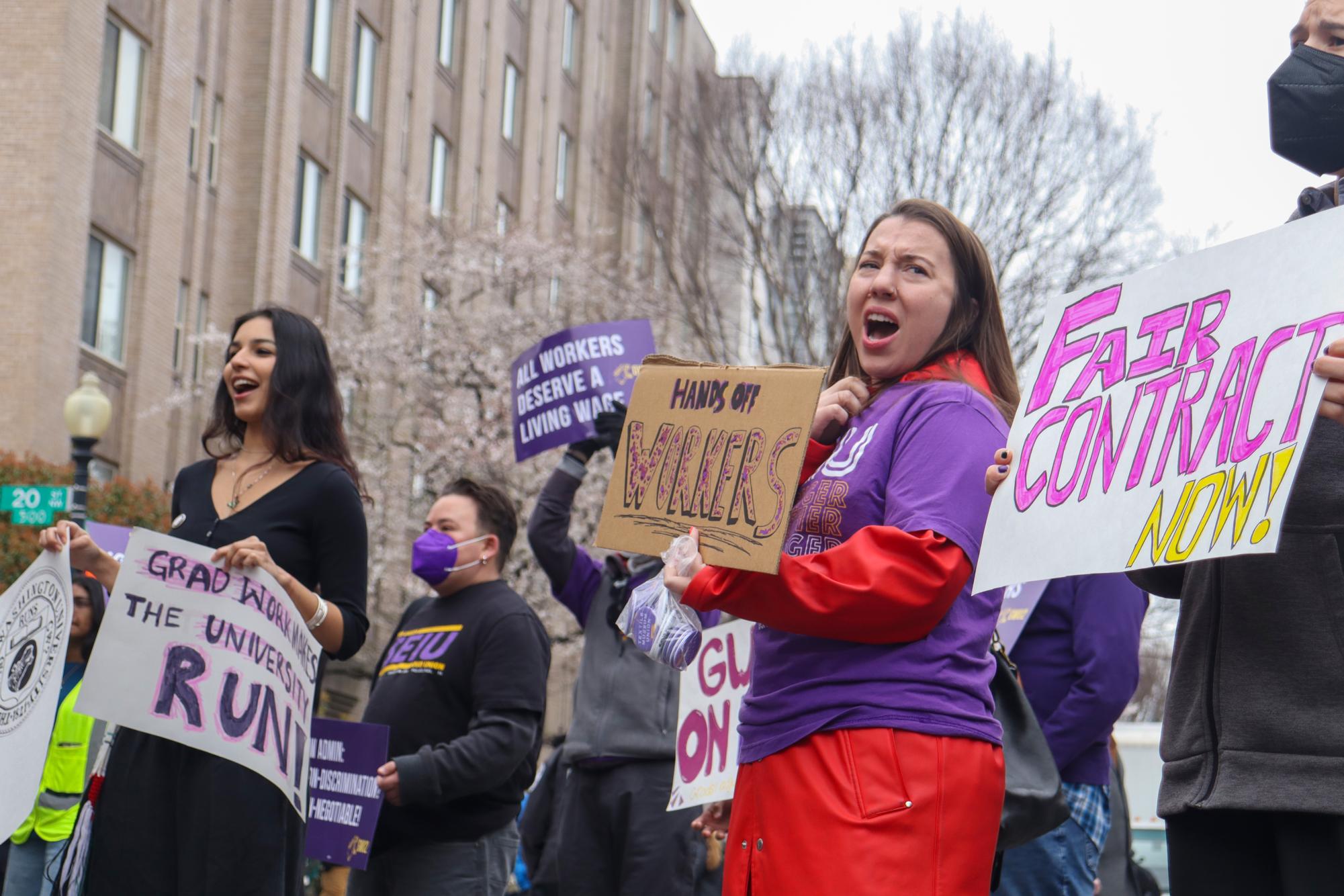
Summer Harvey, an epidemiology Ph.D candidate and union representative, kicked off the rally by saying all workers at the school must unite to demand living wages and dignity in the workplace and thanked faculty, staff and undergraduate students for coming to support the union’s negotiations.
“The people who run this University, the people who make it function, are the workers,” Harvey said. “The people doing the teaching, the people doing the research, the people cleaning the buildings, the people keeping this University going.”
Brian Casemore, an associate professor of curriculum and pedagogy at the Graduate School of Education and Human Development, said the cuts at his school reflected a “shift in the soul” of the University, rather than just budgetary constraints.
GSEHD has faced significant cuts and restructuring this academic year, including plans to consolidate curriculum and faculty layoffs, as part of a “right-sizing” effort by officials to make the school more efficient amid enrollment declines, which officials have attributed to the main reason for the cuts.
“We experience the cultural collapse of the school deeply as we are subjected to endless neoliberal rationalization about the firing of the very professors essential to the project of education,” Casemore said.
Katrina Orsini, a program associate at the George Washington University Museum and Textile Museum, said three and a half years ago she was surrounded by colleagues not making a living wage, but after the museum employees’ union ratified a contract with the University in February 2025, her colleagues now can all afford to live in D.C.
“I encourage all graduates here to fight for everything you can, because you all too should and can be able to afford to live here in Washington, D.C.,” Orsini said.
The rally ended at about 2 p.m. when the union’s bargaining committee came out of 1922 F St. and announced the University had not met their demands, to cries of “Shame!” from the crowd. The representatives said officials offered “very little” health care, no child care and no conference travel reimbursement in their negotiations.
“GW just proved today that the workers who run this University don’t really matter to them,” one of the union representatives told the crowd.
This post was updated to correct the following:
This post was updated to reflect Katrina Orsini said her colleagues were not making a living wage, rather than a minimum wage. We regret this error.