
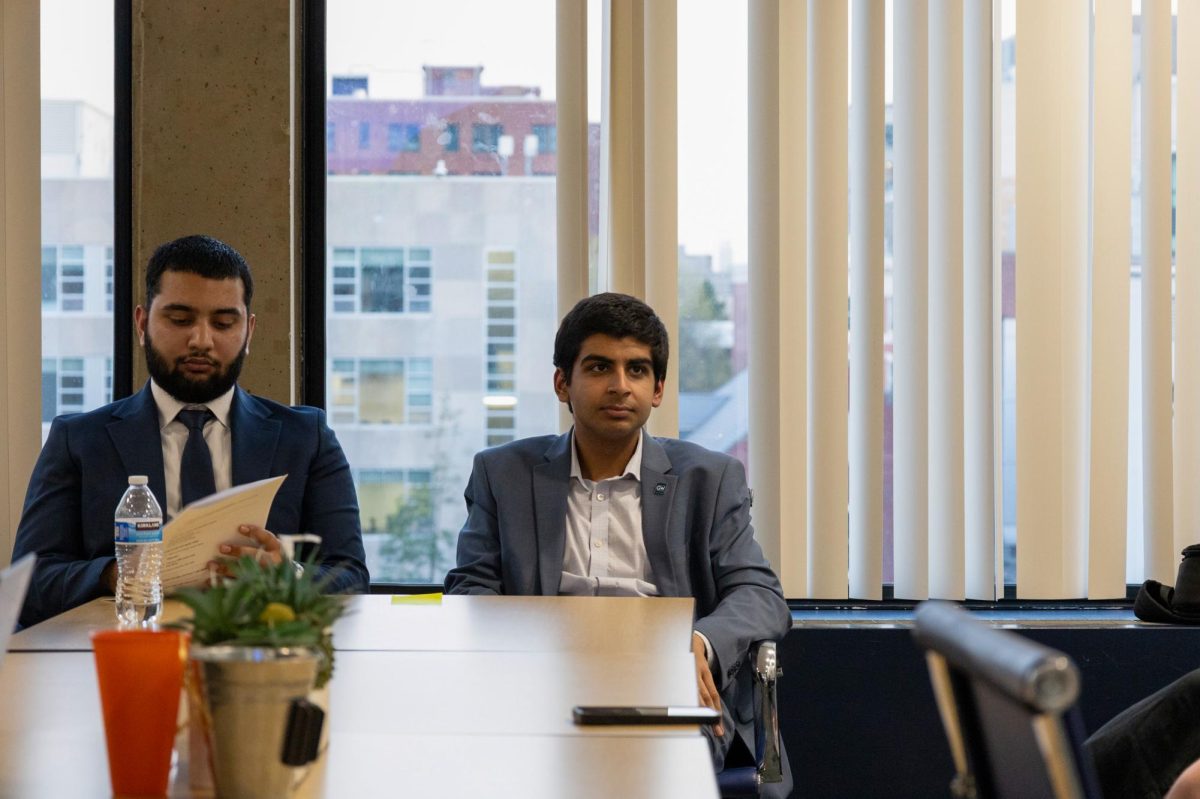
First-year Student Government Association presidential hopeful Zain Masood will not appear on the ballot for the April 16 and 17 elections after the Student Court dismissed his appeal of his disqualification for missing the filing deadline.
Masood — who the Joint Elections Commission convicted with six penalty points last Thursday, the threshold for ballot disqualification — failed to meet the Student Court’s Monday filing deadline to formally appeal the JEC’s ruling to the five-justice court, according to Chief Justice Oliver Bates. Bates said justices dismissed Masood’s Tuesday complaint against the JEC because it was past the deadline to pursue a formal case in Student Court, solidifying his disqualification from the presidential ballot.
Bates said Masood contacted the court Friday about his appeal, but did not file an official complaint within the required 48-hour window after his disqualification Thursday. Bates said the court extended the appeal window until Monday at 11:59 p.m. and provided Masood with legal document templates and instructions on how to fill them out, but never received a response.
Bates said the court notified Masood Tuesday morning the case was closed, but then received Masood’s appeal filings later that day. He said the court discussed whether to allow Masood’s appeal to continue but voted to uphold the extended deadline and dismiss Masood’s case against the JEC.
Masood wrote in his notice to file an appeal that the JEC moved to disqualify him as a candidate without “sufficient or credible evidence.” He said the JEC did not present “verifiable” evidence substantiating the complaints against him, and he asked the court to overturn the commission’s ruling on those grounds.
“As such, I believe the decision was made in error and does not meet the evidentiary standards required for disqualification,” Masood wrote in the appeal.
Masood said in a statement to The Hatchet Wednesday he will not let his appeal’s denial stop his campaign and he will “keep fighting” for fairer ballot access for himself and those that want to run for SGA positions in the future.
He said although he is formally disqualified from the race and will not be allowed to appear on the ballot, his campaign plans to conduct “independent polling” of students to determine the most popular SGA candidates and communicate that taking candidates off the ballot is “silencing them.”
“We are in this election to win it and will keep this campaign going until the end,” Masood said in a message.
Masood wrote in a Substack post Monday that disqualification is the “most serious” penalty the JEC can impose, and it should require a high standard of evidence and process that “ensures fairness” to all candidates. He said in the post “at no point” did the JEC present tangible or verifiable evidence that demonstrated he knowingly violated election rules.
“When decisions of this magnitude are based on unverified or unchallenged claims, it raises important questions about whether that standard is being met,” Masood wrote.
Masood launched his campaign for SGA president late in mid March, pledging to advocate for a cut to undergraduate tuition and press officials to sell the Mount Vernon Campus as some of his top policy priorities. Several students last month reported Masood to the JEC leading to six campaign violations alleging he pressured a student to sign his petition — presidential candidate hopefuls must collect at least 359 student signatures to get on the ballot — against the student’s “express will” outside an 8th-floor Thurston Hall study room, a restricted campaign zone.
Masood appeared before the JEC for a hearing last week, pleading not guilty to all six penalty points, becoming the first presidential candidate since 2023 not to take a plea deal from the JEC for campaign violations. SGA President Ethan Lynne pleaded guilty to five counts of violations for an authorized agent campaigning in restricted zones during the 2025 election, and former presidential candidate Dan Saleem pleaded guilty to five campaign violations in the 2024 election — pleas which allowed them to remain on the ballot.
During the hour-long hearing Thursday, the JEC called three in-person witnesses to testify against Masood and presented five written statements from other witnesses, who asked to remain anonymous.
Masood throughout the hearing repeatedly denied the legitimacy of the evidence in the case, stating complaints against him lacked direct eyewitness accounts or sufficient evidence for a conviction. He also alleged two of the JEC’s witnesses were potentially biased due to their roles as staffers for SGA Vice President Liz Stoddard, who launched her campaign for SGA president last week.
Masood during the hearing said he had no knowledge of the restricted zones rule and therefore should not be disqualified on the grounds that he accidentally violated the rules. JEC Commissioner Eric Gitson said at the hearing that candidates are required to read and know the campaign rules, and even unknowing violations of the JEC code are still valid reasons for disqualification.