
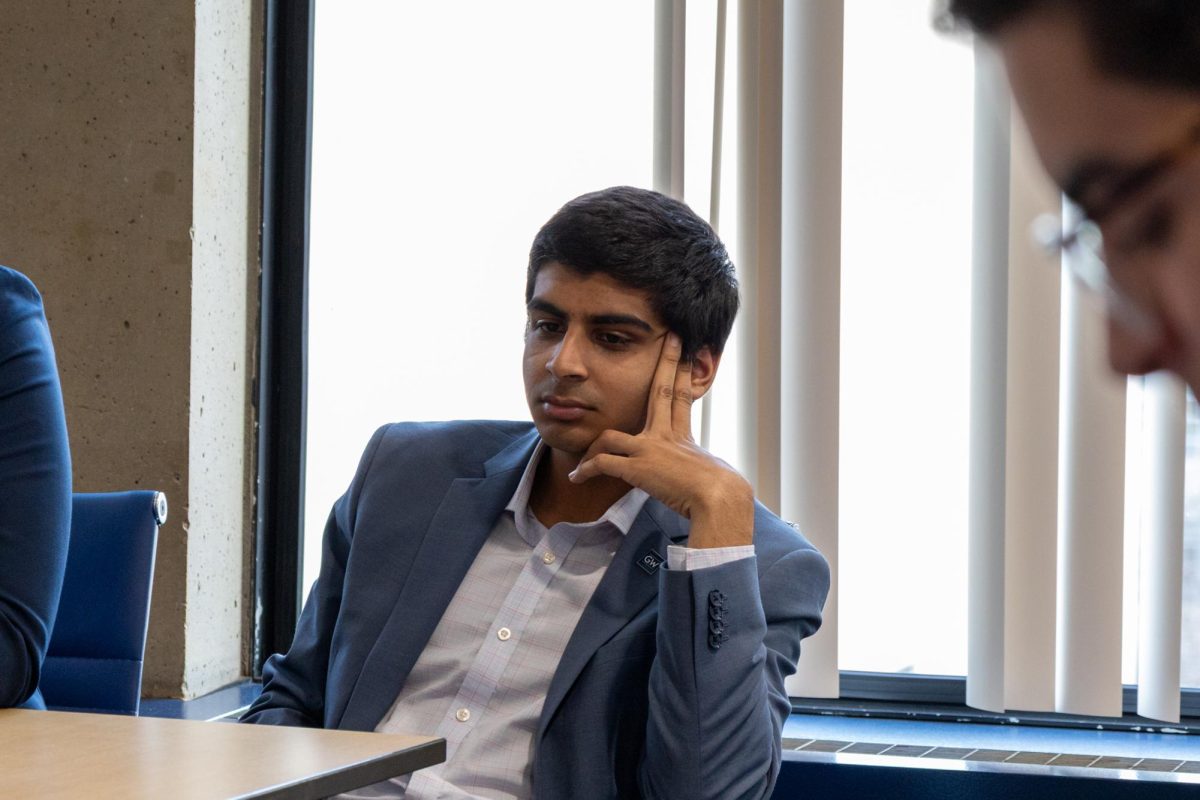
The Joint Elections Commission disqualified first-year Student Government Association presidential candidate Zain Masood from April’s election, finding him guilty of six election violations at a more than hour-long hearing Thursday.
The commission found Masood guilty on five counts of collecting signatures in a restricted zone and one count of forceful distribution of campaign material for a total of six penalty points — the JEC’s threshold for ballot disqualification — after the commission filed an indictment Wednesday. Masood, who pleaded not guilty to all charges and is the first candidate in three years the JEC has disqualified, said he will appeal the decision to the Student Court within the required 48-hour window, where justices will determine whether to uphold or overturn the JEC’s verdict.
Three witnesses testified against Masood at the hearing, with five additional anonymous witnesses submitting written statements, alleging Masood solicited signatures on Thurston Hall’s 8th floor and pressured at least one student into signing his petition after they refused in violation of the JEC’s code. Two of the three in-person witnesses said they saw Masood leaving the Thurston 8th floor lounge with a clipboard and confirmed with students in the area that they had signed his petition, while a written statement from an anonymous student alleged Masood “pressed” him to sign his petition even after he declined.
Most academic and residential buildings are prohibited campaigning areas under the JEC code. The code also states no candidates may distribute or attempt to distribute campaign materials against the will of the intended recipient.
The JEC found Masood guilty on all alleged charges after a roughly five-minute deliberation following the hearing, which lasted over an hour.
Masood said in a statement to The Hatchet Thursday night while he is “disappointed” with the JEC’s verdict, he appreciates the time and effort of everyone involved with the hearing. He said he plans to appeal the decision on the grounds that the JEC was unable to provide “tangible evidence” that he engaged in efforts to improperly collect signatures.
“I take these accusations very seriously, and plan to continue fighting to stay on the ballot,” Masood said in a message.
The JEC’s first witness, first-year Maelee Hurst — who serves as SGA Vice President and presidential candidate Liz Stoddard’s deputy communications director in the SGA Senate — said she submitted a complaint which led to the indictment against Masood after she saw him walking away from a group of students holding petition papers on Thurston Hall’s 8th floor, a restricted area for collecting signatures. Hurst said she walked around the corner, saw Masood handing his clipboard to students and heard him say “This is my petition.”
Hurst said her complaint was based only on what students in the 8th floor lounge told her about signing Masood’s petition, not on her own direct observation, but she asked the students what happened first.
Masood and his counsel, first-year Mohammad Ishaq Kashify — who gave a three-minute opening and closing statement and cross-examined the JEC’s witnesses — repeatedly denied the veracity and severity of the alleged violations, stating reports against him lacked direct eyewitness accounts or sufficient evidence for a conviction. Kashify also alleged two of the JEC’s witnesses were potentially biased due to their ties to Stoddard’s campaign and staff in the SGA Senate.
“The remaining allegations rely heavily on assumptions, second-hand reporting and testimonies from individuals with potential political affiliations,” Kashify said. “Even witnesses themselves used language such as ‘I would assume,’ demonstrating uncertainty rather than certainty.”
Kashify said he objected to the commission relying in part on written statements to render a verdict, because it did not provide the defense a chance to question the witnesses’ written allegations or assess the statements’ credibility.
“Several of the key witnesses referenced to this case were not present at the hearing, while their statements were introduced and relied upon, we did not have the opportunity to question them directly or assess their credibility through cross examination,” Kashify said.
JEC Commissioner Eric Gitson said at the hearing the commission is not required to make witnesses appear in-person, and as a student body, the commission does not have the ability to subpoena witnesses or force them to testify.
Stoddard said in a statement to The Hatchet she was aware of two of her campaign members potentially participating in the JEC process, but was not aware of the “extent and severity” of the charges presented against Masood or of any other witnesses, since she was not informed about the complaint until after Hurst had submitted it. She said she never asked any person to file a report or testify to the JEC.
Stoddard said if Masood believes the trial was biased or unfair, she believes he should “use his rights” to appeal.
“I hope that witnesses were questioned and any conflicts of interest were exposed, spotlighted and explored by the commission,” Stoddard said in an email. “I will also say that all of these rules apply to each candidate. They were presented to all candidates, both in person and virtually.”
Aruba Ahmed, the JEC’s chief investigator, said during her opening statement at the hearing the JEC’s purpose is to uphold the integrity of SGA elections and ensure all candidates compete under conditions that are “fair, equal and transparent.”
“When candidates disregard these rules, it undermines the fairness of the electoral process towards other candidates,” Ahmed said.
Ahmed also read the statement of an anonymous witness, who went by the pseudonym “Randy K.,” who claimed Masood “pressed” him to sign his petition after he refused and told Masood his policies — which include selling the Mount Vernon Campus and switching dining providers — “are stupid.”
“He proceeded to tell me, ‘It’s fine, we’re all freshmen, I want a chance,’” Ahmed said reading the statement. “I signed the petition because he pressed me.”
The JEC also called sophomore LillieMae Sweigert, Stoddard’s deputy chief of staff, as a witness, who said she is helping Stoddard manage and “strategize” her presidential campaign. Sweigert said Hurst did not receive any rewards from Stoddard or her staff for submitting the complaint, and Hurst already submitted the complaint against Masood before communicating with Stoddard and her staff about the alleged violations.
Ahmed said all the other written witness statements came from students unaffiliated with the SGA and Stoddard’s campaign.
Masood did not call any witnesses or present any evidence to rebut the JEC’s claims.
Gitson announced at the hearing that Masood could face up to four additional penalty points under a separate indictment alleging he collected signatures in District House in violation of the restricted zone policy and also used an unregistered agent — the SGA’s bylaws require candidates to register any students helping them campaign or collect signatures with the JEC.
Gitson said the JEC would not consider the additional charges at Thursday’s hearing because the commission is required to give candidates at least 24 hours notice prior to a violation hearing. Gitson said the JEC would schedule another hearing to consider the additional charges.
The last SGA presidential candidate the JEC disqualified from an SGA presidential election was former SGA President Christian Zidouemba in 2023, after the JEC found he impersonated other candidates while collecting signatures to get on the ballot. Zidouemba appealed the JEC’s ruling to the Student Court, but ultimately dropped the case and withdrew from the election.
SGA President Ethan Lynne pleaded guilty to five counts of violations for campaigning in restricted zones during the 2025 election, falling short of the JEC’s disqualification threshold, and former presidential candidate Dan Saleem pleaded guilty to five campaign violations in the 2024 election, which allowed him to remain on the ballot.