
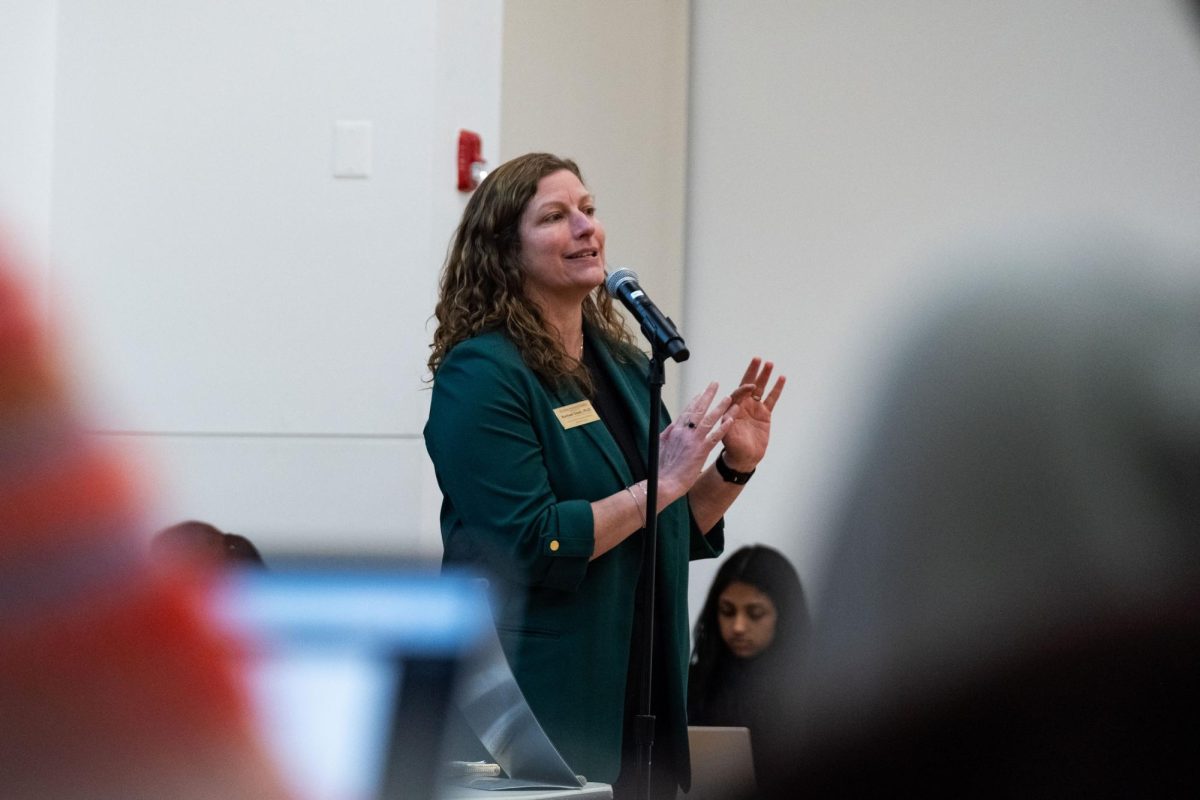
Associate Vice Provost and Deputy Dean of Students Rachael Stark fielded questions from Student Government Association senators Monday about proposed changes to the Code of Student Conduct, defending officials’ plans to remove student conduct panels and limit appeal pathways.
Stark, who is overseeing proposed changes and feedback to the draft code — which officials announced in November with the intention of implementing the changes at the start of the 2026-27 academic year — said officials are willing to carry out some minor changes based on student feedback, but stand by their decisions to remove student-involved conduct panels from the process to boost efficiency. Stark pushed back against senators’ concerns that proposed changes to the code, including the removal of the Statement on Student Rights and Responsibilities and limits on appealable sanctions, would undermine students’ rights in the conduct process, saying the revisions would improve the conduct office’s effectiveness while preserving students’ rights.
Officials released a draft code in November and are continuing to solicit feedback from students and community members. Proposed changes include the removal of student conduct panels in the conduct review process, the addition of new prohibited conduct and the ability for officials to hold students accountable for the conduct of an unregistered student organization.
Here’s a breakdown of what senators discussed at the meeting:
SGA senators press Stark on proposed changes to Code of Student Conduct
SGA Sen. Cheydon Naleimaile-Evangelista (CCAS-U) asked Stark why officials chose to remove the Statement on Student Rights and Responsibilities — which outlines rights like free inquiry and expression and freedom from unlawful discrimination — from the draft code, since it serves as the introduction to the current code. Stark said the statement will “absolutely” remain a publicly accessible document for students, but officials chose to remove it from the code itself because they felt it was “so important” they wanted it to stand alone.
“It’s almost like a bill of rights and a constitution,” Stark said. “Like two documents that support one another but are indeed separate.”
Stark also defended officials’ decisions to remove student-involved conduct panels from the discipline process and instead move to a model where full-time professional case managers hired by the Division of Student Affairs will hear a student’s case and decide its outcome. The proposed code also removes a provision allowing students to appeal a sanction issued by a case manager if it was “clearly inappropriate” or disproportionate to the conduct violation, except for suspension and expulsion, which now are adjudicated by a DSA official.
“Requests for appeals are truly rare, and this means that students are already feeling like their sanction is fair and equitable because our requests for appeals are so low,” Stark said. “So we really just wanted to spend our time and attention on the majority of the infractions, as opposed to this really small number.”
Stark, responding to a question from SGA Vice President Liz Stoddard if anyone outside DSA would be involved in the conduct process under the new code, said under the revisions students and faculty would no longer be involved. Stark said although officials plan to remove students from the actual conduct process, they plan to create an advisory committee that will provide suggestions and feedback on the code during the first three years of its implementation, which would include students.
“We’re absolutely taking all of your thoughts and feedback into consideration,” Stark said. “So please do know that it is a draft, and we’re absolutely happy to hear your thoughts and concerns and really process them.”
She said based on the current feedback, officials are “mulling over” some changes to the code, like reinserting the word “reasonable” after it was removed from a paragraph stating students must comply with the “reasonable directions” of University officials and adding back language stating students must follow officials’ orders only if they are “acting in performance of their duties.”
Stark said the Board of Trustees does not have to approve the new code for it to go into effect, although the Board signed off on the code’s previous two revisions in 2019 and 1996, but she said officials would present their planned changes to the Board.
SGA leaders condemn ICE’s actions, University’s lack of response
SGA President Ethan Lynne said SGA leaders are taking the actions of Immigration and Customs Enforcement agents — who killed two U.S. citizens during immigration crackdowns in Minnesota last month — seriously and are pushing for greater transparency, resources and protection from administrators regarding federal immigration enforcement near campus.
“What we are seeing throughout videos, and especially what’s been going on in Minnesota, is abhorrent, cruel, evil and indefensible,” Lynne said. “Students across the country should not be afraid to go to class, to live on campus or to simply exist in their community.”
Officials said in a federal updates email in September that ICE agents detained “a number of individuals” from the restaurant Circa at Foggy Bottom, but said they had no information suggesting any are affiliated with GW. Since August, federal law enforcement presence — including ICE — has surged in the District following President Donald Trump’s federal takeover of the Metropolitan Police Department and move to deploy National Guard troops across D.C.
Officials released a frequently asked questions section on their Federal Updates website in January, providing responses to questions like what students should do if approached by ICE agents or what legal resources those detained by ICE can use. University spokesperson Julia Garbitt said in November students who see federal officials attempting to enter GW facilities should contact the GWPD and refer to the University’s posted resources on what to do in the case of unannounced federal personnel visits.
SGA Sen. Kassy Bonanno (MSPH-G), the chair of the Student Life Committee, said SGA leaders are planning to host a “know your rights” training in collaboration with the Student Bar Association — GW Law’s student government — which will take place later this month.
Stoddard said the University needs to do a “better job” to stand up against violence for students and people engaging in lawful protests and ensure that they are aligning themselves with democratic principles. She said the University has a “responsibility” to protect students exercising their right to protest and free speech from violence, harm and threats to their constitutional rights.
“You have rights in the United States of America, and you should be able to use them without threat of violence,” Stoddard said. “But yet that doesn’t seem to be the case recently.”
Senators confirm new JEC commissioner, amend commission’s charter
Senators confirmed sophomore Eric Gitson as SGA Joint Elections Commission commissioner following a brief period of uncertainty in the JEC after former Commissioner Alex Wan — who senators confirmed in October — resigned from his role on Jan. 12 due to an unspecified “combination of factors.”
Gitson, who had been working in an acting capacity since Lynne nominated him following Wan’s resignation, said at the meeting he has been “working overtime” to catch up since his appointment in mid-January, since he said Wan did little work to prepare the commission for the spring elections. Gitson said he met with former JEC members, University administrators and Stoddard to begin discussing ideas on how to improve candidate recruitment and voter turnout — issues which have historically plagued SGA elections.
“We are taking every step to ensure smooth, timely elections, and we’ve assembled a team with the skill and dedication to get this done,” Gitson said.
Gitson said one of his priorities as commissioner is to increase the number of candidates running for SGA positions by getting students to “see themselves” in the SGA through more targeted outreach programs. He said the JEC will also be more strict with enforcing campaign finance rules, which currently limit SGA presidential and vice presidential candidates to $375 in spending and SGA Senate candidates to $150 and will require candidates to submit financial paperwork showing they obeyed the limits before verifying their election results.
“It’s an incentive to make sure they give us the proper paperwork so we can hold them accountable for staying within the spending limit,” Gitson said.
Senators also confirmed junior Marko Sanchez and first-year Elise Steketee as general members of the JEC, filling two of the four total seats for general members on the commission. The JEC is also yet to appoint a chief investigator, who oversees and investigates alleged campaign violations.
Senators unanimously voted to amend the JEC’s charter, making changes to outline a procedure for potential future resignations of JEC members and upping campaign finance limits by $25 for presidential, vice presidential and SGA Senate candidates.
The amended charter also adds language that allows a member of the SGA to be appointed as JEC commissioner if the previous commissioner resigns during the spring semester prior to the SGA elections. Senators also removed an existing cap of 12 “authorized agents” — students who can collect signatures and place posters on a candidate’s behalf — and now allow candidates to enlist an unlimited number.
Senators amend bylaws
The SGA Senate passed five additional bills amending the SGA’s bylaws, with most adding requirements and duties for the SGA Senate’s committees and officers.
Senators passed a bill requiring the SGA Senate’s Committee on Community, Advocacy and Inclusion — which focuses on issues and disparities in community resources — to write and release a public report each year detailing accessibility issues on campus. The SGA Senate also passed two bills creating quarterly reporting requirements for each of the SGA’s committees, which will be published publicly on the SGA’s website.
Senators also voted to add a required annual ethics training conducted by the SGA’s Ethics Committee for all SGA senators and senior staff, with specific requirements for the training to consist of educating members about conflicts of interest, standards of professional conduct, confidentiality obligations and potential sanctions.
The SGA Senate approved a bill requiring the Committee on Student Life to organize at least one town hall meeting per semester.
The SGA will hold its next meeting on Feb. 19 at 7 p.m. in the University Student Center Amphitheater.