
Updated: November 20, 2025, at 7:15 p.m.
Division for Student Affairs officials announced a flurry of changes to the Code of Student Conduct last week as they enter a two-month-long community feedback period before finalizing the code in the spring and implementing it at the start of the 2026-27 academic year.
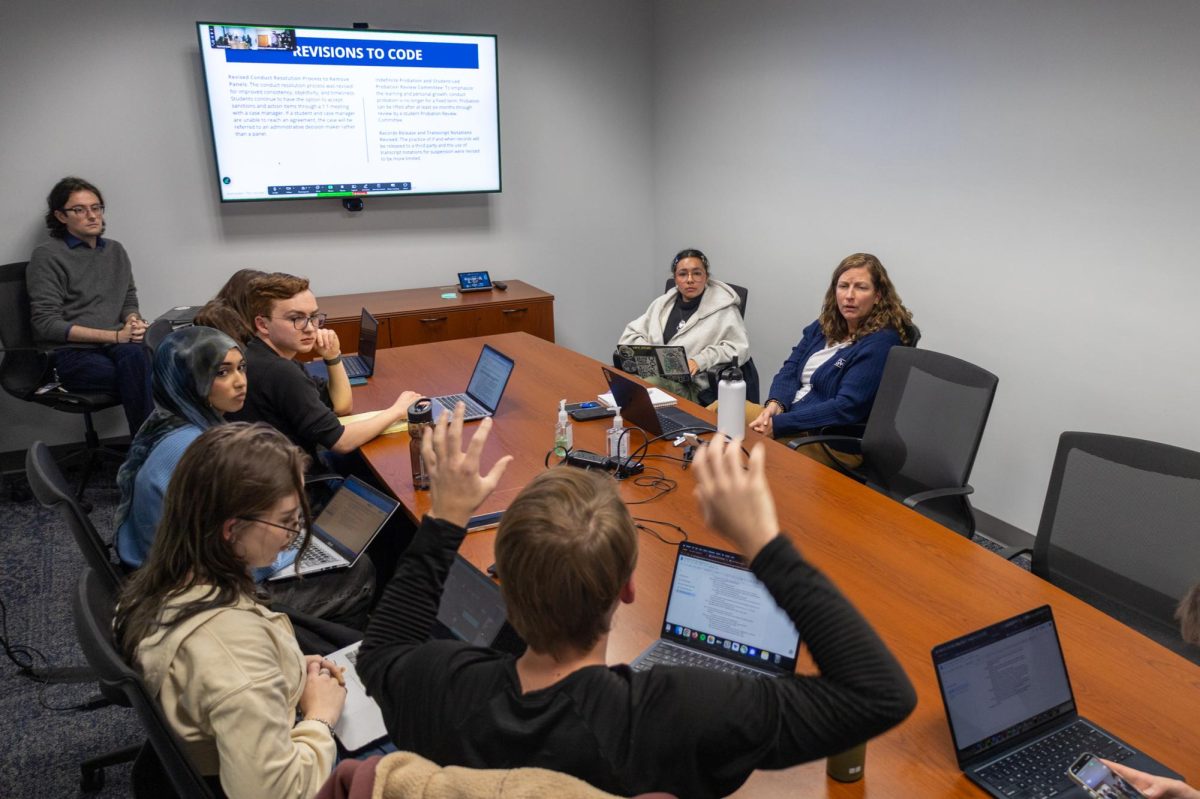
Officials released the draft code last week, providing the opportunity for students and community members to weigh in on proposed changes, which include the removal of student conduct panels in the conduct review process, the addition of new prohibited conduct and the ability for officials to hold students accountable for the conduct of an unregistered student organization. Deputy Dean of Students Rachael Stark said at a community forum Tuesday that officials initiated the review of the code in the spring after receiving community feedback showing a “renewed interest” in the code and its applications in light of recently shifting University policies that impacted the “content or application” of the code’s standards, though she didn’t specify further on what policies shifts sparked community interest.
“The exciting part about this code review is that we didn’t do an editing, copying and pasting, switching out a word here and there,” Stark said. “Instead, we did a wholesale rewrite of the code.”
Officials last underwent a revision process for the code during the 2018-2019 academic year, when then-new Director of Conflict Education and Student Accountability Christy Anthony realized the code had not been updated since 1996. The Board of Trustees in 2019 approved the new code before it went into effect, but Stark said it was unclear whether or not the Board would be voting on the new code at their spring meeting.
Stark said in an email DSA officials solicited feedback from the community in the spring, before meeting with stakeholders representing students, faculty and staff as they rewrote the code.
She said the revision process is being guided by four main principles, including informing and educating the University community about conduct expectations, using clear and easy-to-understand language, encouraging learning and accountability and reflecting standards of being procedurally sound and community focused.
In the revised code, officials now have the power to hold students accountable for conduct from an organization that is not registered with the University but has members who are GW students.
“Unregistered groups do not have an agreement with the University and therefore individual students continue to be held accountable for their individual behavior, regardless of affiliation,” Stark said in an email.
The move comes as student organizations like Students for Justice in Palestine and the Anti-Zionist Jewish Student Front — formerly known as Jewish Voice for Peace — have disaffiliated from the University following suspensions for disorderly conduct and discriminatory harassment, respectively. Students have also formed unofficial organizations this year after officials over the summer paused the formation of new student groups in order to improve the support structures in place for the current official student organizations.
The code also removes student conduct panels as one of the conduct proceeding processes, an option currently only afforded to students when a proceeding could reasonably result in removal from housing, suspension or expulsion. Stark said officials removed the option to allow the majority of cases to be resolved through a “mutually agreeable” outcome in the student conduct conference, a current resolution pathway between a student and a case manager — typically a University administrator — offered when proceedings will likely not result in removal from housing, suspension or expulsion.
As a result of the April 2024 pro-Palestinian encampment in University Yard, officials used a student conduct panel to hear the cases for all nine student groups charged for their alleged involvement in the encampment.
Stark said the removal of the panels will improve “objectivity and timeliness” of the conduct process and allow for consistent conduct proceedings.
“The new draft aims to better leverage trained professionals with expertise in conduct and community standards to review and investigate reports and develop sanctions and action plans in a non-adversarial, one-on-one setting,” Stark said.
At one of three public forums officials held on the revised code this week, Stark said in lieu of panels, if a student and case manager are unable to reach an agreement in conduct proceedings, the case will be referred to an “administrative decision maker” instead of a panel of students. The revised code specifies that Stark, in her role as associate vice president and deputy dean of students or a designee of her, will be the decision maker.
“It was challenging because we had to bring all these people together to hear a case, so it’s causing a lot of delays,” Stark said at the forum.
The revised code establishes disciplinary probation as an indefinite period, with the option to appeal and end it every six months. Appeals will be heard by a new Student Probation Review Panel, which Stark said will emphasize “student learning and personal growth” and allow students to end their probationary period sooner if they “adequately petition” their case.
She declined to comment on which students would sit on this panel and how they would be appointed.
In the past, when students received probation as a part of their conduct proceedings, it was for a fixed period of time, and students did not have the opportunity to end the probationary period until they completed the original sanctioned time. Students only have the right to appeal a full conduct proceeding decision if they did not reach a student conduct agreement.
Other changes Stark said include adding “harming behavior” as a new form of prohibited conflict, which will address “severe or repeated” acts directed at an individual that causes them “physical or substantial emotional harm.” The new code also makes the Statement of Students Rights and Responsibilities — which lists students’ rights and freedoms at GW students — a part of the current code, a standalone document.
She said discriminatory misconduct will be removed from the code and instead addressed by the new Office of Access of Opportunity, which officials debuted over the summer to helm anti-discriminatory efforts on campus.
Stark said the updated code also includes revised transcript notations, adding that after a student is suspended, and they have completed the obligations of their suspension, the suspension will not be included on their transcript when it is released to third parties, like graduate schools.
As part of the revised code, DSA officials will launch the Code of Student Conduct Advisory Committee, which will “support and evaluate” the implementation of the new code for at least three years, including reviewing data, soliciting feedback and proposing revisions. Stark declined to comment on when the committee will be formed, who will sit on it, how and by whom those members will be selected and the role they will play in writing the final draft.
Luke Clark Moody, a member of the Student Government Association’s Student Advocate’s Office, said students should be “terrified” of the revised code because it removes conduct panels. He said the changes to the code restrict students’ rights and increase administrators’ discretionary power.
“Without panels, administrators will now investigate alleged actions, assign charges based on vague language, and determine sanctions — all without protections against bias or discrimination,” Moody said in a text message.
Ben Wieser, the chief of the SAO, said the revised code’s “vague provisions” expands potentially prohibited conduct. He said the new code also removes mention of conduct amnesty for students who request emergency care for alcohol or drug use, something present in the current code.
“The end result is an amorphous Code of Conduct that leaves students confused and afraid,” Wieser said in a text.
This post was updated to correct the following:
A previous version of this story misspelled Wieser’s name. We regret this error.