
GW expects to operate at or near break-even in fiscal year 2026 after operating expenses exceeded revenue by $75 million in the prior fiscal year, officials told the Faculty Senate Friday.
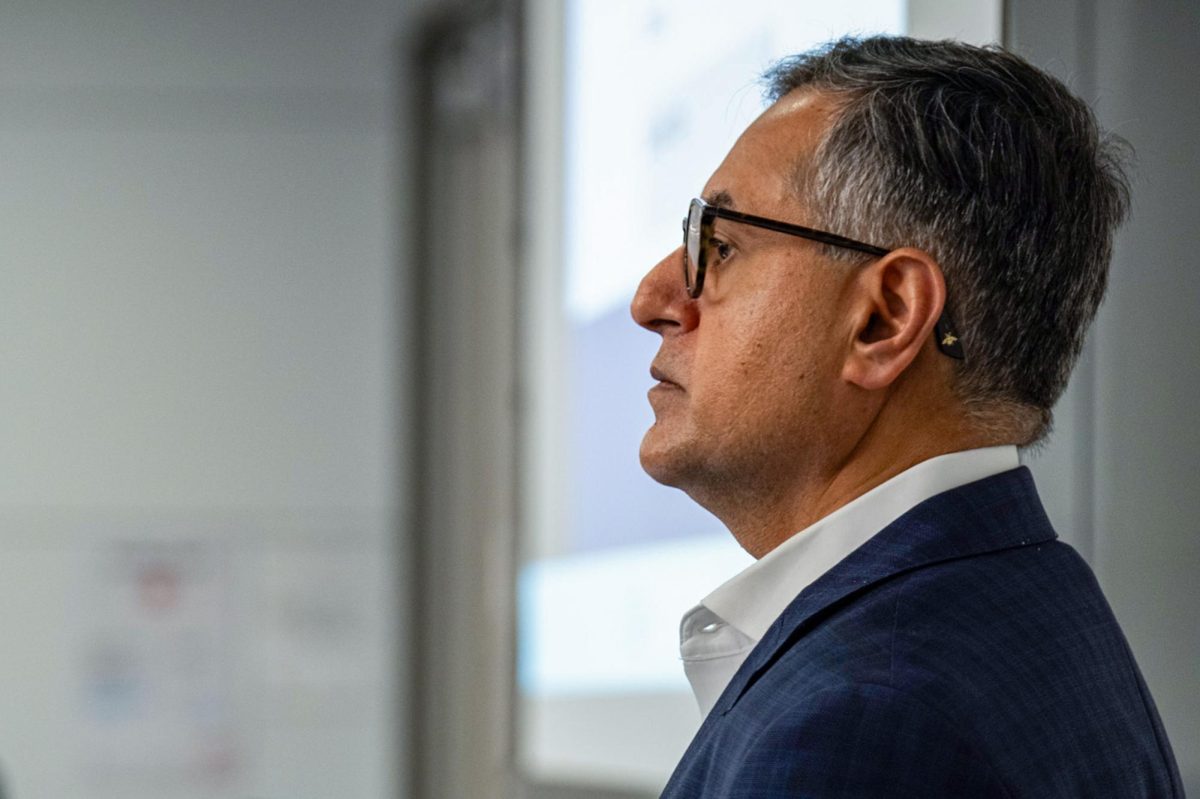
Vice President for Finance and Assistant Treasurer Hemant Bakshi said FY2026 marks an “inflection point” for GW as officials work to reverse the structural deficit and reach a 2 percent operating margin in “the short term,” before stabilizing at 3 percent over a five-year period. Officials shared in the update — the first since GW disclosed its deficit and University-wide budget cuts — that operating expenses climbed 8 percent in FY2025 while revenue rose just 2 percent, coinciding with a temporary $45 million draw from the quasi-endowment and the Medical Faculty Associates halting payments to GW.
Bakshi said officials reworked the FY2026 budget heading into 2025 to address anticipated financial strains from President Donald Trump’s return to power, after initially projecting a 1 percent operating margin, or $14 million surplus, before his election. The new break-even budget, which officials brought to the Board in August, accounts for policy changes affecting international and graduate student enrollment, inflation and a roughly four-point increase in financial aid costs — $25 to $30 million higher than last year.
“While we initially expected that the budget would yield an operating surplus, by the time we worked through all of the machinations and some of the risks that were inherent in what we’ve experienced this year, we came up with a break-even budget,” Bakshi said.
Here’s a rundown of GW’s FY2026 budget projections and FY2025 results:
GW expects minimal $1 million operating gain in FY2026
Officials expect GW to generate $1.333 billion in revenue against $1.332 billion in expenses in FY2026, yielding a slim $1 million operating surplus, according to numbers Bakshi shared with the Faculty Senate. That would put the University’s operating margin at 0.1 percent this fiscal year, following a -1.6 percent margin — or $22 million shortfall — in FY2025, according to the University’s financial highlights website.
GW’s operating margin sat at 1.4 percent in FY2024, 1 percent in FY2023, 2 percent in FY2022 and 0.2 percent in FY2021, per the website.
Bakshi’s presentation shows that officials project compensation and benefits — excluding any merit salary increases, which officials paused at the start of FY2026 — to account for more than half of the University’s expenses, totaling about $757.7 million. He said a 3 percent merit increase would have cost GW roughly $20 million this fiscal year.
The presentation shows officials estimate purchased services, occupancy and other expenses — which officials grouped together in the slides but detailed separately in GW’s consolidated financial statements — will total $375 million in FY2026. Depreciation and amortization are expected to cost $97.5 million, making them the third-largest expense, followed by interest at $92.2 million and a $10 million contingency.
Bakshi said he believes GW is making progress reversing its structural deficit, which officials last reported at $24 million in mid-July, and added that its committed to bringing back merit raises in FY2027. He did not disclose the current deficit, and no faculty senators pressed for the figure.
Officials throughout the beginning of FY2026 made cuts to campus operations, programs and resources, ranging from discontinuing Counseling and Psychological Services’ walk-in hours to laying off 43 staff members and refraining from funding some strategic plan initiatives.
“What we’ve done over the last several months is take a hard look at various different initiatives that we can focus on, quantify and then implement to be able to help us get out of that structural deficit,” Bakshi said. “As we do that, I have confidence that we will be able to turn this around.”
FY2025 operating costs outpaced revenue, net assets rose despite $76 million deficit
University Controller Neena Ali said in an FY2025 financial update that GW’s consolidated operating expenses rose $138 million, or 7 percent, while consolidated operating revenue increased $49 million, or 3 percent.
She said GW’s salary and benefits costs rose by about $52.8 million, or 7 percent, from FY2024, largely due to an average 4.5 percent merit increase for faculty and staff. She said officials attribute $32 million of the $52.8 million rise to the merit pay boost, adding that GW incurred an additional $10 million in expenses under salary and benefits after the University dropped its ‘use-it-or-lose-it’ paid time off model at the beginning of FY2024 and implemented a maximum accrual limit policy.
Then-Staff Council President Bridget Schwartz told the body at the beginning of FY2025 that officials had increased the merit pool by 1 percent.
Ali also said officials boosted staffing in the Division of University Advancement, Division of Student Affairs and Athletics Department, which contributed to the compensation cost hike.
Ali’s slideshow shows purchased services expenses also increased in FY2025, growing 14.5 percent — roughly $47 million — which officials attributed to “expanded security measures” and the use of “specialized consultants to address areas of strategic focus.” Officials retained the lobbying firm they used during the spring 2024 pro-Palestinian encampment, paying Pillsbury Winthrop Shaw Pittman $220,000 in FY2025.
GW, also in response to the encampment, installed permanent metal fences around University Yard in FY2025, though they declined numerous requests to share how much the infrastructure cost.
Ali’s slideshow attributes the boost in operating revenue to an increase in both undergraduate and graduate tuition and fees, a higher endowment payout and medical education agreements due to the new Cedar Hill Regional Medical Center GW Health, which opened in early April.
She said officials borrowed $45 million from the quasi-endowment, which they have since paid back. According to GW’s consolidated financial statements, officials tapped into the quasi-endowment — a pool of funds that aren’t legally restricted by donors, which had 1.79 million in net total assets in FY2025 — to “provide liquidity,” and paid it back on Aug. 15. Officials did not draw from the quasi-endowment in FY2024, FY2023, FY2022 or FY2021.
GW’s accounts receivable balance rose to $176 million in FY2025 from $148 million in FY2024, which Ali attributed to the MFA halting its monthly payments, including rent to the GW-owned building and shared parking spaces, after December 2024. The University’s regular receivable from the MFA rose $18 million in FY2025, and the receivable from Universal Health Services, GW Hospital’s owner and operator, rose $12 million.
University President Ellen Granberg in September 2024 said the MFA had continued to make its payments on time even as the medical enterprise lost tens of millions of dollars annually. Ali cited the MFA’s “financial difficulties” as reason for it stopping payments.
GW loaned the MFA $99 million in FY2025, which Ali said brought the total the medical enterprise had borrowed from the University to $371 million at the end of the fiscal year. The MFA, which sat $444 million in debt to GW and other lenders at the end of FY2025, has operated in a deficit for the last six fiscal years, and officials are in negotiations with UHS to cut the University’s financial ties to the medical enterprise.
“Since we started consolidating, they have lost $444 million, which means all the money that we’ve given them has gone to fund their operation,” Ali said.
GW’s consolidated statements of activities and cash flows began including the MFA’s figures in FY2020. GW brought the MFA under its governance in December 2018, which gave the University control over its budget and leadership.
Consolidated statements of GW’s cash flows show change in net assets rose $41 million in FY2025, up from -$132 million the year prior. But net cash used in operating activities sat at -$117 million at the end of FY2025, significantly larger than the -$15 million in FY2024, reflecting weaker cash flow from operations despite investment gains.
Ali said the cash flows figures are consolidated with the MFA’s, and cash used in operations for GW only would sit at -$30 million, meaning the University’s core operations are still cash-negative but significantly less than the consolidated figure.
Ali’s presentation shows GW’s debt increased in FY2025 in part because of officials’ move to draw $168 million from its line of credit with PNC Bank to meet “liquidity needs.” She said GW’s net assets — not factoring in the MFA’s finances — rose $141 million in FY2025, from about $2.7 billion at the end of FY2024, to $2.84 billion.
That rise comes after GW’s net assets decreased by roughly $25 million in FY2024, and shows GW strengthened their balance sheet last fiscal year, even as operating costs rose significantly faster than revenues.
“Our net assets, which is a very important number, increased to $2.8 billion,” Ali said. “So when Bruno says our financial statements or our balance sheet is strong, the higher this number is, the better it is.”
Ali said GW’s endowment payout increased by roughly $10 million in FY2025, which brought in $120 million — up from $110 million in FY2024. $81.7 million of that payout was unrestricted, while $38.5 was restricted, according to GW’s consolidated financial statements.
Ali said GW ended FY2025 with a $76 million operating deficit, noting “it’s been a very, very rough year,” but the University’s strong investment portfolio supported a $41 million increase in net assets. GW’s net assets sat at around $2.4 million in FY2025 compared to $2.35 million in FY2024, according to the consolidated financial statements.
Officials reported that total assets climbed $323 million — a 6 percent jump from FY2024 — and investments rose $181 million, with consolidated total assets sitting at $5.3 billion — a $223 million, or 4 percent, increase from last fiscal year.
Ali said GW incurred substantial one-time costs tied to UHS and MFA legal affairs, student protests, security costs, the arming of some GW Police Department officers and consulting expenses as GW builds a new budget model. She added that some of these expenses are continuing into FY2026.
She said GW’s renovation of Mitchell Hall led officials to review the residence hall’s assets and determine what they could reuse in the remodel, resulting in $4 million in asset write-offs.