
The Board of Trustees will hold its March meeting entirely behind closed doors, departing from its longstanding practice of keeping portions of its three mandated meetings open to the public.
Trustees last met publicly on Oct. 17, and while the website lists May 15 as the next scheduled session — the second of three required annually under the bylaws — University spokesperson Shannon McClendon said the Board will satisfy the mandate by convening privately in March. The departure from traditional disclosure and partial open access comes on the heels of operational changes the University’s top governing body made over the last year without public notice, including a bylaw update that permitted trustees to extend Board Chair Grace Speights’ tenure and a decision to separate the governing body from the Medical Faculty Associates’ board, which prompted a trustee to resign.
Web archives from August show the Board initially planned a meeting and retreat from March 18 to 21, 2026. McClendon said the March session, which will coincide with the annual retreat, no longer appears on the calendar because there will be no public portion — marking the first time since at least 2014 that the Board has omitted one of its three regular meetings from online records, according to available web archives.
The Board’s bylaws, last revised March 24, 2025, require trustees to hold an annual meeting each May and at least two additional regular meetings, with retreats optional at the chair’s discretion. The bylaws do not mandate that the meetings be partially public or disclosed on the governing body’s calendar, but web archives over the last decade show the Board has routinely listed at least three meetings, including any retreats, online.
The Board’s secretary or an officer must send trustees notice of annual and regular meetings at least 10 days in advance, according to the bylaws. The bylaws do not mandate that the Board notify the public of its meetings, but the body has done so for at least its three mandated meetings over the last decade, according to web archives.
As the University’s top governing body, the Board directs major fiscal, academic and operational decisions. Trustees set long-term strategy, approve the budget and strategic plan and have made consequential moves in recent years, from arming select GW Police Department officers to selecting University President Ellen Granberg and retiring the Colonials moniker.
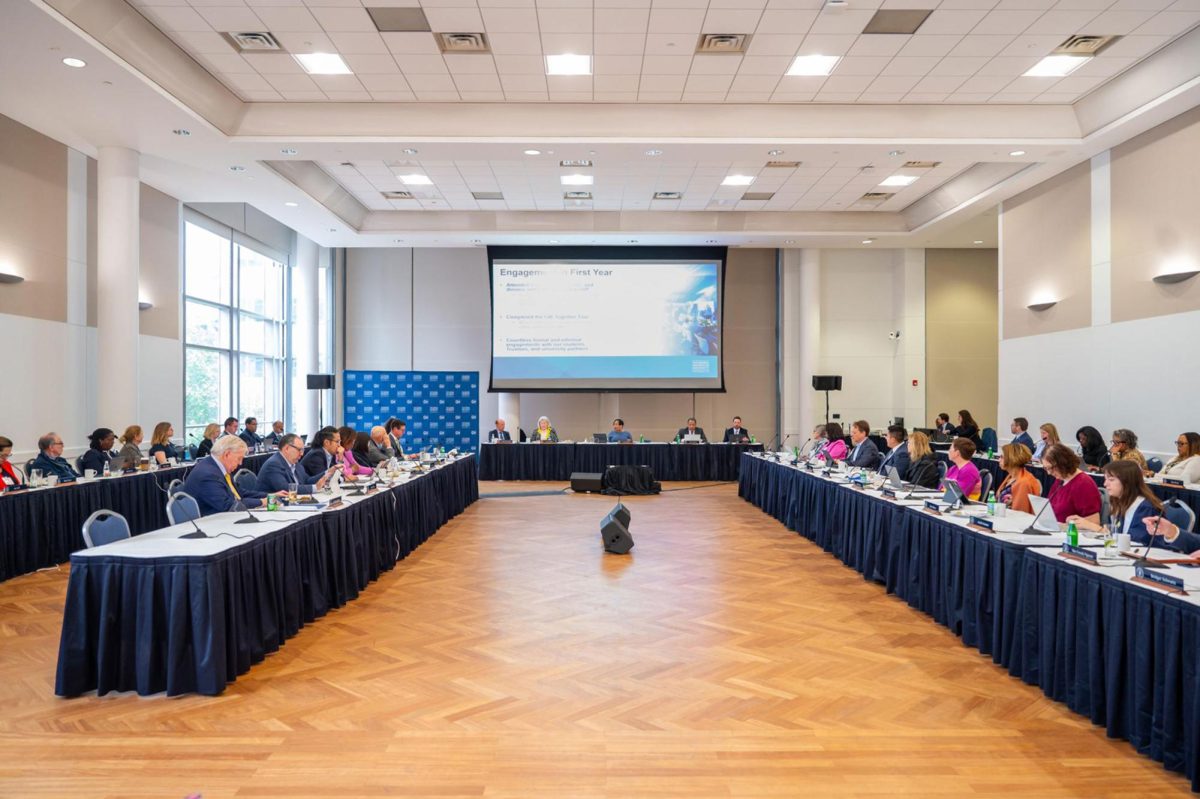
The Board in recent years has convened for regular meetings in the University Student Center, with virtual registration for the public portion open to community members. In a typical year, the Board’s public sessions at each meeting offer an endowment update and insight into top leaders’ perspectives on University-wide developments.
Dating back to 2014, the Board publicly listed a broader slate of gatherings beyond its regular meetings and retreats, including committee sessions and trustee orientations. In May 2018, for example, web archives show the Board had posted 24 events between February 2018 and October 2020, spanning meetings, retreats, committees and orientations.
During the open portion of meetings, the chair typically reviews the consent agenda, followed by reports from the University president, the Faculty Senate Executive Committee chair, a representative from the Alumni Council, the Student Government Association president and the Staff Council president, according to past meeting notes.
The public portion of the meeting then traditionally proceeds through a series of committee reports, including the Executive, Finance and Investments, Academic Affairs, Governance and Nominations, Audit and Compliance, External Relations and Engagement and Real Estate, Campus Planning and Facilities committees. The chair then typically adjourns the public session, after which the Board enters executive session, which is closed to the public.
Public access to Board meetings expanded in September 2017, when then-Chair Nelson Carbonell moved committee reports into the public session, citing the move as a step toward greater transparency with students, faculty and staff.
The Hatchet directed questions to Speights on the Board’s 2025-26 meetings and her tenure, but she did not respond to the request for comment. Instead, a University spokesperson said GW cannot “speculate on hypothetical Board action regarding potential leadership extensions.”
GW announced in March that trustees voted to extend Speights’ term to May 2026, though they omitted in the release that the governing body had amended its bylaws to permit the move, as Board officers were previously capped at six years. The current bylaws allow trustees to extend an officer’s term by one year with a two-thirds majority vote, with such “extraordinary extensions” limited to a total of two years per person.
The spokesperson said GW faced “extraordinary circumstances” since 2020 that prompted the Board to extend Speights’ tenure, citing financial pressures affecting higher education broadly and unsustainable losses at the MFA — which sits $444 million in debt to GW and other lenders — along with disruptions from the COVID-19 pandemic and leadership transitions.
The spokesperson said if the Board opts to extend Speights’ tenure for another year — which would mark her eighth year at the helm — trustees will communicate the decision to the community.
Over the last decade, the Board has reshaped its composition, reducing its trustees from 43 in 2013 to 21 by 2018 in a stated effort to boost productivity and improve communication among members. The Board currently comprises three officers and 19 trustees, including Granberg, who serves ex officio.
Former Trustee Pam Lawrence resigned in February with less than four months remaining in her term, following a decision by the boards of GW and the MFA — on which she also served — to separate. The MFA does not publicly list its board membership, but the organization’s Form 990 tax filings show GW appointed Lawrence to the body in FY2019.
Officials did not announce the move publicly, revealing it only when asked by The Hatchet about Lawrence’s apparent premature departure earlier this month. The resignation came months before the University announced it reached a preliminary agreement with Universal Health Services, GW Hospital’s owner and operator, to co-fund the MFA as the parties negotiate ending the University’s financial support of the debt-ridden medical enterprise.