

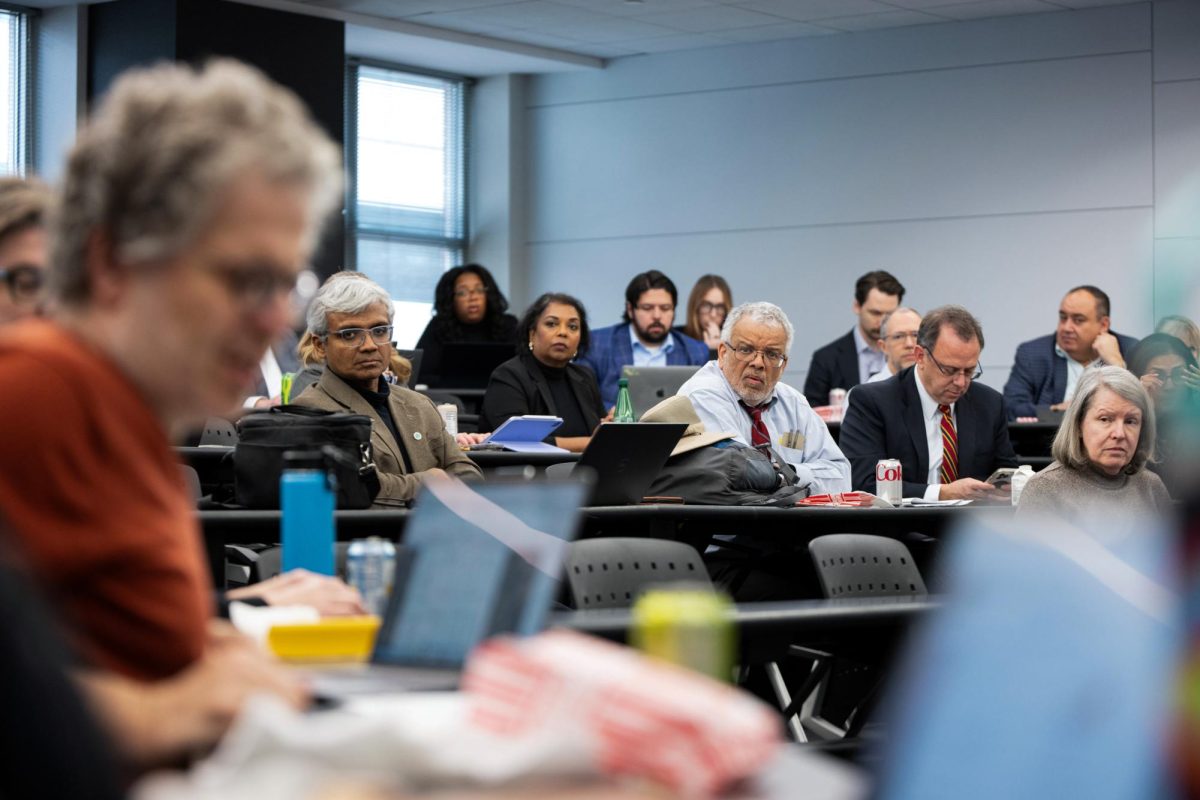
The Faculty Senate unanimously elected a new Executive Committee chair Friday, after the former chair resigned last month at the request of several committee members.
The Faculty Senate elected Guillermo Orti to serve as FSEC chair for the remainder of the academic year after former Chair and Columbian College of Arts & Sciences Representative Katrin Schultheiss resigned last month at the request of six committee representatives. The Faculty Senate also unanimously elected Orti as the CCAS representative to the FSEC, along with Tarek El-Ghazawi as the School of Engineering & Applied Sciences representative and David Mendelowitz as the School of Medicine & Health Sciences representative — a move that followed the disappearance of the previous SEAS and SMHS representatives from the senate’s website after last month’s meeting.
A heated debate at last month’s meeting over the FSEC’s request that Schultheiss step down as chair revealed that six of nine committee representatives asked her to resign instead of proceeding with an alleged threat to hold a vote of no confidence. The three FSEC members who opposed calls for Schultheiss’ resignation criticized the other members’ request and prompted faculty senator Jamie Cohen-Cole to draft a resolution to remove all FSEC members from their positions, though the motion never reached a vote after the meeting lost quorum.
FSEC ahead of Friday’s meeting temporarily elected Orti — who seconded Cohen-Cole’s resolution to undo FSEC, saying he sensed confidence in the committee had diminished — and Amita Vyas, one of the six who called on Schultheiss to resign, as co-chairs of the committee before the senate reconvened Friday to hold a formal vote.
“On a personal note, I believe that following a series of unfortunate events, FSEC is ready to move forward and to commit to a collaboration to conduct important business expected from us by this senate,” Orti said in his first report as chair.
Student Government Association President Ethan Lynne and Staff Council Vice President Mindy Galván attended the in-person meeting, saying in a joint statement that they plan to be as “engaged as possible” with the senate as the parties work to strengthen shared governance.
Several faculty senators also raised concerns about GW’s commitment to freedom of expression after officials confirmed in September that a staff member who called Charlie Kirk’s assassination “fair” in a personal social media post is no longer employed by GW, calling on officials to reexamine their policies and make the community aware of the guidelines they should follow. Faculty senators denounced Anthony Pohorilak’s apparent firing as inconsistent with the University’s commitment to freedom of expression, but Granberg declined to confirm whether officials dismissed Pohorilak, saying she could not comment on personnel issues.
Officials in September confirmed Pohorilak was no longer employed by GW due to the impact his social media post had on his ability to fulfill his professional responsibilities and that he was not authorized to speak on behalf of the University.
Pohorilak’s departure from the University came as faculty and staff across the country faced termination or suspension over comments they made online about Kirk’s assassination. Several universities’ top officials, including their presidents, issued public statements about their employees’ conduct online, but Granberg did not publicly release a statement.
Faculty senator Phil Wirtz said he worries faculty and staff are increasingly feeling like they can’t express themselves freely in public, pointing directly to Pohorilak’s departure.
“I just want to express my own concern when I start hearing about people being fired through expressing their opinions here and people being afraid to reveal the members of committees,” Wirtz said. “That’s just not the GW I know or I want to be part of.”
In response, Granberg called faculty and staff’s fear of speaking their minds a “very important topic” and noted that it is an issue affecting higher education more broadly. She said the topic warrants a more in-depth conversation and added that the Faculty Senate and University officials could have a joint discussion to address questions surrounding the issue.
“Certainly I, and I am certain John agrees, want an environment that is characterized by free expression and academic freedom and the way in which those things are connected,” Granberg said. “But I would be a fool if I didn’t realize that there are elements happening in our country that is causing that to close in a little bit.”
Faculty senator Ilana Feldman said the University should evaluate its rules to ensure employees feel institutionally protected in the current “climate” and are “robust enough” to guarantee employees are protected in the case of pubic pressure on Granberg, Interim Provost John Lach and the Board of Trustees. She said the procedures shouldn’t allow officials to punish or fire employees for their academic work or freedom of speech.
University spokesperson Julia Garbitt said last month officials are currently reviewing GW’s social media policy as part of GW’s regular policy review process. She said the review process — which the Office of Communications and Marketing began in August and is expected to be completed by the end of the semester — will determine whether officials need to revise the policy.
Faculty Senator Arthur Wilson said he was “embarrassed” to hear that a GW employee no longer worked at the University following his comments about Kirk, calling the staff member’s comment “innocuous” and a national overreaction. He suggested officials consider rehiring Pohorilak as part of the University’s commitment to free speech.
Lach said he’s looking forward to his planned meeting with the Faculty Senate Committee on Professional Ethics & Academic Freedom — a group of 37 faculty and staff charged with overseeing administrative and faculty policies — Tuesday to discuss faculty members’ academic freedom. He added that he expects the group to discuss the University’s new Office of Access and Opportunity’s processes that officials are setting up in relation to academic freedom.
“The discussion with PEAF will also include examining the role of academic freedom within the context of allegations and investigations of discrimination, bias, and harassment, as GW must keep our campus free from such behaviors without having a chilling effect on academic freedom,” University spokesperson Shannon McClendon said in an email about Lach’s upcoming meeting with PEAF.
Lach said in his report the Federal Matters Working Group officials created this semester met for the first time on Oct. 31, where they are working under privilege with the provost and general counsel’s offices to provide recommendations to University leadership on how they should respond to potential discussions with the federal government. Lach said the group has at least two more meetings scheduled, adding that the faculty on the group decided officials should not disclose their identities to reduce potential instances of doxing, pressure or intimidation.
Faculty senator Jennifer Brinkerhoff asked Granberg what faculty can expect the University to do to protect their academic freedom when representing GW in their areas of expertise.
Granberg said in recent years, some faculty members’ statements within their areas of expertise have provoked “strong public reaction,” and the University has provided resources to help community members “clean up” their social media presence. She said the University subscribed to DeleteMe, a service that helps users remove their personal information from data broker websites, specifically in response to “everything” that was happening in Israel and Gaza when faculty and students were attacked on social media.
Laura Engel, a professor of international education and international affairs, also said 18 contract faculty received notices of termination earlier in the year. Lach confirmed Engel was referring to “some” of the termination notices officials sent to contract faculty at the Graduate School of Education and Human Development.
A University spokesperson said officials sent 15 letters to contract faculty, with nine stating their contract was not renewed and three “special service” termination letters. They said all faculty remain employed by the University until the end of the academic year.
In June, officials sent out notices of possible termination to 25 percent of GSEHD’s contract faculty members, citing declining enrollment in higher education degree programs. In September, officials laid off 43 staff members, citing budget strains and a yearslong structural deficit.
Lach said he has been working with Interim GSEHD Dean Lionel Howard over the past few months to determine the right path forward for GSEHD.
“When it comes to the number of faculty that we should have in GSEHD in order to have it be a strong school is part of what we’re exploring right now,” Lach said.
Granberg said in her report officials, including GW Police Department Chief Victor Brito, have been in “close communication” with the National Guard, adding that officials have been clear about their policies and restrictions on entering the University’s private property. The announcement comes after a University spokesperson declined to comment earlier this month which specific GW officials were involved in the conversations with the guard.
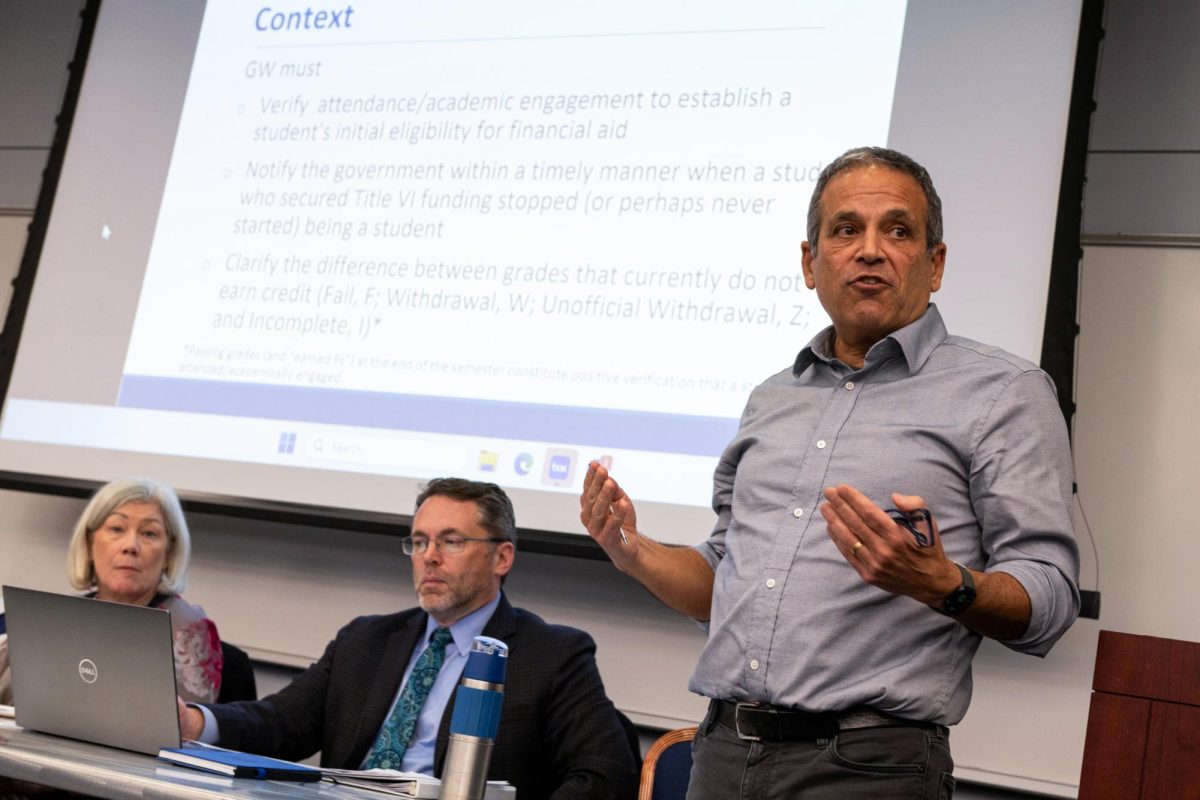
The Faculty Senate unanimously passed Cohen-Cole’s resolution from the Educational Policy and Technology Committee to enforce a University-wide attendance policy that clarifies what grades professors should give students based on their engagement in a class. Cohen-Cole invited Forrest Maltzman, a professor of political science, and Irene Foster, a professor of economics and EPT member, to give a presentation outlining the resolution, which they said would ensure GW would be in line with federal regulations regarding University grading practices.
Maltzman said these regulations are so that the federal government can more accurately determine whether a student is actively receiving an education or not, with those not receiving an education losing their financial aid.
Foster said the goal was to clarify the difference between attendance and engagement through the letter grades F, W, Z and the new designation, NE. She said under the new guidelines, an F is given to students who attempted coursework but earned a failing grade, a W is granted to students who officially withdrew from a course and a Z for students who unofficially withdrew during the semester or showed up during the first few weeks and later “disappeared.”
Foster said the new “never engaged” or NE notation is reserved for students who appear on the roster but never show up to class or complete any coursework.
“So if you’re on the grade sheet, but never, ever showed up in class, never did any of the work in class, this is pretty straightforward, get a ‘never engaged,'” Foster said.
Foster said forms of engagement that differentiate an F from an NE include attendance, completing assignments and turning in tests. She said engagement does not include meetings with an academic adviser.
Foster said faculty who give students I for incomplete, W, Z or NE grades must also alert them that they could potentially lose their federal financial aid. The resolution states that students who receive those letter grades in a class will not receive academic credit for it and if an undergraduate student takes less than a certain threshold of credits a semester — 12 for undergraduates and nine for graduate students — they “may” see a reduction in their financial aid.
Maltzman said the resolution aimed to ensure GW was compliant with federal regulations while also placing as little additional burden as possible on faculty.
“We wanted a system that was compliant with the federal regulations,” Maltzman said. “And so what we need to do is to use, we think, another way, which is actually a way that most, a lot of universities go ahead and do that.”
Paris Albrecht and Sofia Ang contributed reporting.