
Each year, commencement speakers are a highly anticipated figure of the graduation ceremony — imparting final words of wisdom on the graduating class before they make their way into the real world.
Some schools host major celebrities as the annual keynote speaker at commencement ceremonies, like Hillary Duff at Northeastern University this year and Jennifer Coolidge at Washington University in St. Louis in 2024. But GW has stuck to hosting politicians, past presidents and powerful corporate figures alike to stand on the towering stage set against the backdrop of the National Mall.
From GW’s first commencement ceremony on December 15, 1824 with the Marquis de Lafayette and Henry Clay in attendance to President of MS NOW Rebecca Kutler delivering the 2026 address, The Hatchet took a look back at the inspirational figures and messages they left to each year’s graduating students.
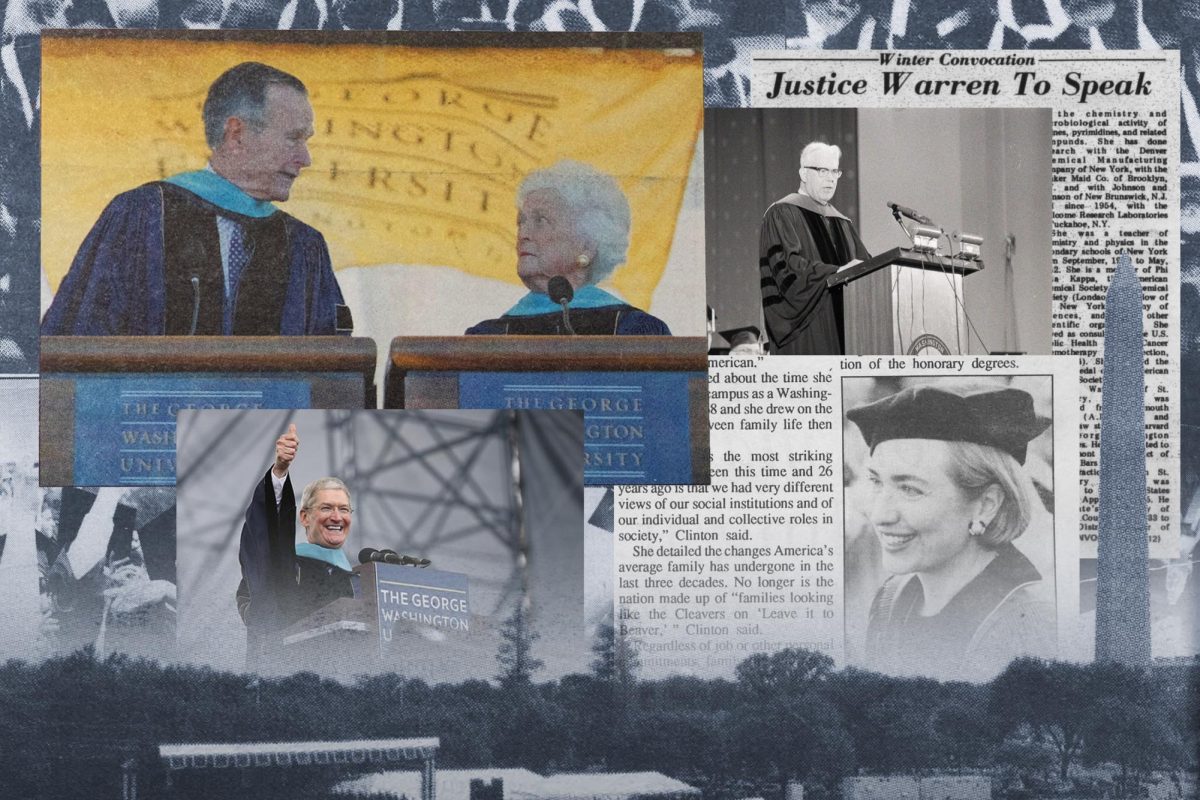
Tim Cook – 2015
Despite a steady flow of product placement during his speech — holding his Apple phone up to take a picture of the graduates from the podium, instructing the audience to silence their cell phones and students in the crowd holding up emoji posters — Tim Cook chronicled his career, spoke of his influences, including Dr. Martin Luther King Jr. and instructed audience members to find a “North Star” of values and commitments in life.
“If you don’t have an iPhone, please pass it to the center aisle,” Cook said in his address. “Apple has a world-class recycling program.”
Cook devoted a portion of his address to recounting his career, highlighting how Steve Jobs’ vision for the future of technology made him transform his own mindset of what the future of the company could be, motivating him to further pursue Jobs’ vision. While the business was “adrift” in the late 1990s, teetering on the brink of bankruptcy, Cook said Jobs asked him to come on board to move the business forward, later going on to assume the CEO position himself in 2011.
“In that first meeting he convinced me if we worked hard and made great products, we too could help change the world,” Cook said. “And to my surprise, I was hooked. I took the job and changed my life. It’s been 17 years and I have never once looked back.”
Cook also discussed the importance of technology in everyday life, from documenting and exposing injustices with a camera, to a phone being a “lifeline” for people with disabilities.
He ended his speech by reminding graduates to not live life on the sidelines but to solve problems themselves, put an end to injustices and to use their energy and passion to take action in whichever direction of their lives they’re headed.
“History rarely yields to one person, but think, and never forget, what happens when it does,” Cook said, “That can be you. That should be you. That must be you.”
Hillary Clinton – 1994
In a letter inviting then First Lady Hillary Clinton to be the commencement speaker in 1994, former University president Stephen Joel Trachtenberg extended the invitation and encouraged Clinton to bring her mother to participate in presenting Clinton with an honorary Doctorate of Public Service — an award typically given to commencement speakers — during the ceremony, as Mother’s Day and commencement fell on the same day.
Clinton answered Trachtenberg’s call and addressed an audience of nearly 4,800 graduates on the Ellipse. She used Mother’s Day as a springboard to discuss family values, as well as her platform as First Lady, with a commitment to delivering “affordable, quality healthcare” to every American.
Clinton also discussed how society’s values had changed across generations, living on GW’s campus as a summer intern herself 26 years prior to the speech, and remarked on how societal views on family life and social institutions have shifted from the idea of a nuclear family to less traditional family models.
“But remember, as you go forth, no matter what a family unit looks like today, the family remains the essential ingredient in shaping our later lives — and you have no greater responsibility ahead of you,” Clinton said.
Chief Justice Earl Warren – 1969
Former United States Supreme Court Chief Justice Earl Warren delivered the University’s 148th winter convocation speech in Constitution Hall, discussing generational changes, comparing his own college experience to that of the class of 1969 and telling graduates they were about to assume jobs that have the potential to change the country. He instructed graduates to keep George Washington’s “spirit” alive through maintaining faith in the pursuit of political freedom.
Warren exuded optimism throughout his speech, saying if America could build cities, develop education systems and become the most “prosperous nation” in the world, it could also wipe out discrimination and prejudice and free waterways from pollution in the United States. Around the same time as Warren’s speech in 1969, industrial and sewage pollution ravaged waterways around the country, causing the Cuyahoga River fire, also affecting Lake Erie.
“I dislike casting the burden on you who are graduating at this time because you did not create the problems, but you are the ones who must either solve them or sit on the sidelines and watch them magnify both to your discomfort and your discredit,” he said.
Warren concluded his speech by telling graduates he feels they will make the United States better through making themselves heard in large numbers and wanting a better country for their children and future generations to come.
George H.W. Bush and Barbara Bush – 2006
Standing behind two podiums, the Bushes received honorary Doctor of Public Service degrees and delivered a joint address to more than 25,000 graduates, faculty, staff and guests, with playful banter between the couple.
George H.W. Bush kicked off the speech by saying that he and Barbara had just used their GWorld cards to get coffees at Java City, a former GW coffee shop, telling Barbara she looked a bit like George Washington herself. The pair cracked jokes throughout the address, receiving roars of laughter from the audience.
They each gave advice from commencement speeches they had delivered in the past, as well as quotes from President Abraham Lincoln about his philosophy to live life to the fullest. Barbara quoted one of her husband’s past commencement speeches from the University of Michigan, discussing how change can be made outside of government walls by ordinary citizens through passion and living out personal principles of common decency and commitment. She also stressed her own passion for the importance of literacy, emphasizing the need for people to be reading more and using technology less, in a time when tech use was surging among Americans, especially with the creation of Twitter in 2006.
“Knowing how to read and write and comprehend is crucial to keeping our young people off the streets, out of jail and in school,” she said.
George concluded the speech by defining a successful life as performing service for others, rather than spending time on material items like video games and expensive cars, and instead investing human ability to better the lives of others.
“If you want to build a better America, now is the time to start,” George said. “Be bold in the way you live. Be bold in the way you think. And most of all, be bold in the way you care for others.”