
“Prepare yourself, America,” reads Hatchet archives from Feb. 9, 1976. “It’s the Bicentennial.”
As America enters its semiquincentennial, or its 250th year, The Hatchet took a look back on the nation’s past celebrations to learn about how GW and the District honored the country 200 years after its founding. From the Freedom Train to special course offerings to endless celebrations, The Hatchet examined the paper’s and the University’s archives to see how the nation honored achievements and advancements through academia, organizations and celebrations.
As the District and the country prepare to celebrate the semiquincentennial this summer, many of the celebrations are living in the legacy of those 50 years ago, from the restoration of the Freedom Train to the Kennedy Center — which hosted multiple bicentennial galas — closing on July 4 for two years following a celebration.
Students form a club to collect the “worst” Bicentennial memorabilia
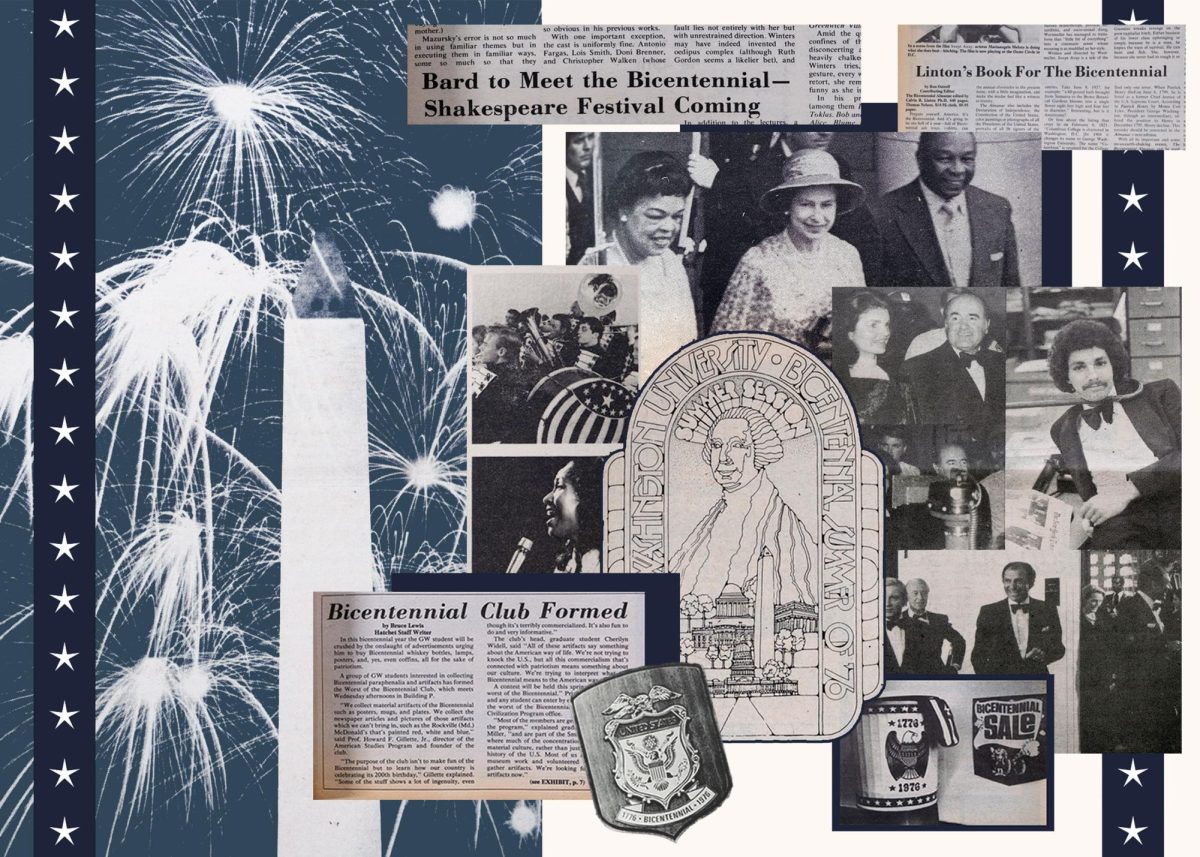
In a year where students were “crushed” by advertisements urging them to buy items ranging from Bicentennial whiskey bottles to coffins for “the sake of patriotism,” a group of GW students banded together to create the “Worst of the Bicentennial Club,” which met each Wednesday in Building P, one of the current American Studies townhouses.
Director of the American Studies program, Professor and founder of the club Howard F. Gillette Jr. said the club collected bicentennial posters, mugs, plates, newspaper articles and took photographs to document items that they couldn’t physically store, like the Rockville, Maryland, McDonald’s that was painted red, white and blue. The club divided materials into four categories, including news items, advertisements, GW artifacts and miscellaneous items, like a star-spangled lollipop and a Betsy Ross doll.
“Some of the stuff shows a lot of ingenuity, even though it’s terribly commercialized,” Gillette said. “It’s also fun to do and very informative.”
Gillette also taught a three-week summer course, titled “Contemporary American Civilization as Seen Through the Bicentennial Celebration,” taking a “deeper and more serious” look into the country’s bicentennial year.
Most of the club’s members were pursuing master’s degrees in American Studies and were part of a Smithsonian program focused on the country’s material culture, to which they’d donate their artifacts upon completion. Cherilyn Widell, the club’s president, said students were not trying to “knock the U.S.” through the club’s mission but instead to understand how commercialism was connected to patriotism. The club also volunteered to donate its “artifacts” to add to the museum’s collection.
“We’re trying to interpret what the Bicentennial means to the American way of life,” Widell said.
Hatchet reporter attends a star-studded Kennedy Center celebration
“The cold cuts were O.K., the booze was fine,” wrote Hatchet reporter Walter Winnick in January 1976 about his experience at the Kennedy Center’s bicentennial celebration.
The Hatchet received an invitation to one of the Kennedy Center’s many bicentennial celebrations that year, and Winnick was cleared to attend after “haggling” with the White House, the Secret Service and the Kennedy Center, with the help of Editor in Chief Mark Toor.
The Kennedy Center’s bicentennial celebration in January also honored Roger Stevens, the founding chairman of the National Council on the Arts, which opened in 1971, and who President John F. Kennedy asked to establish the National Cultural Center in 1961, which President Johnson renamed to be the Kennedy Center for the Performing Arts in 1963.
Winnick wrote that attendees looked in awe when Jackie Kennedy Onassis entered the front door of the Hall of Nations promptly at 6 p.m., with photographers swarming the former first lady. Rose Kennedy, the family’s matriarch, and brother Teddy Kennedy were also in attendance.
Some photographers poked fun at him for being a solid 10 years younger than the rest of the press as he also attempted to photograph attendees like former Secretary of State Henry Kissinger, former Senator Charles Percy, former Senator Mike Mansfield and former Vice President Nelson Rockefeller, Winnick wrote.
Only when President Gerald Ford arrived did the show begin.
Actor Henry Fonda hosted the show that included performances from vocalist Pearl Bailey, violinist Issac Stern and ballet dancer Edward Villella. But, Winnick wrote, it was the star-studded audience who truly stole the show that night.
George Washington painting boards the Freedom Train
William Coblenz, assistant director in the Department of Justice’s Public Information Division had the idea in 1946 that people shouldn’t have to trek all the way to the District to see impressive artifacts and exhibits, and instead, the museums could become mobile and travel to them. An earlier version of the American Freedom Train, containing founding documents and other exhibits about American history, sponsored by the American Heritage Foundation and the Department of Justice, traveled cross country for over 33,000 miles in 1947.
Inspired by the first train, the second Freedom Train came to life for 21 months in 1975 and 1976, in honor of the bicentennial. A 24-car steam-powered train toured 48 states and stopped at 138 cities, giving millions of Americans the chance to see items like George Washington’s copy of the Constitution, Dr. Martin Luther King Jr.’s robes and pulpit, a lunar rover and Judy Garland’s dress from “The Wizard of Oz.”
“This exhibit touches virtually every phase of the American experience,” President Gerald Ford said in a Freedom Train press release obtained from University archives. “I see the Bicentennial of 1976 as a rebirth as well as a birthday — a rediscovery of our strength and of our potential.”
GW contributed to one of the over 500 items spread across the nine exhibition cars, which ranged from an “Innovations Car” to a “Labor and Professions Car” to a “The Beginning Car” containing the country’s founding documents, and the other non-exhibition cars included power generators and security.
The University announced in a press release in April 1975 that a portrait of George Washington, which hung in the Board of Trustees room, would board the Freedom Train. GW acquired the portrait by Rembrandt Peale in 1955 from American art collector Walter P. Chrysler Jr.
Peale painted the portrait before 1850, and as a young man, his father, Charles Willson Peale, painted the earliest known portrait of George Washington at Mount Vernon.
Vice President of the Artifacts Collection at the American Freedom Train Foundation Ruth Packard wrote former University President Lloyd Elliott that the portrait was “strong and fine” and that they wanted to display the painting in car nine with the fine-arts gallery. Packard assured Elliott that the Foundation would assume shipping and packing costs as well as “wall-to-wall” insurance coverage.
The foundation was also in contact with GW arts professor, Donald Kline, to work out the loan agreement. Elliott responded to Packard that he was “delighted to cooperate” with the Foundation to get the painting on board.
Columbian College of Arts & Sciences Dean traces 200 years of America in book
In his 1976 book, “The Bicentennial Almanac,” Dean of the Columbian College of Arts & Sciences Calvin D. Linton chronicled each year of American history dating back to its founding, including events from an Indonesian flower blooming in the Bronx Botanical Gardens to sneaking in a few facts about the very campus where he worked.
In a Hatchet review of the book published in February 1976, Contributing Editor Rob Ostroff said the book had a short summary of each year with a chronological listing of all the significant events that occurred that year.
Ostroff described the book as a “running diary” in The Hatchet’s article as Linton recorded the items in the present tense — allowing the readers to use their imagination to make themselves “feel like a witness to history.”
Facts and details listed in the book ranged from “the trivial to the significant,” including sports records, the Declaration of Independence, the Constitution, paintings and photographs of every president and portraits of all 56 signers of the Declaration of Independence, as well as the results of every census and national election, the party makeup of each Congress and the results of U.S. Supreme Court cases.