
Updated: April 20, 2026, at 3:10 p.m.
GW’s slate of Asian American and Pacific Islander student organizations aims to strengthen collaboration among the groups throughout the year as they celebrate the annual Asian Pacific Islander Heritage Celebration this April.
Leaders of student organizations like the Asian American Student Association and the Japanese Cultural Association said they appreciate the intent behind the celebration month but want more programming year round, and leaders of groups like the GW Hawai’i Club and the Philippine Cultural Society are calling for greater collaboration among AAPI organizations during the month. Despite APIHC taking place in April rather than the nationally recognized AAPI Heritage Month in May, a shift the University made to allow a full month of programming before summer, all leaders said they hope to see greater collaboration among GW’s AAPI organizations in the coming years.
Cheydon Naleimaile-Evangelista, a sophomore and GW Hawai’i’s chief of staff, said attending APIHC events is a learning experience for students as it allows AAPI student organizations to acknowledge and showcase their diverse roots with other students who may not be aware of the wide-ranging cultural traditions.
“It’s important to come together as a community to really just showcase the diversity and showcase how we are still a vital part of this, of our GW community,” Naleimaile-Evangelista said.
Naleimaile-Evangelista said his fellow executive board members have attended events hosted by other AAPI organizations during this heritage month, including those held by PCS or AASA, to show support for the time and effort each organization put in to host these events. He said GW Hawai’i hosted its annual Lu’au on April 4 and hosted several opportunities for students and members to learn the traditional dance form in classes in the months leading up to the event.
“We really do a lot of collaborations with those sorts of orgs,” Naleimaile-Evangelista said. “Not only to attract a larger audience who may not be from Hawaii but just to show who we are here at GW.”
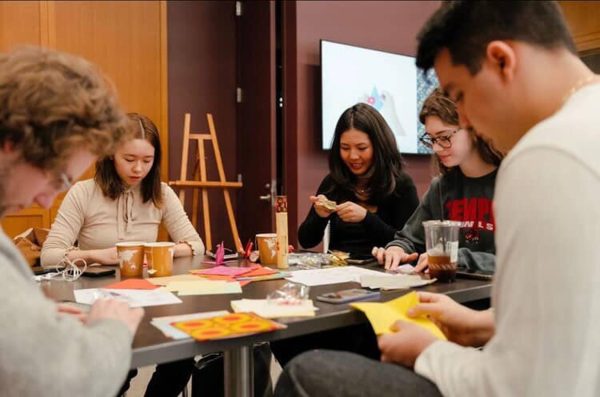
Erika Braun, president of JCA, said JCA has reached out to the MSSC asking them for a place to hang their handcrafted senbazuru — a Japanese tradition of crafting 1,000 origami cranes to symbolize good fortune — which this year they made in collaboration with The George Washington University Museum and The Textile Museum.
Braun said the MSSC was “very open” to hanging the senbazuru for APIHC month, but that the group has not collaborated with the MSSC to offer further collaborative programming. She said that, with further coordination and support from the MSSC, the JCA would be willing to collaborate with other organizations represented in APIHC in the future, after they featured other AAPI organizations, such as the Vietnamese Students Association and AASA, during their events this month.
“It would be great to do something a little bit larger with the other Asian orgs on campus,” Braun said.
MSSC Director Vanice Antrum said in an email the center had reached out earlier in the year to student organizations seeking a point of contact to amplify event marketing and support programming for APIHC 2026 but received no response from those organizations. She said MSSC staff followed up with the same organizations in April and received responses from two student organizations who shared their event information but did not further respond to the opportunity to be featured in GW Today.
Antrum said that the MSSC’s primary role during cultural heritage months is to display decorations in the MSSC’s space in the University Student Center and to feature student leaders in GW Today to announce the month’s events.
“The MSSC remains ready to offer support to a planning committee or AAPI student organization leaders who are interested in working together to plan an impactful month,” Antrum said in an email.
Braun said APIHC presents a “great moment for visibility” for the Asian population on campus, though representation for AAPI students should not be limited to a single month but rather should be celebrated year round with events coordinated by AAPI student organizations and the MSSC taking place throughout the school year.
“I don’t think we bound ourselves by AAPI month,” said Braun. “We’re much more focused on continuously developing community and visibility where we can.”
Charlie Basa, president of the Philippine Cultural Society, said many students this year appear “tapped out” from ongoing political issues affecting Asian and Pacific Islander communities, with limited awareness of topics such as continued anti-Asian sentiment stemming from the COVID-19 pandemic and the deportation of Filipino seafarers from the United States. He said he wants to ensure advocacy for the AAPI community remains at the forefront of students’ attention.
“There are a lot of ongoing issues in our respective communities, both here and abroad, that we really want to uplift and make it aware to the general population,” Basa said. “We think we could all use a little more.”
Karan Raina, the advocacy coordinator for AASA, said AASA has hosted events throughout the semester, like their slime-making event in January at the MSSC, but doesn’t want to participate in APIHC. He said the group has disagreements with the term “AAPI” to begin with, believing it neglects Native Hawaiians and other Pacific Islanders, so they choose not to host events specifically as part of APIHC.
“We like when other people do cultural programming for the event, and if we get to be uplifting that month, that’s great,” Raina said. “But it’s just that we have a problem with the term itself, and so that’s why we don’t necessarily see that month and go, ‘Okay, now let’s do something special.'”
Raina said AASA has not felt any neglect from the MSSC this academic year in promoting their events because the organization holds special events throughout the year, not just in April, explaining the group would rather have ongoing recognition from the University throughout the year instead of being limited to a month.
“As much as it is good to be uplifted for a month and get special attention for a month, we try our best not to make that the only time people pay attention to Asian Americans,” Raina said.
This post was updated to correct the following:
An earlier version of this post incorrectly spelled Vanice Antrum’s name. The Hatchet also incorrectly attributed the celebratory month to the MSSC. It is not the MSSC’s month. A prior version of this post also used incorrect pronouns for Karan Raina and misspelled his last name. We regret these errors.