

In the spring of 1976, GW students voted to give their student government a second chance.
Eighty-four point eight percent of students voted in favor of a University-wide referendum re-establishing a constitution for the student government in April 1976, and on May 24, the Board of Trustees ratified the then-Student Association’s charter — resurrecting a governing body that students voted to abolish just six years prior. This spring marks 50 years since the revival of student government at GW, a milestone as the current Student Government Association continues to grapple with the same foundational questions that prompted its original abolition: how effective student government at GW is and whether students care enough to sustain it.
The road back to the 1976 vote was long and contentious.
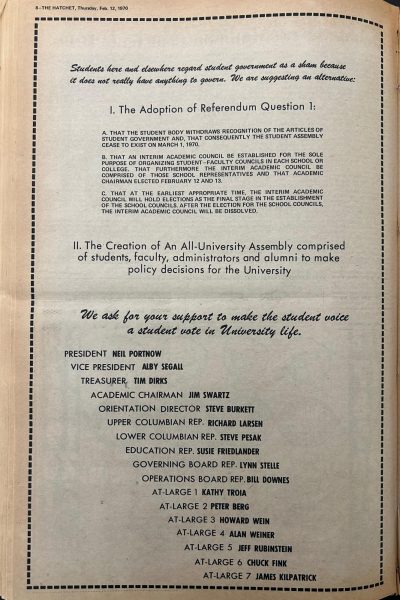
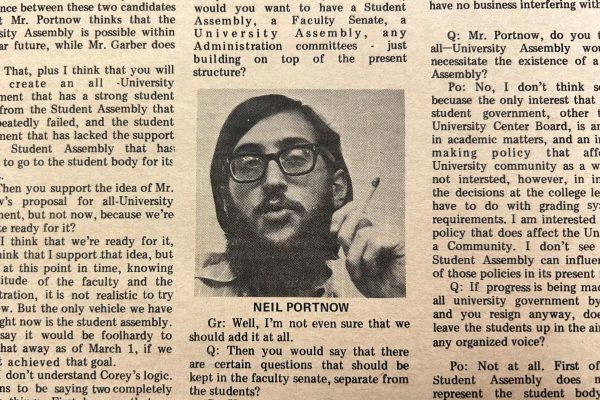
At the height of anti-Vietnam War protests that tore through campus, 69 percent of students voted in a campus-wide referendum in favor of dissolving GW’s student government — the Student Assembly, which was established in 1909. Then-assembly president Neil Portnow ran for re-election, promising to scrap the organization, concluding that student government at GW had been “systematically excluded” from decision-making at the University as students felt overwhelming apathy toward the body.
Portnow and members of the assembly were dissatisfied with the amount of input and influence the student government had, particularly frustrated by what they perceived as an apathetic student body, and felt their role in University governance was not great enough to influence decisions which had been given faculty or administrative priority, such as grading or the charging of tuition and fees. Portnow suggested in late 1969 the next iteration of student government at GW needed a major overhaul so they didn’t have to go through “all the crap we have.”
Assembly Vice President David Berz in 1969 told The Hatchet GW’s student government’s impotence and tension with the administration had reached a boiling point, where student leaders felt secondary to the far more powerful Faculty Senate, whose recommendations officials quickly implemented.
“I’m getting tired of making recommendations and not knowing if they’re going to have any effect on the University,” Berz said.
Today, student leaders express the same frustration with administrators, claiming officials often do not value, or downright ignore, student perspectives. SGA leaders, and especially candidates running for the body’s top posts this year, have called on officials to include students in more substantive discussions about the University’s future, like their decision to sell the Virginia Science and Technology campus without community input.
Student participation in the SGA is also low. This year’s senate elections drew only 20 candidates for 39 available seats, leaving the majority of the chamber to sit vacant. Voter turnout in SGA elections has also been on a decline for the past several years, with only about 10 percent of eligible students voting in last year’s elections.
All five of the candidates running for president and vice president have also pledged to use their time in office to get students more involved in University decision-making.
The numbers paint a picture of the SGA that would have been familiar to Portnow and the disillusioned students of 1970 — a governing body that exists but that most of the campus it represents has tuned out.
Instead of a solely student-run government, Portnow intended to boost students’ advocacy power by replacing the assembly with an “All-University Assembly,” which included students, faculty and staff that would jointly advise decisions across GW. But professors strongly resisted the idea, claiming in Hatchet articles that students would meddle too much in affairs over which only faculty should have influence, like curricula and academics.
“There are certain matters which only the faculty should vote on,” Arthur Kirsch, a statistics professor, said in 1970.
Six professors wrote in a 1974 Hatchet editorial that University governance should not be “one man, one vote,” and faculty should have a far greater say in the University’s future than students.
The assembly Portnow championed never fully materialized. The Board of Trustees nearly unanimously shot down the All-University Assembly proposal in 1974, yielding to faculty’s concerns the new assembly would undermine the role faculty and the Faculty Senate play in the University.
But students were not willing to cede their governing power entirely to the University yet. Following the All-University Assembly’s defeat in 1974, student advocates met that same week in Mitchell Hall to discuss electing delegates for a new constitutional convention with the goal of establishing a new government that centered students over politics and bring back student advocacy to GW.
“We have a definite need for a student government,” then-Mabel Nelson Thurston Hall President Sherry Belkin said, who attended the delegate selection meeting.
Roughly 80 delegates to the constitutional convention held their first meeting on Valentine’s Day 1975, which led to hours of meetings about the structure of the organization. The convention extended its work into the summer, then again into the fall, laboring through the kind of prolonged institution-building that George Washington — whose name the University bears — knew well when he presided over the 1789 constitutional convention that dragged well past anyone’s initial expectations.
Much like the United States’ founders in 1787, members of GW’s 1974 convention created a more deliberately structured three-branch government — an executive cabinet, a senate and a student court — that holds today.
For half a century, the SGA has outlasted controversial presidential administrations and candidacies pledging once again to abolish student government. The body held the Student Association name for 48 years, spanning from 1976 to 2024, before the Board of Trustees unanimously voted to change the Student Association’s name to the Student Government Association in 2024.
SGA leaders cast the rebranding as the start of a “new era,” casting away the SA initialism — a frequent abbreviation used for “sexual assault,” even as others said the renaming did little to resolve the SGA’s ineffective advocacy.
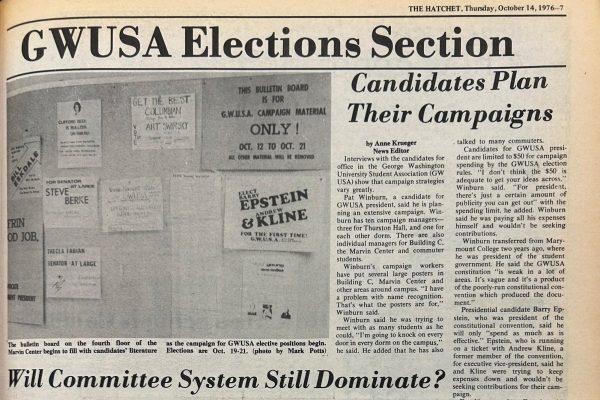
Those tensions are not new. The same frustrations that colored Portnow’s 1970 abolition campaign — that student government at GW was treated as an advisory body at best rather than a body with independent governing power — have echoed through the decades since.
In 2019, a first-year student ran for SGA president on the platform of abolishing the student government, picking up enough votes to force a runoff election. Last year’s SGA elections brought a faux rat to prominence, with the spoof candidate running to show students’ disengagement and indifference to the SGA.
The rat bested several senators as a write-in candidate, earning a total of 105 votes in last year’s elections.
And yet the SGA has also shown, in its 50th year back on campus, that students in the body believe it still matters.
Current SGA President Ethan Lynne, sworn in last spring, pledged to increase student representation in University decisions during his term, describing shared governance as the “only common sense way forward.” In this vein, Lynne has revived joint faculty and student committees and established a council to advise Student Health Center officials.
The students who spent 1974 in constitutional conventions, debating structure and purpose late into the summer believed that the right institution could earn students’ trust back. What they built has lasted half a century. At 50, the SGA’s greatest challenge is the same one it has always faced: convincing students that it exists for them and that their participation is what makes the difference.
Fifty years on, each new SGA is still trying to prove that idea right.