
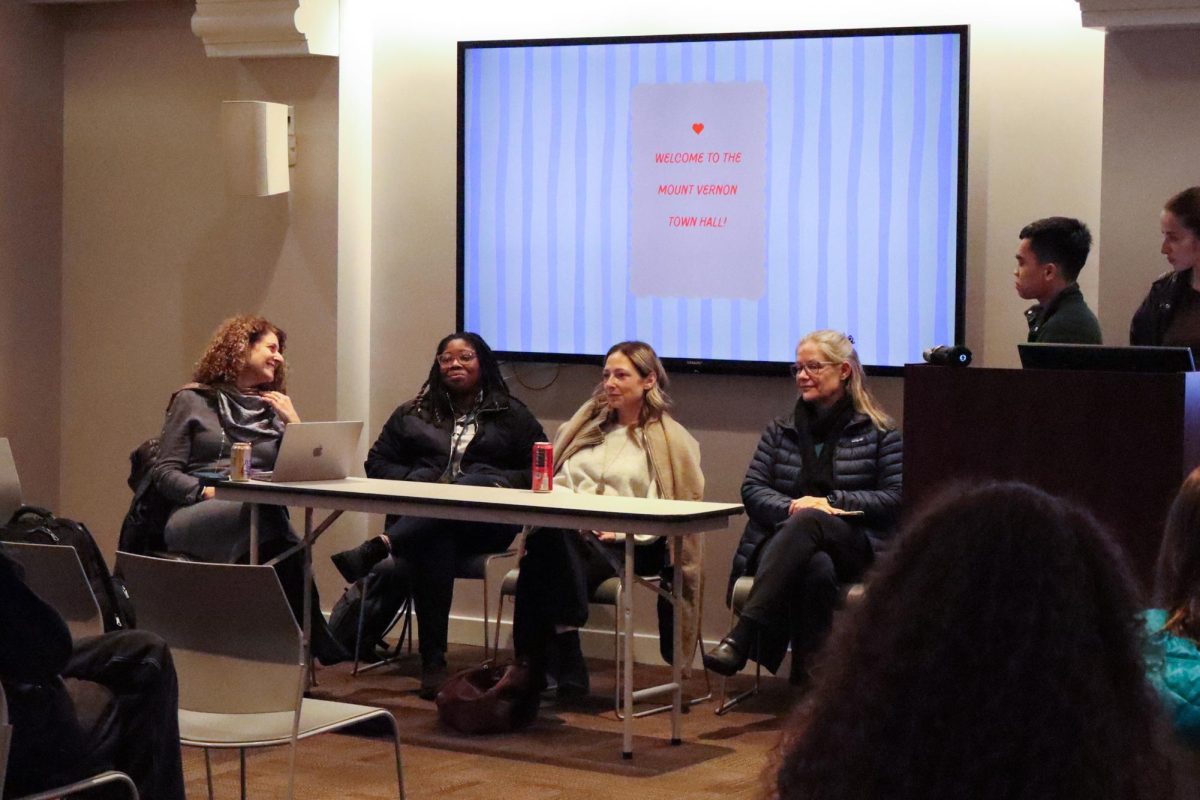
Students questioned student life officials about significant reductions to late-night transportation options to and from the Mount Vernon Campus on Tuesday, raising concerns about safety and access to resources during a town hall hosted by the Student Government Association.
Officials cut Vern residents’ late-night rideshare app credits in half at the start of the year — which Assistant Dean of the Mount Vernon Campus Betsy Shimberg attributed in part to University-wide cuts — with students at the town hall saying the cuts make it harder and less safe to travel between campuses at night. Alongside about a dozen representatives from the SGA, administrators — including Student Health Center Medical Director Rebekka Christie and Counseling and Psychological Services Director Laura Finkelstein — also fielded questions from SGA members and Vern residents about building security issues, the reliability of blue light emergency phones and the limited availability of health and counseling services on the Vern.
SGA Sen. Sofio Kipiani (ESIA-U) asked Shimberg why officials switched from Lyft to Uber, as the University began partnering with the ridesharing company this year — a change she said led to reductions in the hours and quantity of free rides Vern residents could redeem each month to travel back from Foggy Bottom late at night.
During the 2024-25 academic year, Vern residents could use up to 30 free Lyft rides per month between midnight and 7 a.m. to travel between the Foggy Bottom and Mount Vernon campuses, according to web archives. Officials cut the service by 50 percent this year after changing providers, with Vern residents only able to use 15 free Uber rides a month on Fridays, Saturdays and Sundays instead of every day and restricted hours to midnight to 3 a.m., according to the University’s transportation website.
Shimberg said she does not directly oversee transportation, but thinks University-wide budget cuts were at least part of the reason for the sharp reduction in service for Vern residents. She said the other aspect of why officials reduced the program is because they heard feedback from parents who did not want their children using rideshare services frequently with drivers who are unaffiliated with the University.
She said Safe Ride vans, which travel between the Vern and Foggy Bottom at 30-minute intervals starting at 12:15 a.m. and running until 6:45 a.m. when Mount Vernon Express service resumes, have been more dependable this year, which she thinks makes up for the lost service due to the Uber transition.
Officials also cut the frequency of Vex shuttles by half at the beginning of this academic year, reducing shuttle frequency from every five minutes to 10 minutes and cutting the number of vehicles in circulation from nine to seven, providing another dent in transportation options for students living on the Vern.
SGA senators passed a bill authorizing a campus safety and transportation survey at a meeting last week, which criticized officials for “cramming” students into Vex shuttles and creating an unsafe ride between the Vern and Foggy Bottom by making some students stand. After officials made changes to Vex service this year, students reported long lines and delays in their commutes due to the decreased capacity.
Shimberg said safety remains her top priority when thinking about concerns to address on the Vern. She said officials are actively working to address several security issues with buildings on the campus, including doors in West Hall that do not close fully after being opened due to an “airlock,” allowing those without tap access to enter.
She said although the issue has been mostly resolved, officials are ordering new custom doors for West Hall’s entrances, which let air out and ensure they are fully closed and locked, but she doesn’t expect them to be delivered until at least spring 2026.
“We have resolved the airlock issue so that when you open one door, the other door doesn’t stay open,” Shimberg said. “That was a career highlight for me.”
Students also asked officials about reports of the University’s blue light emergency phone system — pillars stationed around campus with buttons that directly call GW Police Department officers to the location — not functioning.
SGA Sen. Justin Liu (CCAS-U), the chair of the SGA’s Committee on Physical Facilities and Urban Affairs, said campus safety officials have told him blue lights see little use, leading to preliminary discussions about removing the pillars, which he said are expensive to maintain, and replacing them with a mobile-only version to rapidly call GWPD like students currently have in the GW Guardian app. Liu said he is advising against officials’ idea to remove blue lights — which he said was not a finalized decision — instead advocating to ensure they’re all functional and better advertised.
Cole Bowie, the SGA executive branch’s deputy director for facilities, said statistics shared with the SGA by facilities officials show that last year the blue light system went off only seven times, and all were false alarms. Bowie said officials have expressed to SGA leadership that the system is expensive to upkeep for how little it is used, but he has encouraged them to keep the physical pillars present on campus to at least maintain the image of security.
“I think that even with the presence of the blue light system, it creates a more safe atmosphere just because they’re there,” Bowie said.
Finkelstein, in response to students’ questions about the possibility of expanding health center and CAPS hours on the Vern — which are currently on Monday only from 10 a.m. to 6 p.m., said the number of Student Health Center appointments utilized on the Vern is “really minimal,” which doesn’t give officials an incentive to expand the hours.
“If we were ever full or had a lot of appointments, we would certainly look at more availability,” Finkelstein said. “It’s just hard now to justify with how few folks are coming in.”
She said CAPS appointments on Foggy Bottom are always “totally booked” and in high demand, so expanding Vern hours to multiple days a week is impractical when counselors could be seeing patients on the busier campus.
Officials ended CAPS walk-in hours on the Foggy Bottom and Mount Vernon Campuses this academic year, a change officials attributed to a new online scheduling system introduced this year despite ongoing University-wide budget cuts.
She said a possible middle-ground officials are looking at is creating a dedicated space on the Vern where students can have private telehealth appointments. The SGA’s mental health assembly in 2024 advocated for officials to provide private telehealth spaces on Foggy Bottom, which opened in the basement of the University Student Center beginning this year.
“It’s kind of always juggling wanting to meet the need but not wanting counselors to be here not doing anything,” Finkelstein said.