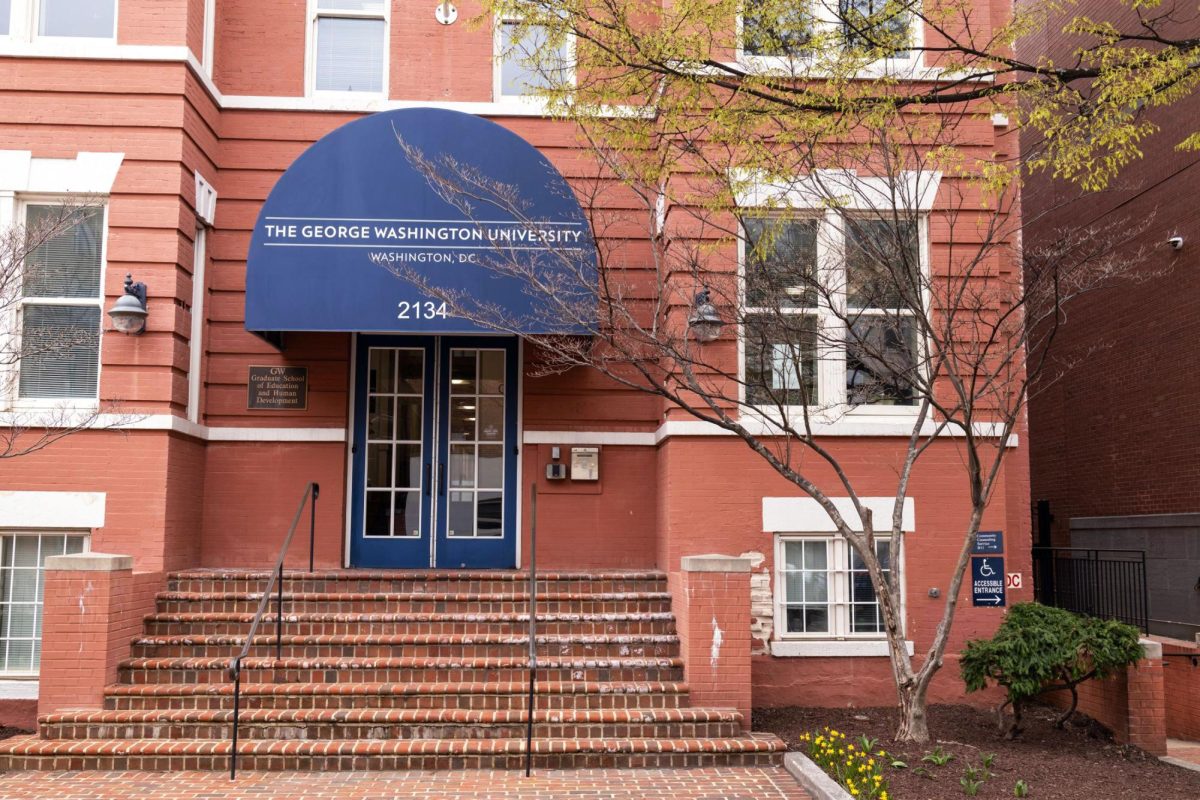


Higher education experts say looming layoffs and curriculum cuts at the Graduate School of Education and Human Development reflect a national decline in interest in education graduate degrees, driven by low wages and shrinking job prospects over the last decade.
Faculty said they learned in private budget meetings with officials that, due to ongoing enrollment declines, GSEHD does not have the funding to retain most of its assistant professors and is considering cutting programs and consolidating classes to stabilize the school. Higher education experts said the enrollment drop over the last 15 years — which promoted officials to begin “right-sizing” the school — may stem from waning interest in teacher preparation programs, federal attacks on higher education and declining wages over the past decade.
University spokesperson Shannon McClendon said the decision to implement organizational changes within GSEHD was driven by declining enrollment, reflecting national trends affecting education schools across the country.
GSEHD’s enrollment dropped 35 percent from 2014 to 2024 — from 1,479 to 958 students. The school’s enrollment declined 29 percent between 2020 and 2024 alone, from 1,341 to 958 students.
The number of master’s degrees in education awarded in the United States dropped 15 percent from 179,047 in 2012 to 151,707 in 2022, according to the National Center for Education Statistics.
“The challenges facing GSEHD are consistent with those at schools of education nationwide, as demand for certain programs shifts and higher education continues to navigate volatility,” McClendon said.
McClendon said the elimination of federal Grad PLUS loans and borrowing caps may pose challenges for some students pursuing graduate education. She added that the University is closely monitoring the impact on all graduate programs and remains committed to supporting students through its financial aid offerings.
The One Big Beautiful Bill Act, which President Donald Trump signed into law on July 4, will terminate the Grad PLUS loan program in July 2026, which currently allows students to borrow up to the cost of their graduate program and limit graduate students’ borrowing to $20,500 a year, with a $100,000 lifelong cap.
GSEHD costs between $1,000 and $1,960 per credit hour, depending on the program and whether students take classes in person or virtually, along with a $300 matriculation fee. GSEHD requires a total of 30 to 75 credits to graduate, depending on the program.
“The university is continuing to evaluate and assess the potential impact of the new law on graduate education across all of our schools and colleges, including GSEHD,” McClendon said.
Jennifer Delaney, a professor of higher education at the University of California, Berkeley, said declining interest in teacher preparation programs — like elementary and special education — over the past decade has contributed to lower graduate enrollment in education programs nationwide.
Teacher training programs, like elementary education and early childhood special education, are some of several programs GSEHD offers, along with programs on counseling and education administration.
During the 2010-11 school year, 600,601 students enrolled in teacher preparation programs nationwide, compared to the 431,087 students enrolled during the 2020-21 school year, according to Education Week.
The largest nationwide decline in teacher preparation enrollment occurred between the 2011-12 and 2012-13 school years, falling from 602,583 to 486,681 students. According to Education Week, this drop was largely driven by the Great Recession, which caused widespread teacher layoffs and made the profession less appealing to prospective students.
In 2011, 33 students graduated from GSEHD’s elementary education program, and 39 graduated from early childhood special education, according to enrollment data. In 2023, those numbers fell to eight in elementary education and seven in early childhood special education.
Delaney said enrollment in teacher preparation programs has remained low, likely due to a recent decline in the K-12 student population, which has resulted in fewer teaching job openings and made the profession less appealing.
From 2008 to 2020, birth rates in the United States declined by around 1 percent annually, meaning around 700,000 fewer children entered the schooling system, leading to smaller class sizes until 2037, according to EY-Parthenon.
“This is not a GW-specific issue,” Delaney said. “It’s really a change in teaching as a profession nationally. And it’s enrollment drops in K-12 education, so there’s less demand for teachers, and then enrollment drops in teacher training programs.”
Sarah Ray, an assistant professor of human and organizational learning, said that although the June email warning certain professors about possible layoffs was just a caution, she learned from committee service that GSEHD currently lacks the funds to retain many of those professors beyond this academic year.
GSEHD Dean Lionel Howard and former Dean Michael Feuer said in an email to faculty in June that some faculty have received notification of “changes to their employment status.” Feuer and Howard wrote in the email that the Office of the Provost intended for the message to be a “warning,” not a “final determination” of the status of their contracts.
During September’s Faculty Senate meeting, Maria Cseh, a professor of human and organizational learning, confirmed that about 25 percent of GSEHD’s faculty received letters, but there is no update on the job status of those who received them.
Ray, who received a potential layoff letter, said she has been searching for other jobs and no longer sees herself as part of the school’s future, as she believes she is likely to be laid off.
“Budgetarily, there does not appear to be a budget to support assistant professors, much less existing full faculty or associate faculty,” Ray said.
Tim Cain, a professor of higher education at the University of Georgia, said that negative perceptions of the education field — such as low wages and mounting political attacks — are likely contributing to the decline in enrollment in graduate education programs.
A 2023 study by the Economic Policy Institute found in 2022 teachers are paid 26.4 percent less than other college-educated professions, compared to 1996, where they were paid only 6.1 percent less.
“If you’re saying it’s not as lucrative and the conditions of work, through budgetary cutbacks, through legislative interventions, through culture war attacks, is not as positive as it was, too that can affect the larger labor market,” Cain said.
Amanda Rutherford, the chair of the O’Neil School of Public and Environmental Affairs at Indiana University — who specializes in personnel management and education policy — said disproportionately high enrollment declines puts pressure on the administration to solve problems quickly because they are getting less revenue through tuition, which can result in layoffs of faculty.
GSEHD was not impacted by University-wide staff layoffs Tuesday, according to Howard, however, officials have said faculty and staff layoffs could be part of the changes in GSEHD.
“For GW, the enrollments are not where they were, say, three, four years ago, and so they are experiencing an enrollment decline,” Rutherford said. “And if the enrollment decline is higher in, say, that unit versus other units, there probably is certainly at least pressure to figure out how to solve the mismatch.”
Interim Provost John Lach said at the September Faculty Senate meeting the University’s new budget model will share more information with faculty about where money is spent and also switch from a year-by-year model to a multi-year plan, a change aimed at stopping scenarios like GSEHD’s “right-sizing” from happening again.
Dwayne Wright, an assistant professor of higher education, said Lach has already taken steps to increase transparency with faculty, and at the GSEHD town hall meeting, he shared data previously not shown to faculty. The data included the percentage of GSEHD’s budget allocated to staff and faculty compensation and the percentage of GSEHD’s income that goes back to GW.
He also said that although transparency has increased, there’s still room for improvement for increased transparency from administration.
“I don’t know if we’re happy with the level of transparency, but it’s better than it was before,” Wright said. “You go from zero to one, it’s better, it’s 100 percent better, but you haven’t got to 100 percent of your grade. One is still bad.”