
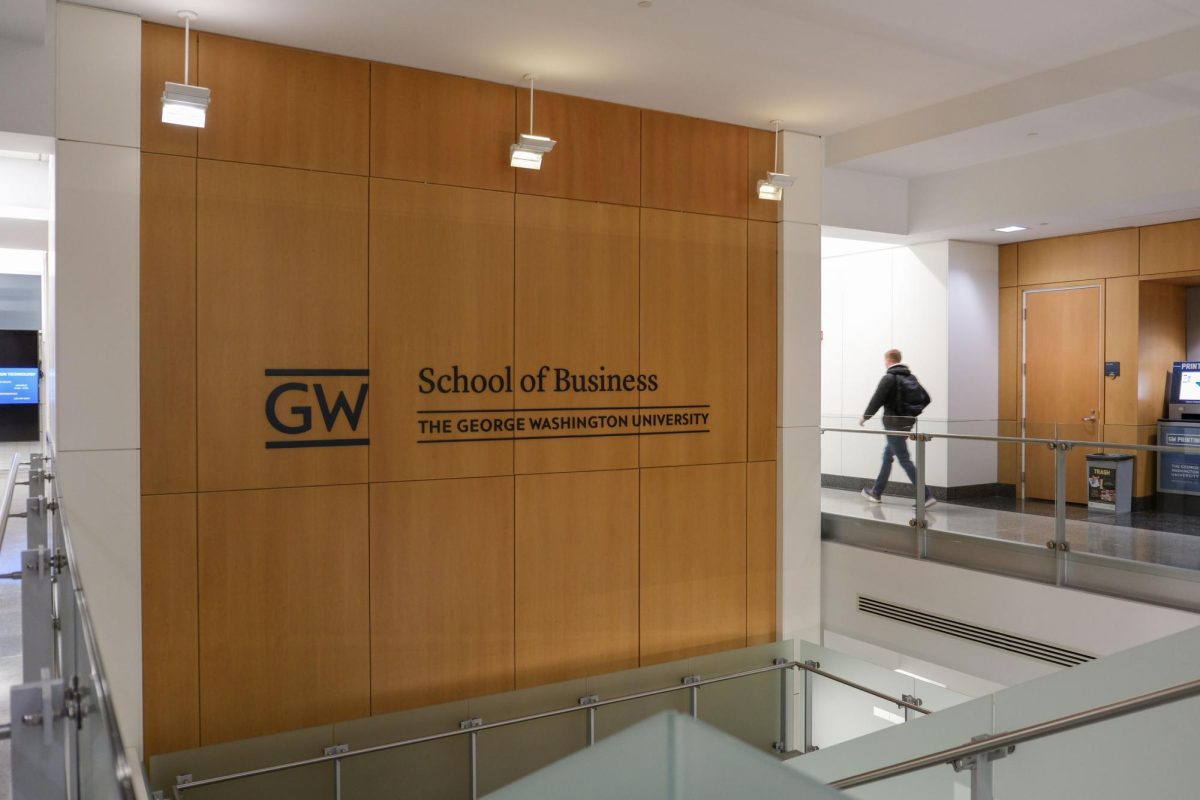
The School of Business will offer a new master’s degree in artificial intelligence for business beginning next academic year.
The 30 credit program is a collaboration across multiple GWSB departments, including information systems and technology management, decision science and strategic management and public policy and is designed to combine the technical foundations of AI with business strategy and responsible AI governance, according to the program’s website. Officials said the program came about amid increased interest in AI-focused courses in recent years and aims to turn students into AI leaders in the workplace.
University spokesperson Claire Sabin said GWSB faculty had already been teaching AI-focused courses over the past few years because of student interest, and officials recognized the growing importance of AI in business causing them to consolidate these course offerings into a “cohesive” degree beginning in fall 2027.
“Broadly speaking, we see this new program as advancing the goal of helping GW better understand what students need to know about AI and teaching the skills they will need to succeed in a world where AI is an everyday part of the workplace,” Sabin said in an email.
Sabin said the program intends to teach students the frameworks and strategic thinking necessary to evaluate, deploy and lead AI initiatives in buisness environments as technology evolves. She said the goal is for graduates of the program to become leaders in their organizations when it comes to these initiatives.
The program consists of 30 credit hours, including a 12-credit core curriculum that features courses like Programing and Coding Agents, Probabilistic and Statistical Foundations for AI, Generative AI with Business Applications and the Ethics of AI in Business. The foundational courses are intend to build an understanding of the technical and ethical components of AI before students select a specialization, according to the program’s website.
The program marks the first AI-related degree program outside of the School of Engineering and Applied Science which currently offers masters’ in artificial intelligence and machine learning and artificial intelligence engeneering and comes months after GWSB appointed its first Chief AI officer in November.
Sunghun Chung, an associate professor of information systems and technology management who worked on the program’s development said students choose one of three tracks at the end of their first semester, including AI Systems and Development, AI-Driven Analytics or AI Across the Enterprise, where they will focus for the 18 remaining credits. He said as AI continues to evolve, faculty members teaching within these tracks will need to keep their curriculum up-to-date in order to provide “state-of-the-art” courses.
Chung said he began developing the degree program in fall 2025 with other faculty members and coordinated stakeholders across GWSB departments prior to receiving final approval for the program’s curriculum in February. He said since the inception of ChatGPT in 2022, universities exist in an “AI-era,” which has caused students to fall behind in understanding how to utilize new technology in business settings, prompting GWSB’s development of the program.
“Instead of purely technical AI training, I wanted to have the goal of this program to be training people who can actually design, deploy and responsibly manage AI inside their organization, not just build the model,” Chung said.
Chung said the program is necessary for the “survival” of the University in the era of AI use. He said the program was developed in-part to keep up with competition from other D.C universities offering AI-focused master’s programs.
American University currently offers a masters degree in business analytics & artificial intelligence and Georgetown University offers an online masters in artificial intelligence management.
“What’s distinctive for us is the business first training, the D.C. policy environment and how cross-disciplinary it is,” Chung said.
Students can also earn a dual degree by combining the master’s in AI for business with GWSB’s master’s of business administration. Select credits count towards both degrees, allowing students to complete 18 fewer credit hours compared to pursuing each degree separately, according to the program’s website.
Chung said students will be paired with corporate and government partners to complete a practicum in their final semester where they will develop a portfolio of work that includes AI prototypes and reproducible workflows. He said no formal partnerships have been established in connection to the degree program, though the World Bank, International Monetary Fund, Amazon and Accenture are examples of organizations that students could potentially work on real-world AI business problems for.
“We already have a lot of relationships within the local and broader D.C. area, private sector or non-private sector or governmental organizations,” Chung said. “Based on our long established relationship with our corporate partners, we can definitely connect our students.”
Sabin said the practicum component of the program will expose students to employers across industries. She said the framework of the capstone will be based on the master’s in business analytics capstone where students participate in a case competition to display their skills to employers.
“It is our belief that this competitive environment provides employers with an invaluable introduction to potential employees,” Sabin said.