
President Donald Trump is implementing a slew of architectural changes and overhauls to D.C.’s buildings, monuments and landmarks, embracing designs that architects said often fail to take into account the city’s storied history.
With projects ranging from a massive sculpture garden along the Potomac River to the painting of the Lincoln Memorial Reflecting Pool to the planned renovations to the Kennedy Center, Foggy Bottom is at the center of many of the Trump administration’s proposed and ongoing changes to D.C.’s landscape. Experts in architecture and historical preservation said some of the president’s initiatives in D.C. are positive, like his effort to repair long-broken fountains around the city, but many of his changes to the District fail to preserve historic architecture, and the administration is undertaking them without providing the proper channels for experts to weigh in, a step they said contributes to the overall success of architectural designs.
The planned closure of the Kennedy Center for a two-year renovation, a proposed 250-foot-tall “Independence Arch,” a plan to develop a “National Garden of American Heroes,” the ongoing painting of the Lincoln Memorial Reflecting Pool and a push to coat the Eisenhower Executive Office Building in white paint, are just several changes in the series of projects, proposals and developments Trump has undertaken in D.C. since returning to office in January 2025 to overhaul D.C.’s architectural scenery.
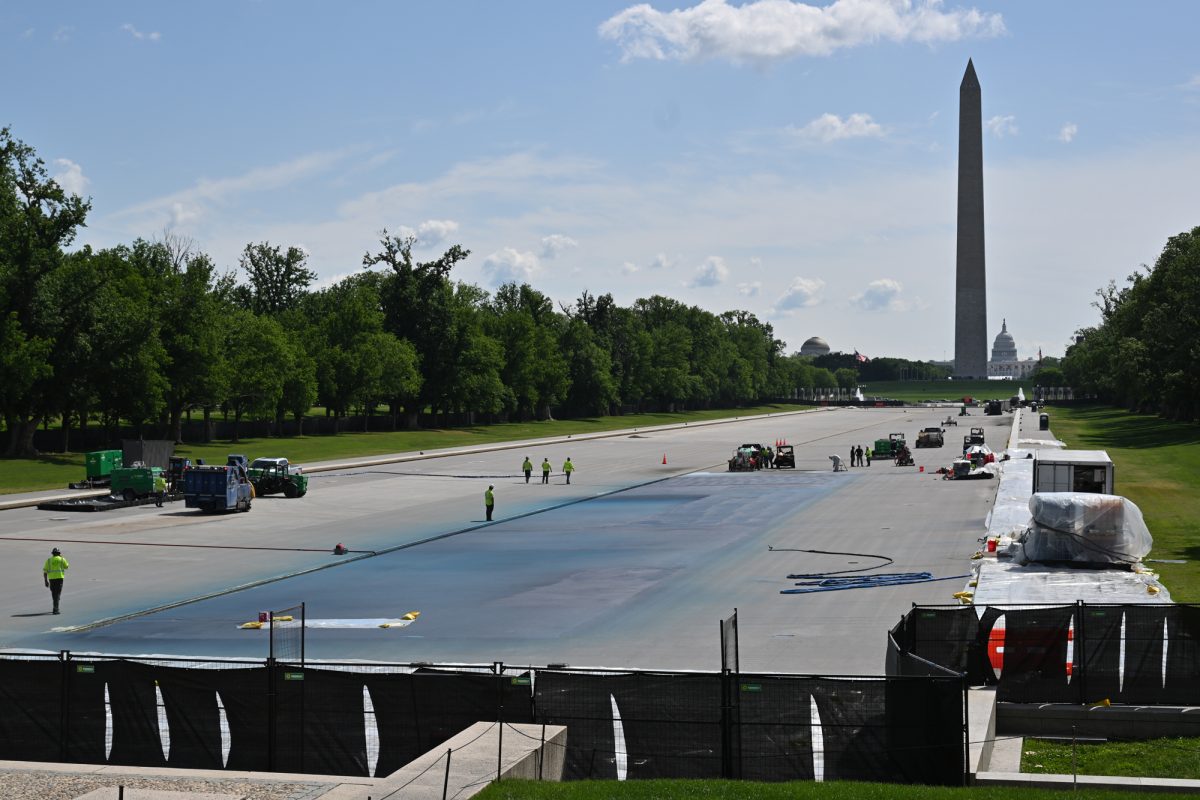
Trump announced last month his administration would paint the surface of the Lincoln Memorial Reflecting Pool “American flag blue,” saying the project was already underway. Federal records show the renovations will cost over $13 million after the government awarded the Virginia firm Atlantic Industrial Coatings a no-bid contract, the New York Times reported.
Charles Birnbaum, the president of the Cultural Landscape Foundation, a nonprofit group that filed a lawsuit earlier this month over the painting of the reflecting pool, said the project could upend the reflective relationship between the Washington Monument and the Lincoln Memorial.
“This is not a pool for recreation,” Birnbaum said. “This was intended to be a commemorative memorial gesture that honored, if you will, Washington at one end and Lincoln at the other.”
The lawsuit argues that the renovation process has not followed Congressionally-mandated procedures for altering historic landmarks, violating the National Historic Preservation Act, which requires agencies to engage in a process of consultation before making changes to historic properties.
“Every day that the resurfacing continues, the historic character of the Reflecting Pool is being further and fundamentally altered,” the lawsuit reads.
Martin Moeller, a former curator at the National Building Museum who said his opinions are his own and do not represent any groups he is associated with, said the proposal to paint the surface of the reflecting pool blue is emblematic of the same “cheap glitz” aesthetic that Moeller said is visible in Trump’s redecoration of the Oval Office.
“One can only assume that Trump went out, looked at the reflecting pool on a cloudy day, and thought it was gray,” Moeller said. “Well, guess what? A reflecting pool on a cloudy day is going to be gray, because it’s a reflecting pool. It’s what it does.”
Philip Kennicott, a Washington Post culture critic focusing on architecture, said Trump appears to see making architectural and physical changes to D.C. as a way of establishing his legacy and leaving an imprint on the District that will last long after his presidential term. He said Trump’s desire to implement aspects of neoclassical architecture — a style used on structures like the White House and Jefferson Memorial that draws inspiration from ancient Greek and Roman forms — in federal buildings, as opposed to the existing brutalist tradition, is reflective Trump’s embrace of design styles that highlight power and wealth.
“His primary aesthetic responses are to things that indicate wealth, luxury and glamor, but not to the deeper set of architectural aesthetics that are really about issues of proportion, balance, symmetry and taste,” Kennicott said.
Foggy Bottom has seen a slew of architectural and design changes stemming from actions of the Trump administration. In December, the State Department added Trump’s name to the U.S. Institute of Peace Building and the board of the Kennedy Center voted to rename it to the Trump-Kennedy Center the same month, two months before Trump announced he would close the center for “complete rebuilding.”
Trump has also proposed installing a towering 250-foot-tall triumphal arch at Memorial Circle, which is located across the Arlington Memorial Bridge from the Lincoln Memorial. The arch’s planned height — nearly 90 feet taller than Paris’s Arc de Triomphe — is so tall that the Federal Aviation Administration is evaluating whether it would interfere with flights as they arrive and depart from nearby Ronald Reagan Washington National Airport.
Last month, the Commission on Fine Arts — the federal agency that advises Congress and the White House on construction projects in D.C. — voted to move forward with the arch proposal. The seven member commission is entirely comprised of Trump appointees after the president fired the board’s previous members in October.
Alison K. Hoagland, an architectural historian and a member of the National Trust for Historic Preservation, said the arch would interrupt the view from the Lincoln Memorial to Arlington Memorial Cemetery and Arlington House, which was meant to symbolize national reconciliation in the aftermath of the Civil War.
“You have this memorial landscape with a triumphal arch in the middle of it, obscuring the view between the Lincoln Memorial and Arlington Cemetery and the Lee house,” Hoagland said. “Again, a complete misunderstanding of that landscape and what it was meant to be.”
The Trump administration is also proposing applying a coating of white paint to the gray granite exterior of the Eisenhower Executive Office Building.
Dorothy Robyn, the former public buildings commissioner at the General Services Administration, said the building was an essential property in the real estate portfolio of the GSA, which oversees most federal property. Robyn, who had an office in the EEOB when she served in former President Bill Clinton’s administration, said the building’s grey facade is “inherent” to the architect’s original design of the building.
“Just architecturally, culturally, historically, it’s an important building and the unpainted gray granite finish was part of its design, that’s inherent in the design,” Robyn said.
Experts who spoke during a National Capital Planning Commission hearing earlier this month said painting the EEOB could damage its granite exterior because doing so traps moisture within the stone, which could potentially cause the granite to crack.
Greg Werkheiser, founding partner at Cultural Heritage Partners, a firm that is involved in litigation against the Trump administration’s actions, including the proposal to paint the EEOB, said many Americans are making “well-organized” arguments for why the Trump administration’s architectural endeavors are “absurd” ideas.
“And then, if you look more broadly, the reason every day there is an article about one or more of these projects in every major newspaper in this country is not because it’s just of interest to journalists or the president,” Werkhesier said. “It’s because the American people have consistently said we want to read the news about this.”
Werkheiser said he is “deeply proud” of the Americans who have stood in opposition to Trump proposals like the arch.
“We have so much going on with the country, one could easily understand if the American people were just said ‘we don’t have time to debate or get involved in a defense of these important places,’” Werkheiser said. “But that’s not what’s happened. American people have shown up by the thousands, the tens of thousands in the comments, the hundreds of thousands online.”
Shivu Sathe contributed reporting.