
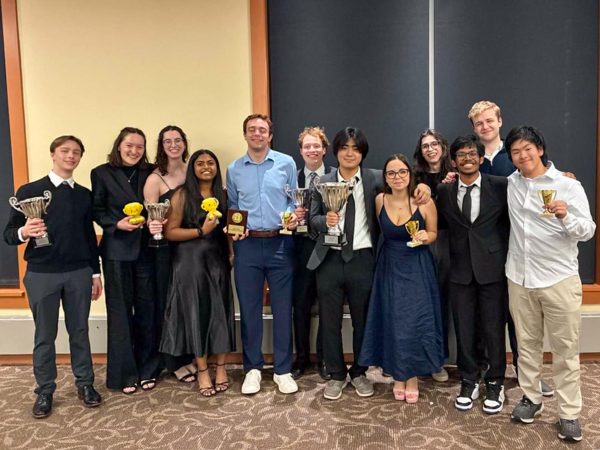
As the GW Parliamentary Debate Society began prepping for this academic year’s competitions last summer, they had one goal in mind — to win Club of the Year for the first time in the group’s history and join the ranks of elite universities like The University of Chicago and Yale University.
The American Parliamentary Debate Association awarded GW the COTY accolade for accumulating the most points — which clubs earn when their members perform well in tournaments — of all the chapters throughout the academic year at 450.5, marking the first time in 16 years that Chicago, Yale or Harvard University did not win and becoming only the fifth team to win the award in the association’s history. Members said a combination of strong talent across the group, extra time spent preparing their debate topics throughout the year and strategically matching up debaters to maximize points contributed to their win.
Sophomore Mabel Rieger, GWPDS’ incoming president, said while in previous years the group had two or three strong debaters, this year’s club has “many, many” strong debaters — with three members reaching the 66-point-per-person limit for the season and six others surpassing 20 points — increasing the group’s depth and helping them win more points across the board.
“We worked exceptionally hard for it,” she said. “It was a full-team push.”
Rieger said the group spent more time strategizing to maximize their points this year than in previous years, including participating in larger tournaments in the APDA’s central and northern regions, as tournaments with more teams allow debaters to earn more points. She said they would send different debaters to separate, larger competitions farther away on some weekends to increase their chances of earning points.
Debaters earn more points the higher they place in APDA-sanctioned tournaments and judges award “speaker points” by rating debaters based on criteria like argument quality and engagement with the other team’s material.
Rieger said GWPDS attended tournaments at other universities almost every weekend of the academic year and practiced twice a week for two hours each session, though some of the group’s strongest contributors practiced on their own almost daily.
“A lot of our push for first place involved a lot more than just the two-times-a-week practices,” she said.
Rieger said she joined the group because she debated in high school and enjoyed GWPDS’ community-centered culture. She said she appreciated that the group members genuinely wanted to improve, which made her feel more comfortable taking risks when debating.
“I thought I was going to give it up in college to be a person and do other things and stuff,” she said. “But I went to one interest meeting, I found the people on the team really wonderful.”
Rieger said while there are multiple popular formats of debate, like British Parliamentary and Policy Debate, the group only does American Parliamentary, allowing them to tailor their training to a format that requires quick, logic-based thinking. She said Chicago and Yale also compete in British Parliamentary debates, sometimes skipping APDA competitions, which limits the number of points they can earn in the COTY competition.
American Parliamentary debate involves two teams of two people, with one team representing the Government and the other the Opposition. The Government team picks a position on a topic like economics, philosophy and government and builds an argument defending their position on logic rather than evidence because the Opposition does not know about the Government’s case in advance.
She said GWPDS is hoping to win COTY again next year, along with other APDA awards at the end of next academic year, like Team of the Year, which recognizes the debating duo that earned the most points throughout the season, after GWPDS members Ryan Tiedemann and Yuki Nakano placed fourth this year, but is losing a few strong senior debaters.
“We have a great team, and we’re gonna keep fighting for awards,” Rieger said. “It’ll be a good year next year.”
Nakano, a junior and GWPDS’ outgoing president, said GW is the first school from the southern region to win since Johns Hopkins won in 2008, a feat that is more difficult because tournaments in the region tend to be smaller, with fewer opportunities to earn points.
“I think it was just, a good mix of some luck of talent, and then also we all collectively, really wanted it and put in a lot of effort,” Nakano said.
Nakano said GWPDS had strong first-year talent this year, with four first-years, called novices in debate, qualifying for the APDA National Championship after achieving a minimum points threshold or ranking highly in certain tournaments throughout the season.
“Without them, we would have lost mathematically,” he said. “So yeah, I’d say definitely, this year we had a very good class of novices who immensely contributed to Club of the Year.”
He said GWPDS used a strategy called “prepping them out,” where they would prepare arguments against Chicago’s cases in advance, since they knew most of their cases from previous tournaments and shared them with other schools’ teams who were debating Chicago, which Nakano said was GW’s main competitor throughout the season.
Nakano said his goal for his senior year is to relax and enjoy debating, rather than stressing about winning COTY like this year. He said while debating every weekend was “grueling,” it was worth it to win the award.
“I spent almost every weekend debating, so I’m practically addicted at this point,” Nakano said. “So you know, even if I wanted to kind of step away, not sure if I’ll be able to.”
Tiedemann, a senior studying international affairs and philosophy who competed with GWPDS all four years of college, said winning COTY in his final year was “incredible” because it recognized the group’s increased efforts this year and allowed him to retire on a win.
“This victory really paints GW in a good light, and so our team is very proud of it for that reason,” he said. “We do take a lot of pride in representing GW, in having the opportunity to compete for GW.”
Tiedemann said a few of Chicago’s strongest debaters graduated last year, which worked to GWPDS’ advantage. He said even though GW lost some strong debaters last year, the group put more effort into practicing over the summer and spent more time strategizing which tournaments to send their debaters to.
“And then I think we just peaked at the right time,” he said. “It was kind of a watershed year where we had a lot of debaters take leaps in their ability and put on performances week in, week out.”
Tiedemann said that even though he is graduating, he will likely return to coach GWPDS members over the summer and is excited to see their success next year, as the group has had multiple impressive first-year students join. He said next year will be a “dog fight” because Chicago will likely come back stronger and be more strategic after GW broke their four-year winning streak.
“So we’re gonna have to match that,” Tiedemann said. “And I think it’s doable. I think we can, but it’s not going to be easy.”