

Democratic candidates competing in the D.C. mayoral and delegate races outlined their different approaches for how, if elected, they would work to protect home rule, address issues of affordability and encourage economic development at the Jack Morton Auditorium Saturday.
The five candidates who appeared at the mayoral debate outlined their visions for D.C. and highlighted what they view as significant concerns among D.C. residents over issues like affordable housing, public safety, economic development and federal intervention into D.C. The delegate race’s debate, which immediately preceded the mayoral debate, featured all five candidates, who reiterated the need for D.C. statehood and expanding local entrepreneurship to grow the District’s economy to include more industries and lower the cost of living for residents.
The Washington Informer, a local newspaper, presented the debate in partnership with the D.C. Democratic Party, the Washington Association of Black Journalists, the Greater Washington Black Chamber of Commerce and the Greater Washington Urban League.
Mayoral candidates outline visions for the city’s direction
Five Democratic mayoral candidates are competing to replace D.C. Mayor Muriel Bowser, who Washingtonians first elected in 2014 and who announced in November that she would not run for reelection, setting the stage for the first competitive Democratic primary for the position in over a decade.
Ward 4 Councilmember Janeese Lewis George said the race was about choosing the candidate who would be able to address issues of affordability within the District, citing the high cost of everyday essentials like utilities and childcare. Lewis George, a self-described democratic socialist, has championed progressive causes on the D.C. Council and introduced a bill in 2022 inspired by the Green New Deal intended to create mixed-income public housing.
“Who do you trust to show up and fight for all the D.C. residents in all eight wards?” Lewis George asked. “Who do you trust to address this affordability crisis when housing and utilities and childcare are too expensive and everyone from the middle class to the margins are feeling the squeeze.”
Lewis George said she would fight to protect D.C.’s autonomy and said she plans to stand up to federal intervention by Donald Trump’s administration, citing her push for legislation that would have ended any cooperation between the Metropolitan Police Department and Immigration and Customs Enforcement.
“You need someone who’s ready to stand up to this administration, to protect our immigrant communities, to protect our Black youth, to protect our seniors who deserve a place in the city that they have built,” Lewis George said.
Lewis George repeatedly attacked Kenyan McDuffie, a former at-large D.C. Councilmember who resigned in January, during the debate for stances he has taken on the council like when he did not sign on to her MPD bill — which never came up for a vote in the council — and for his successful push for legislation that closed some D.C Council meetings to the public.
McDuffie said he would prioritize building more affordable housing by reducing the amount of time permitting takes when required for construction within the District.
“We have to build more housing across incomes, including deeply affordable housing,” McDuffie said. “We have to do it faster.”
McDuffie said if elected, he would prioritize boosting D.C.’s tourism economy through marketing efforts that highlight other parts of the city beyond the city’s traditional tourist attractions, like the National Mall and Smithsonian museums.
“The reality is we have to give people a different experience by focusing on Destination D.C., Events D.C., and making it more attractive to be in Washington, D.C., both for workers and for visitors,” McDuffie said.
Vincent Orange, who also served as an at-large D.C. Councilmember until he lost his reelection bid in 2016, said if elected he would “negotiate” with Trump and Congress to protect D.C.’s autonomy and home rule. Orange said his experience serving on the council makes him a qualified candidate for mayor.
“I spent my career delivering results for the city, growing our local business economy, expanding workforce opportunities and bringing investments to communities that need it most,” Orange said. “Today, what we need is leadership grounded in measured outcomes, not political moments.”
Gary Goodweather, a real estate developer running for his first elected office, said he would “revamp” the permitting and approval process for building housing in order to develop affordable housing more quickly. He said his experience leading the development of hotels in the DMV and his time serving on the NoMa Business Improvement District Board of Directors gave him a window into what he said were high costs to develop new housing.
“We’re going to completely revamp the permitting approval process here in Washington, D.C.,” Goodweather said. “I’ve spent the past 30 years building in this city and about 10 percent, 15 percent of our costs are just to get started.”
Rini Sampath, who is also running for her first elected office and is currently the federal civilian director of a cybersecurity company called Tharros, said D.C.’s government was “failing” to deliver on its promises and said the District needs a “true administrator” as mayor, describing herself as not a “career politician,” but a “tech director.” She said her work in the tech sector sets her up to be a successful “administrator” for the District.
Sampath said if elected, she would seek to bring more businesses to D.C. by making the tax code more friendly to business and by making the permitting process easier.
“The end of the day, we shouldn’t be as a government dictating how these businesses should be run,” Sampath said. “What we do need is more businesses. So let’s bring the jobs to D.C.”
Delegate candidates discuss plans to further D.C. statehood efforts and economic development
Five candidates are vying to become D.C.’s nonvoting Congressional delegate after Eleanor Holmes Norton, who has held the position for the past 36 years, announced her retirement in January.
Almost all the candidates took time in their opening speeches to advocate for the establishment of D.C. statehood and emphasize the importance of Norton’s work thus far in advocating for Congress to pass legislation granting the District statehood.
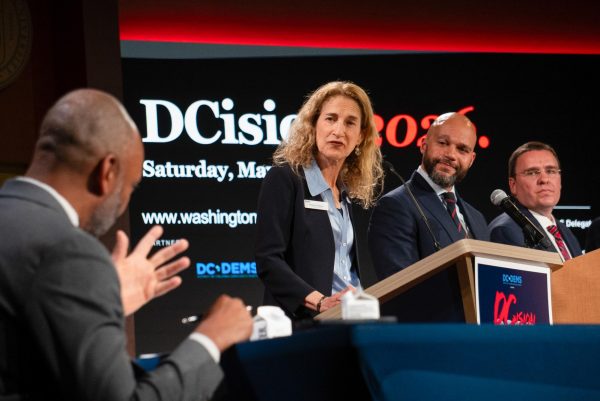
Ward 2 Councilmember Brooke Pinto said she wants to ensure every Washingtonian has the opportunity for economic “prosperity” and to build more affordable housing across the city. She also said her background in assisting residents in economic issues, including her current position as councilmember, will help her protect the city and secure more resources from the federal government, which she said she would use $130 million of for cleaning up the Anacostia and Potomac rivers.
“I am the only candidate who has laid out a bold federal plan to address the housing affordability crisis,” Pinto said.
Pinto’s federal plan is named Breaking Ground D.C., a housing plan focused on expanding access to affordable housing and building new neighborhoods near transit and historic areas. The plan also explains that statehood means the D.C. government would have the ability to decide for itself where and how to build, which the federal government currently has a say in.
At-Large Councilmember Robert White said his background as a fifth-generation Washingtonian and his work with Norton as a lead staff member on Congressional oversight hearings prior to serving on the D.C. Council bring knowledge about D.C. that his competitors don’t have.
He said as delegate, he would work to become a member of the House Committee on Appropriations to help pass bills to increase economic development in D.C. He also said bringing statehood, which requires a majority vote in both chambers of Congress and has failed to pass multiple times, will always be the “north star.”
“I’m going to harness this unique time with people so angry, the country fighting about control of Congress, and use that to build on Congresswoman Norton’s legacy to achieve statehood,” White said.
Trent Holbrook, who also worked with Norton as her senior legislative counsel, said D.C. Home Rule, the federal law granting the District’s residents limited self-government, is under attack right now with the current presidential administration’s actions. He said he would be successful as a delegate because of his efforts in fighting Trump’s “attempted illegal federalization” of the MPD. Trump increased federal law enforcement in the District last August by mobilizing the National Guard and federalizing MPD for 30 days.
“I do not think that the D.C. statehood movement has stalled. I think we’ve made historic progress,” he said. “We’ve continued to make it the national issue that it really needs to be, and that it deserves to be.”
Greg Jaczko, a physicist and former chairman of the U.S. Nuclear Regulatory Commission from 2009 to 2012, said he believes the delegate role is difficult because of the Trump administration’s assault on both the rule of law and the federal workforce within the District, which is the “prime reason” he decided to run in this race. He said he can do more to push back against the administration by running for delegate rather than “firing off” angry tweets on his social media.
“When I am elected, I intend to fight for statehood, and I intend to fight for it in a novel way,” he said.
Kinney Zalesne, a former White House fellow and counsel to the U.S. Attorney General, said the delegate role requires an immense amount of federal agency experience. She built that experience through her time at the White House and attorney general’s office, adding that her opponents didn’t have that experience.
Zalesne said the councilmembers shouldn’t have an advantage in the race because of their time on the Council. She said the delegate position has never been a “stepwise promotion” from the D.C. Council, and the council members in the race will still be in a “critical fighting force” in D.C. without the delegate position.
“This job is for someone who has deep, long-standing and widespread relationships on Capitol Hill and across the country in the business community,” she said.
The primary election for both races is scheduled for June 16.