
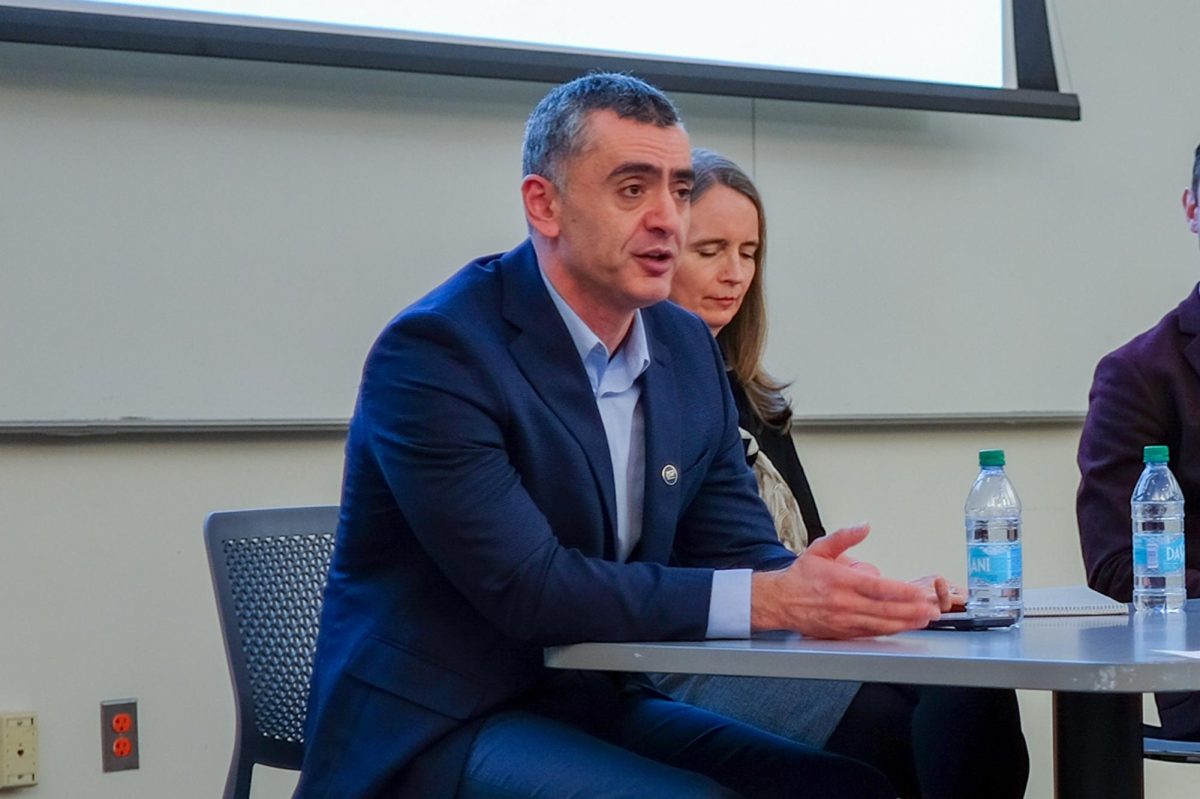
An international security expert and assistant professor of Middle East politics at GW discussed his new book, which traces the evolution of Iran’s nuclear program and how it has shaped the country’s relationship with the United States, at the Elliott School of International Affairs Tuesday.
Sina Azodi, the director of the GW Middle East Studies Masters Program and news contributor on CNN, BBC and Al-Jazeera, said his book seeks to highlight Iran’s nuclear program from an Iranian perspective, as opposed to existing scholarship which is overwhelmingly Western-centric. At the first installment of the Elliott School Book Launch Series highlighting newly released books by GW professors, Azodi debuted his book, “Iran and the Bomb: The United States, Iran and the Nuclear Question,” examining the history of Iran’s nuclear program and connecting it to Iran’s current political tensions with the United States.
Azodi said while Western sources often describe Iran’s nuclear ambitions as “apocalyptic,” the country’s nuclear program is actually rooted in insecurity stemming from historical Western occupation. He said because European powers occupied Iran during the first and second World Wars, Iranian leadership developed the mentality that the country needed to build up arms to protect itself.
“For the Islamic Republic, the nuclear program is also the embodiment of its global standing,” Azodi said. “It uses its nuclear capacity as a bargaining chip to get a seat at the negotiation table with great powers that otherwise would not treat Iran seriously.”
Azodi, a GW alum, said while working toward earning his masters in international affairs from Elliott in 2013, his dissertation eventually developed into a book that seeks to challenge dominant Western scholarship. He said Iran’s nuclear ambitions predate the 1979 Islamic Revolution, and some factions of the Iranian population view nuclear development as necessary to deter aggression from foreign adversaries. He added that Iranian leadership views nuclear enrichment as a source of international legitimacy.
Azodi said both the former Iranian leadership under Shah Reza Pahlavi, who was overthrown during the 1979 Iranian Revolution, and the current Islamic Republic view Iran’s nuclear enterprise as a sign of technological modernization and a source of national pride.
“As one Iranian scientist told me, Iran entered the 20th century on mules and unpaved roads, and it entered the 21st century with nuclear enrichment,” Azodi said.
Azodi said his book takes a “realist” approach to studying Iranian leadership, and that Iranian leaders should be treated by scholars of international relations as rational actors, which some Western scholars do not do.
“Unlike some orientalist views that depict Iranian leadership as irrational and zealots with apocalyptic aims, I contend in this book that they are mostly concerned about survival in a world where might makes it right,” Azodi said.
Azodi said Iran has faced repeated vulnerabilities, notably the Iraqi invasion of Iran in 1980 where Iraq used chemical weapons on Iranian populations, that produced a “loneliness” in Iran and led Iranian leadership to feel that the country can only rely on itself for protection, which is why they have decided to continue with their nuclear program despite international sanctions and military action.
Azodi said Iranian officials openly discussed the feasibility for nuclear weaponization in 2021, but did not have sufficient public support among Iranian citizens to follow through. He said recent U.S. military action targeting Iran’s nuclear facilities could push new leadership to develop a nuclear bomb backed by increased public support.
Azodi said Iranians now view nuclear enrichment as crucial to the country’s national defense, which would not change even if Iran democratized. He said he is critical of the pervasive idea that only Western democracies can be responsible with nuclear weapons.
“I tried to be as impartial as I could be, but most of the books on the Iranian nuclear program is either an angry, Middle Eastern looking man with a nuclear blast in the background, or some, you know, nuclear explosion,” Azodi said.
Azodi said the Iranian regime will continue political crackdowns and executions on citizens as the Islamic Revolutionary Guard Corps exercises more control over the population in the name of “national security.” He said he fears the targeting of key infrastructure by the United States has weakened civilian autonomy, forcing Iranians to rely on the militant government for support.
“My concern is that this war will further diminish the prospects of democracy or human rights in the country, not that it was ever good, but it’s going to get worse for a number of reasons,” Azodi said. “One is the exigent national security exigencies, meaning that under the banner of national security, they can crack down on anyone they want political dissent.”
Azodi said the main deterrent for the Iranian government’s pursuit of a nuclear bomb is setting the precedent for other Gulf states like Saudi Arabia to weaponize. He said if Iran creates a nuclear bomb, Saudi Arabia would follow suit, threatening Iranian supremacy in the Persian Gulf.
“But I think at the end of the day, there’s one structural factor that would incentivize Iran not to pursue nuclear weapons, or what they call it, the nuclear forbearance,” Azodi said. “And it’s the issue of Saudi Arabia potentially wanting to have its own nuclear weapon.”