
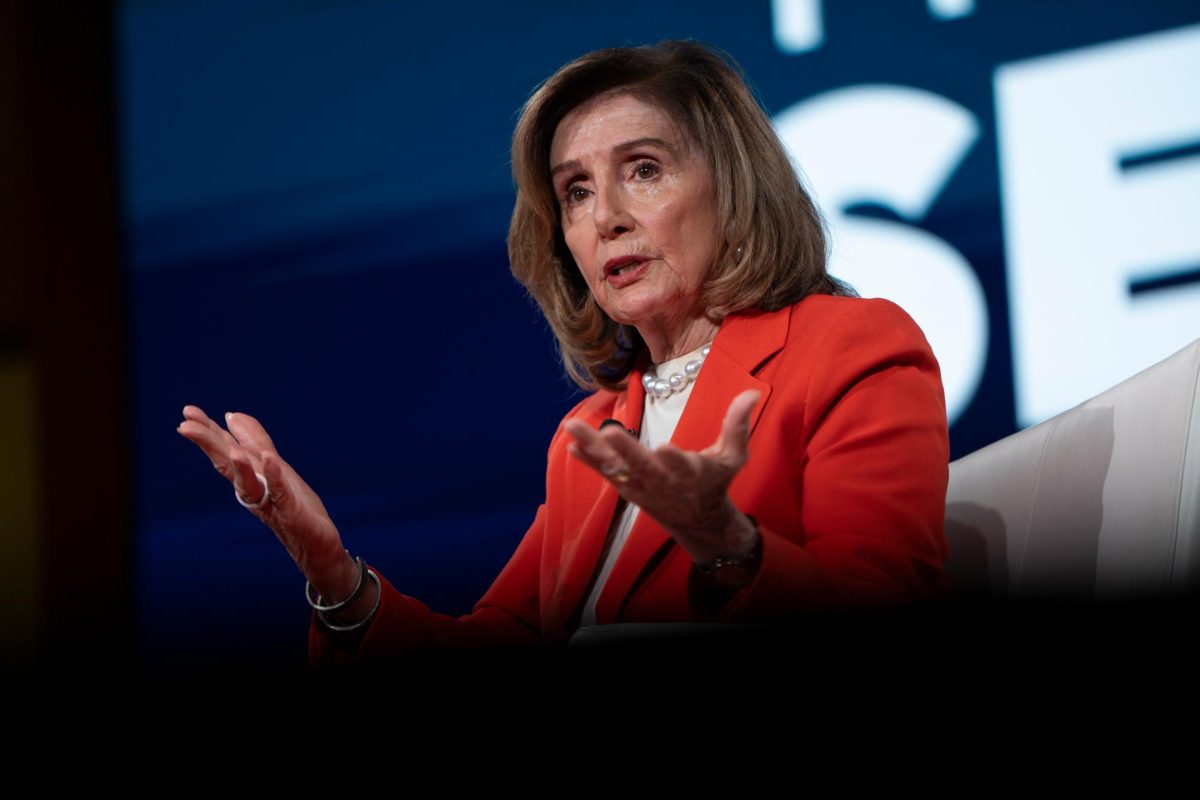
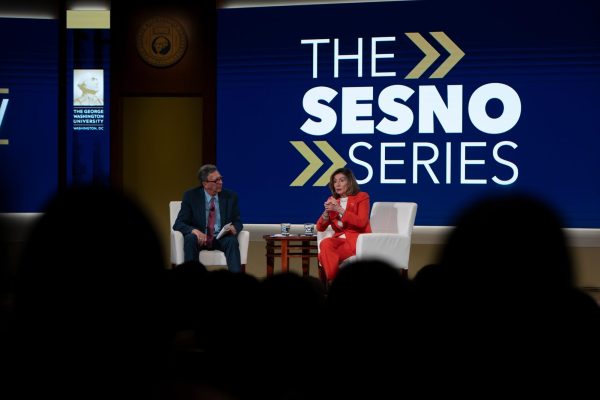
Rep. Nancy Pelosi (D-CA) discussed the devolution of Congressional power during President Donald Trump’s administration and her confidence in the Democratic Party as midterm elections approach in the Jack Morton Auditorium Monday.
Pelosi, who was first elected to Congress in 1987 and served as speaker of the House of Representatives from 2007 to 2011 and again from 2019 to 2023, said there has been a “total abdication” of Congressional power by Republican leadership to Trump, saying the founders of the country put in place guardrails like impeachment to deal with “rogue” presidents, but did not anticipate a Congress that lets presidential power go unchecked. Frank Sesno, a professor in the School of Media & Public Affairs, moderated the conversation — entitled “Power and Precedent” — as part of the Sesno Series, a guest-speaker series featuring conversations surrounding civil discourse.
“They could foresee a rogue president,” Pelosi said of the nation’s founders. “They could not see at the same time, a rogue president and rogue, cowardly Senate not to honor the fact that the president violated the Constitution.”
The event kicked off with an expert panel discussion featuring historian Douglas Brinkley, SMPA Associate Director Jesse Holland and Professor of Political Science Sarah Binder, where they discussed the balance of power and the effective function of the American government.
Sesno began the conversation with Pelosi by asking her questions about current news dominating headlines, like Trump’s Truth Social post calling Pope Leo XIV “weak on crime.” Pelosi, who identifies as Catholic, said Trump’s criticism of the Pope was “inappropriate” and worthy of a “diagnosis.”
Pelosi called Trump a “master distractor,” adding that his vision for the country strays from the original outlook of America’s founding fathers — a vision she said is based on “charity” and “faith” in democracy.
“Our founders believed in the goodness of the American people, and that’s why they thought a democracy could thrive,” Pelosi said.
Pelosi said the Trump administration has continued to undermine the Constitution, changing the political landscape of Congress by making it more polarized. She said the nation’s founders intended the House to be the “people’s house” in Congress, not a body subservient to the president, adding that the current speaker of the house, Rep. Mike Johnson (R-LA), just follows the president’s agenda without regard for the American people.
“We are all concerned about what’s happening to the Constitution, what’s happening to rule of law, due process, freedom of the press and separation of power,” Pelosi said. “We’re all concerned about that because that’s a violation of the Constitution.”
Pelosi said it is “absolute fact” that Democrats are going to win the House in the upcoming midterm elections because American voters are concerned about violations to the Constitution and the rule of law under the Trump administration. She added that she wants to see the party win by 30 or 40 seats — Republicans currently have a four-seat majority in the House — and the party will do that by campaigning in moderate Districts and communicating to voters how the Trump administration’s policies are impacting them.
“You can’t save the democracy by going to the polls and talking about what they’re doing,” Pelosi said. “You have to save the democracy at the kitchen table,” Pelosi said.
Pelosi also answered pre-recorded questions from students in Sesno’s class, including one from Ann Duan, a senior majoring in journalism and mass communications, who asked Pelosi why young people should invest in America given that most young adults believe the American dream is no longer attainable.
Pelosi said the American dream must be restored through a non-partisan method by prioritizing the public’s needs. She added that the increased cost of living, from factors like student loans, healthcare and housing, prevents young individuals from achieving their dreams.
Pelosi said young people have to mobilize in order to sway public sentiment — which she said sparks change, adding that as the future looms, it is the young adult population that is responsible for changing it.
“We hear all these things, gun violence prevention, issues that relate to climate and the rest, listening, listening to young people,” Pelosi said. “But you also have to make the public insist that things go in that way.”
Pelosi said America is worth saving, which can be done by bringing people together to listen to their needs and persisting in the belief of the American dream.
“Know your power, be ready for it and know that the future belongs to you,” Pelosi said.
Brinkley, Holland and Binder discussed what it means to be an American and what reasons young people have to have hope in the country amid rising political polarization. Brinkley said young people must remember that the current time is not “uniquely oppressive,” pointing to eras of slavery and women’s disenfranchisement to show the American dream is always possible even when times are difficult.
“You’re seeing people are feeling a lot of despair, but hope has to be there, because you can’t just wallow in despair,” Brinkley said. “So we have to get a fight on attitude and always care about the community and somebody else besides yourself.”
Binder said over the years, she has seen students in her own classes grapple with lower confidence in the economy, believing America is on the “wrong” track. She said in order to gain back some previous bipartisanship in Congress in an era of heightened polarization, lawmakers may need to have some more closed-door meetings to reduce the “noise” of partisanship when making deals.
“It’s not like we’re looking for the ideological middle,” Binder said. “We’re looking for something that both parties can get, something that they’re after.”
Holland disagreed with Binder, arguing that the power of the press is central to democracy and journalists need to be clued in to conversations on Capitol Hill. He said both John Adams and Thomas Jefferson, though political rivals, both advocated for a free press to provide neutral information to the American people.
“Even though, sometimes, even as a journalist, I will say, we don’t always love what the media does, we still need that protection from the government through information that the media provides,” Holland said.