
Student Bar Association senators voted to amend the body’s bylaws to transfer almost all duties of the executive vice president to a newly created speaker of the senate at a meeting Wednesday.
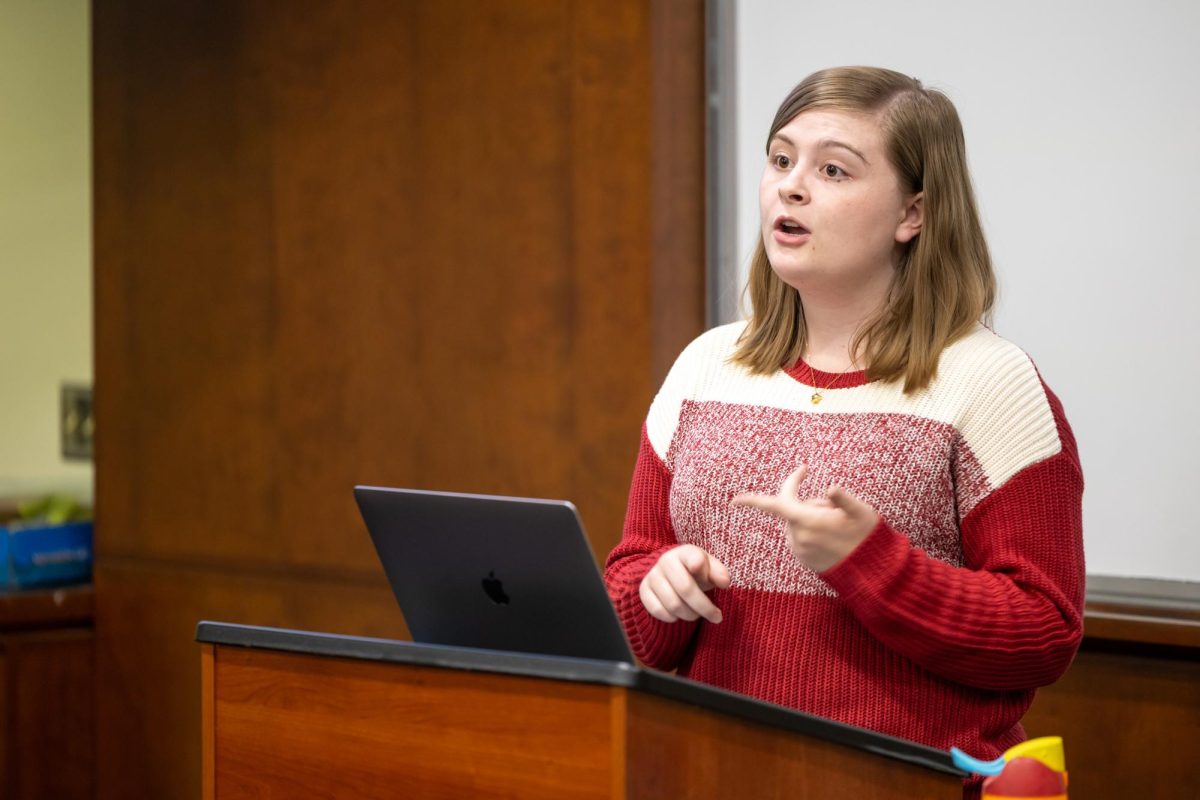
SBA senators said the amendments, which redefine the executive vice president’s role from overseeing the senate to assisting the president in executive duties, are currently unconstitutional, but if the law students pass a constitutional amendment in a referendum next semester, the bylaws will go into effect in fall 2027 after a pilot run next spring. SBA Sen. Callie Stevens said reducing the vice president’s “procedural” workload, like running meetings and doing administrative work, will allow them to assist the president with focusing on broader policy changes.
“I think ultimately this is a procedural thing that frees up space for the executive branch to be able to do more and put less pressure on our people that we rely on a lot,” Stevens said.
The Legislative Leadership Restructuring Act creates a speaker of the senate role, in which a current senator would be directly elected by the senate at the beginning of every academic year to preside over the body, as the executive vice president currently does, with the speaker having the additional responsibility of serving as a liaison between the senate and the student body.
Under the act, the executive vice president will assist the president and seven vice presidents within the executive branch in all their duties like determining the budget, managing the cabinet and serving as a point of contact between the executive branch and the student body. The executive vice president will also join the president and vice president of finance in giving a report of executive business at each senate meeting.
Stevens, a member of the Rules and Constitutions Committee, said because the amendments are currently unconstitutional, the act will not formally change the bylaws unless senators pass a constitutional amendment formally creating a speaker of the senate by the end of their next session, which they didn’t do on Wednesday because of time concerns, and students ratify the amendment in a referendum next fall during an election also held to elect 1L SBA Senators. She said she proposed the bylaw reforms before the constitutional amendment, so students will understand the specific effects of the changes before having to vote on them.
“What I want is for the student body to be able to have something they can see, see how it would practically work, before we ask them to just have blind faith in a new system,” Stevens said. “This way, we can say, ‘Look, here’s what’s already passed. If you want this to go into effect, pass this constitutional amendment.’”
SBA senators passed Sen. Juliana Fernandez’s amendment to the act to include a trial period in the spring semester of 2027, before the amendments are officially enacted in fall 2027, where the senate would elect an acting speaker, who the executive vice president, still officially presiding over the Senate, could guide.
SBA Sen. Thaddaeus Canuel, who will serve as next year’s executive vice president, said the amendment could create a smoother transition for the senate by giving senators a semester to additionally amend bylaws, possibly adjusting the speaker or executive vice president’s roles further, before officially enacting them the next semester, given the student body passes the constitutional amendment.
“I think it would be beneficial for the transition to happen while the people who conceived the idea are still the ones in power to help facilitate the transition,” Canuel said.
Current SBA Executive Vice President Quinn Biever said he was concerned that further separating the executive and legislative branches would reduce communication between the two and suggested creating an attendance requirement of Senate meetings for the executive vice president. He said any amendment should prioritize maintaining communication between the branches so each is aware of the other’s actions.
“It would still be the EVP’s job to the liaison between the executive and legislative, and, to be honest with you, a part of this role that I’ve tried to take pretty seriously is communicate to all of you and make sure that you’re getting a full picture of what the executive is doing,” Biever said.
SBA senators also failed to override SBA President Amanda Hichez’s veto on the Campus Safety Alert Petition Act, asking GW administration to provide students safety notifications of federal agent activity on campus, which the Senate passed at their last meeting after a federal agent attempted to access a residence hall. Hichez cited the possibility of incorrect real-time notifications generating unnecessary fear and panic among students in her veto statement as the reason for her decision.
“This highlights the importance of ensuring that any communication protocol is grounded in verified information and careful judgment, rather than assumption or speculation,” Hichez said.
SBA Sen. Aya Almasri, who drafted the act, said Hichez’s concerns about panic are understandable and thanked her for her recommendation to collaborate with University administration and the SBA Cabinet when redrafting, but that other universities have successfully adopted emergency alert systems for the presence of U.S. Immigration and Customs Enforcement Officials and she would like to see GW do the same.
“I think that eventually I would like to try to push GW Law and GW as a whole towards that direction, but frankly, I don’t want to rush it, and I want to collaborate more on it next year,” Almasri said.
SBA senators also passed the Enhancing Networking and Graduate Alumni Group Engagement Act, requiring student organizations to disclose all interactions with GW alumni, including invitations to speak, attend and donate to events. SBA Sen. Lauren Farrugia said the act will ensure student organizations and GW Law staff do not exhaust alumni resources. She said SBA Vice President of Alumni Outreach Kathryn Chavez has received complaints from GW staff saying donors have stopped funding events after receiving too many requests from organizations and faculty.
“We’re completely losing donors, people are just not donating,” Farrugia said. “We’re not just trying to think about the three years we’re here, we’re trying to think about this longevity.”
SBA senators voted to divide the remaining ad hoc money, around $1,984, equally to support five first-year law students with unpaid judiciary internships over the summer. SBA Sen. Yasameen Ganji on the Finance Committee said students without paid positions next year will receive priority for funding if there are an overwhelming number of applicants.
The SBA will hold its last meeting of the academic year on April 15 at 9 p.m. in Lerner Hall room 201.