

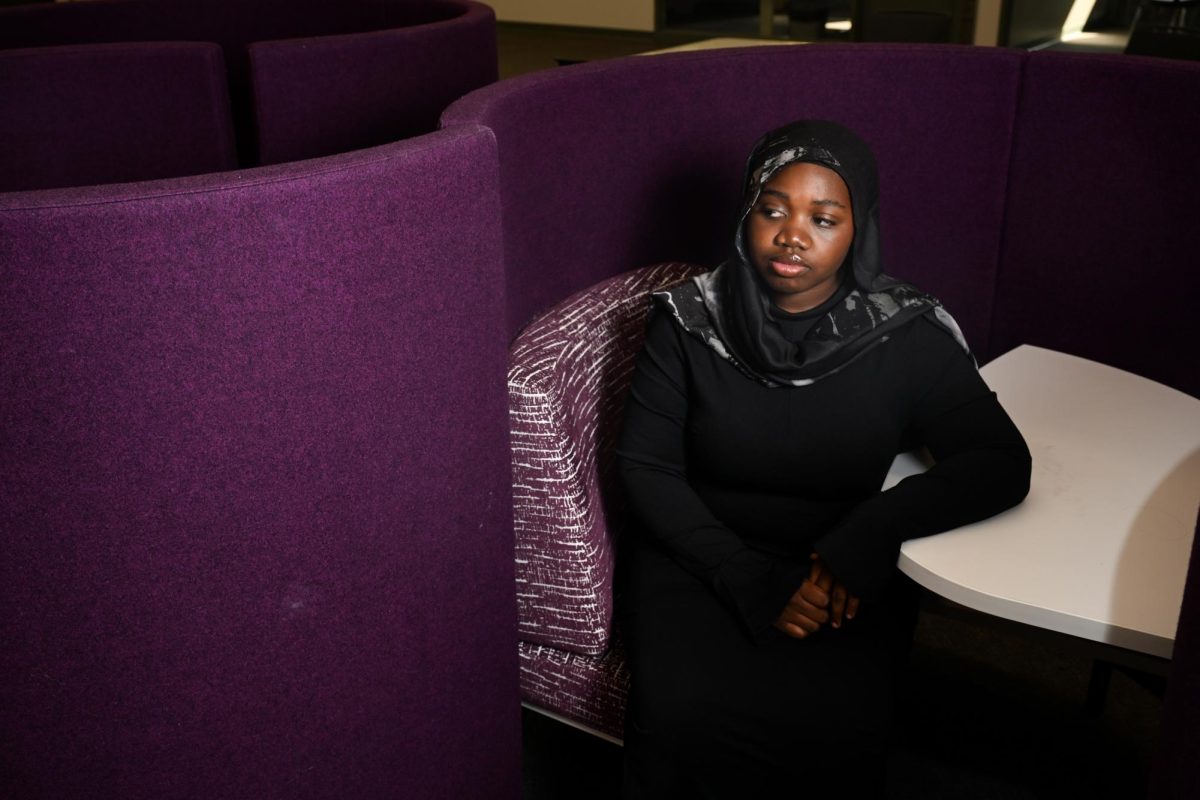
The next Student Government Association vice president must do more than represent — they must connect.
In evaluating candidates for the 2026-27 Student Government Association vice presidency, our editorial board prioritized a clear set of qualities: a demonstrated commitment to the broader GW community, a platform grounded in realistic and actionable policy and a readiness to embrace the legislative demands of the role. The vice president must not only understand the mechanics of student government but also actively work to close the gap between the SGA and the students it represents. We believe SGA Sen. Aicha Sy (CCAS-U) best embodies these priorities and is equipped to lead with both purpose and pragmatism.
Sy has a clear understanding of the vice president’s role as a legislative leader, making us confident she has the ability to translate that understanding into action. Throughout her time in the SGA Senate, Sy has demonstrated a consistent commitment to policy work, whether that be her resolution that asked officials to “resist pressure” from President Donald Trump’s administration to remove diversity, equity and inclusion initiatives or her plan to build a policy-writing office as vice president. Plus, we feel her experience as chair of the SGA Senate’s Community, Advocacy and Inclusion Committee gives her a familiarity with both the inner workings of the SGA and the needs of the student groups it serves — a balance that is critical for a role tasked with both crafting policy and representing a broad student body. It is clear Sy approaches the vice presidency with a focus on impact, prioritizing initiatives that are not only meaningful but also realistically achievable within the scope of the SGA.
Sy’s proposed policy-writing office stood out to our editorial board as one of the most tangible ways to strengthen the connection between students and their government. Not only is the policy point fresh — no candidate in past years has proposed such a plan — she recognized that drafting legislation can be an intimidating and often inaccessible process, particularly for students who are not already involved in the SGA. By creating a space where students can receive guidance and actively participate in writing policy, Sy aims to lower that barrier to entry and make the legislative process more inclusive. Just last month, we called on students to more actively engage with the SGA and make use of its role in shaping conversations with administrators. Sy’s policy-writing office directly addresses that gap, giving students both the tools and the access needed to move from passive observers to active participants in the policymaking process.
Further, we respected Sy’s approach to navigating the complexities of working with the GW administration. She acknowledged that meaningful progress often involves tradeoffs, but empathized that her guiding principle would be acting in the best interest of the student body rather than any single stakeholder. Sy proved to us that she understands the importance of persistence and sustained one-on-one conversations in building trust between students and administrators, arguing that stronger relationships can create a more productive foundation for addressing points of disagreement. She also expressed that she is prepared for difficult conversations, noting that she has already engaged in them throughout her time as an SGA senator. If elected vice president, we would like to see continued and visible efforts to engage across the full spectrum of student organizations at GW, ensuring that this commitment to outreach is consistently reflected in practice.
Much of Sy’s platform struck our editorial board as both practical and achievable, including her proposal to expand cultural-food offerings in dining halls. Sy emphasized that “being realistic is what rooted this whole campaign to start with,” a sentiment that consistently came through in both her platform and her explanations of implementation. This focus on feasibility helped ground her proposals in the actual limits and capabilities of the SGA, rather than relying on broader or less-defined ambitions.
Without a doubt, SGA Sen. Cheydon Naleimaile-Evangelista (CCAS-U)’s “Aloha” spirit shone through his interview, and we appreciated the passion he brought to the table. But we felt his interview and platform did not resonate as strongly with our editorial board, particularly in terms of scope and feasibility — key details we were looking for. Much of his focus centered on highly specific or narrowly framed policy changes, including a proposal to revise the wording of GW’s Title IX policy on its website to emphasize a commitment to a “violence-free campus” and “zero tolerance for sexual misconduct.” While our editorial board supports the intent behind this initiative, we are unconvinced that changes in phrasing alone fall within the vice president’s most effective sphere of influence, particularly when the role is better suited to advancing policies with more direct, tangible impact on students’ day to day experiences.
More broadly, we felt Naleimaile-Evangelista’s platform fluctuated between feasible initiatives, such as hosting a joint SGA-Title IX event, and weaker proposals, including a student organization succession plan that, in many cases, already exists in practice across campus groups. Plus, when we asked Naleimaile-Evangelista how he would work to make the SGA a more inclusive and accessible space, he emphasized that he is approachable and that students should feel comfortable coming to him with concerns. While accessibility is important, Sy’s response to the same question ultimately set her apart for our editorial board. Rather than waiting for students to seek out the SGA, she emphasized the importance of actively seeking out student communities and meeting them where they are.
We concluded our conversation with Sy by asking what legacy she hopes to leave behind at the end of her tenure in the SGA. Her response captured both her approach to leadership and the core of her platform: she hopes students will have the “wiggle room to make mistakes and learn new things.” That emphasis on openness and growth extended to her broader vision of the SGA, where she aims to ensure students feel heard, seen and comfortable not only within student government but across the wider campus community. We believe Sy is well positioned to turn that vision into a more engaged and cohesive campus community as SGA vice president.
The editorial board consists of Hatchet staff members and operates separately from the newsroom. This week’s staff editorial was written by Contributing Opinions Editor Ava Hurwitz, based on discussions with Opinions Editor Andrea Mendoza-Melchor, Research Assistant Ethan Tsai, Sports Editor Grant Pacernick and Social Media Director Max Gaffin.