

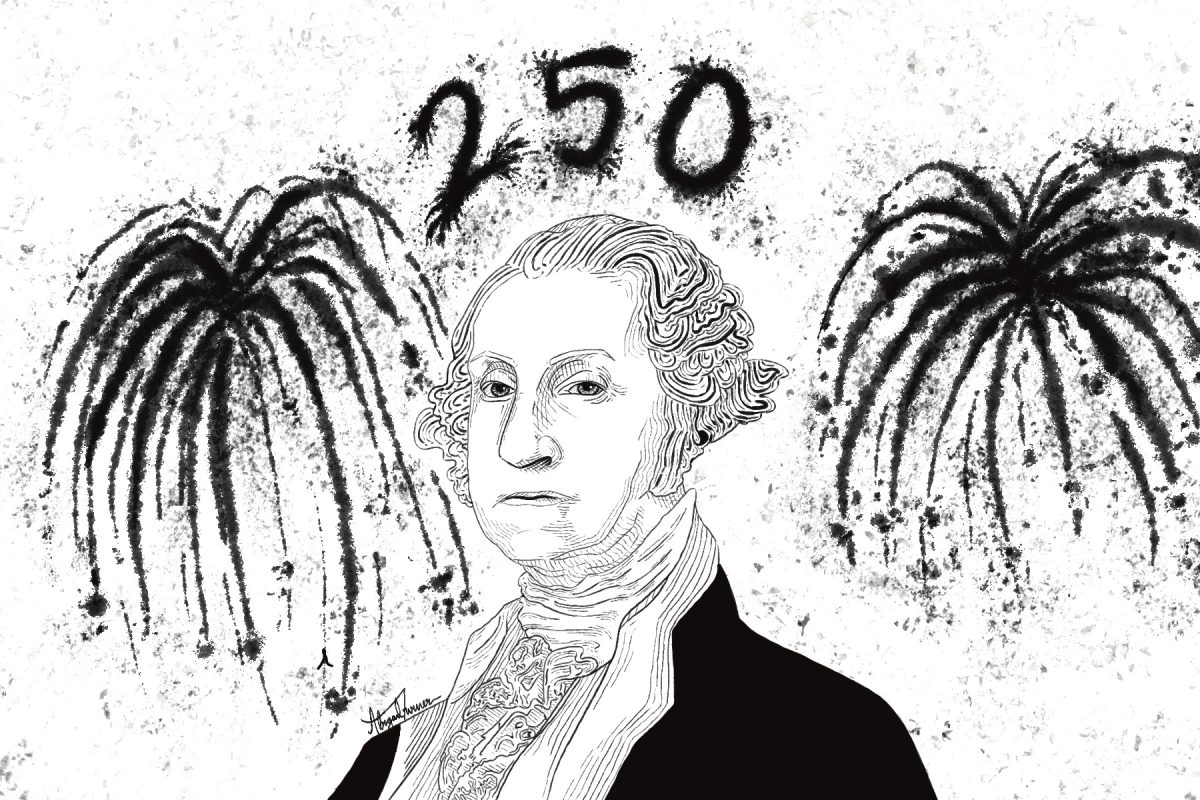
In the heart of D.C., GW bears the name of the nation’s first president — a man who led the American colonies to independence, presided over the Constitutional Convention and warned against the perils of partisanship in his farewell address. He embodied ideals of civic virtue, personal sacrifice and uniting a nation with a vision for a more perfect union. At the same time, he owned enslaved people, a reality that complicates his legacy and contrasts with the values the University seeks to embody in its mission. At the nation’s 250th anniversary, we must confront our namesake’s full history, just as the country wrestles with the promises and contradictions of its founding.
As a higher education institution in the nation’s capital and bearing the name of George Washington, the University has a responsibility to challenge its politically active student body to grapple with the country’s history and the meaning of citizenship. The future of our country depends on the next generation of leaders fully confronting the challenges, contradictions and lessons of America’s history.
The 250th anniversary comes at a moment of deep division in the country. The nation is facing deepening polarization, growing mistrust in institutions and the media and rising political violence. President Donald Trump’s attacks on higher education — from federal funding cuts and crackdowns on diversity, equity and inclusion programs to disputes over “wokeness,” federal loan changes, visa restrictions and travel bans — understandably complicate how universities are engaging with the anniversary and Trump’s Freedom 250 plans. But the next generation of leaders will need to work deliberately to unite communities, restore trust in institutions and navigate a country increasingly fractured along ideological lines. That doesn’t happen unless universities urge their students to face the successes and injustices of America’s past, demanding engagement with its complexities at a time of deep division.
As an editorial board, we’ve been surprised by how little the University has said about the nation’s 250th anniversary so far or announced public plans for its commemoration. The combination of bearing George Washington’s name, being located in the nation’s capital — where Trump’s “Freedom 250” plans will be highly visible across the city this summer and have prompted projects impacting D.C.’s landscape and people, including the unhoused population — and educating a student body that is heavily politically engaged gives GW a unique responsibility to lead the conversation.
This isn’t to say GW has done nothing. The history department is offering an American Revolution at 250 class, which several people on The Hatchet are taking. University President Ellen Granberg spoke on a “Democracy at 250” panel in Los Angeles, and The George Washington University Museum and The Textile Museum has offered some programming for the anniversary and is opening a Generations D.C. exhibition in April. We know staff and professors across departments are engaged in projects for the 250th and are confident that officials are holding extensive discussions about how D.C. events will intersect with the University’s operations. We recognize that, especially given the current pressures on higher education at the federal level, this is a challenging time for universities to grapple with the nation and its history. We are not suggesting that officials aren’t carefully weighing these issues and being deliberate about their approach. But we believe it is crucial for the university to expand its programming and actively encourage student engagement. Everyone on this campus should be aware of and have thoughtfully considered both the 250th anniversary and George Washington’s role in the country’s history.
We urge the University to more visibly promote events for the 250th and to share information about George Washington across campus. Every school and department should consider how the nation’s history informs their work, and students should be encouraged by professors to do the same. Officials should ask professors across disciplines to dedicate time in their classes to engaging with this history. Even brief conversations matter, and they should take place in every classroom. Professors, student leaders, teammates and peers all have a role to play in fostering these discussions in the months ahead.
Substantial engagement with the 250th anniversary is critical not only because the nation and its future leaders must grapple with what it means to be American, but also because failing to engage risks reinforcing Trump’s narrative that universities are anti-American and radical. It is important for GW to communicate to students the value of engaging with both the strengths and shortcomings of American history. At a moment when leaders across the political spectrum are reassessing the role nationalism and patriotism play in modern political rhetoric and party allegiance, that engagement is more critical than ever. Ignoring or failing to fully understand the history of our country will only deepen divisions and mistrust, and it is important that the University ensures its students don’t graduate without grappling with its full scope.
As the nation marks its 250th anniversary, GW must reckon with both the legacy of its namesake and the full scope of American history. The University has a unique responsibility to prepare its students to understand the promises and failures of the country, engage critically with its past and develop the skills to lead in a divided society. Doing so requires visible programming, campus-wide discussion and active encouragement from professors, student leaders and all members of the GW community to ensure that students graduate with a nuanced understanding of what it means to be American.
The editorial board consists of Hatchet staff members and operates separately from the newsroom. This week’s staff editorial was written by Opinions Editor Andrea Mendoza-Melchor, based on discussions with Contributing Opinions Editor Ava Hurwitz, Research Assistant Ethan Tsai and Contributing Sports Editor Grant Pacernick.