
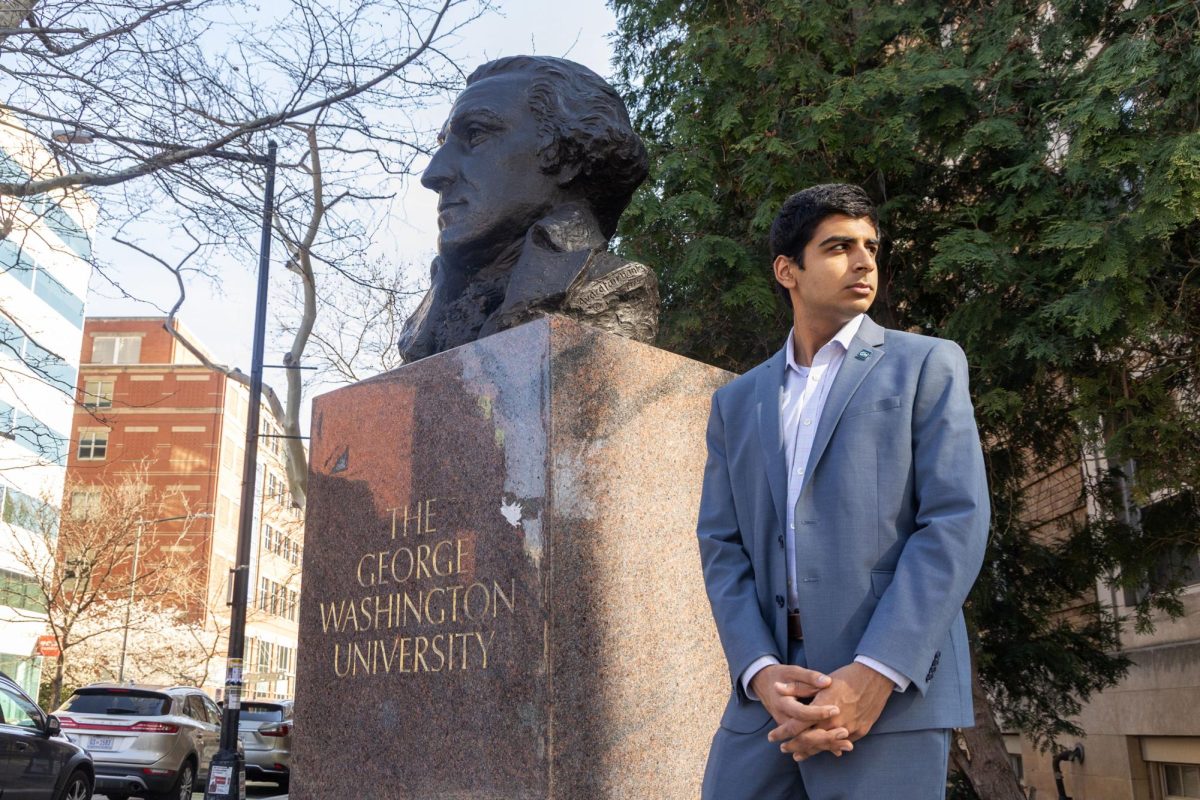
The Joint Elections Commission indicted first-year Student Government Association presidential candidate Zain Masood with several alleged campaign violations Tuesday night, placing him at risk of disqualification ahead of next month’s elections.
The JEC charged Masood with five counts of collecting signatures in a restricted zone and one count of forceful distribution of campaign material after they received several student complaints, reaching the threshold of six penalty points for the JEC to disqualify Masood from the April 16 and 17 election. Masood will appear before the JEC for a public hearing Thursday at 6 p.m. in the main SGA conference room, where he will have the option to plead guilty or not guilty and defend himself against the alleged violations before the commission renders a verdict.
Masood said in a statement to The Hatchet he intends to plead not guilty at Thursday’s hearing, and the indictment is an “undemocratic” attempt by the JEC to silence student voices and participation in student government. He said the indictment was “extremely disappointing” behavior from the JEC, and he is not the first candidate the commission has “targeted” by attempting to shut down campaigns they do not like.
“How can we as a GW community ensure that student government elections are free and fair, when the same people who count the votes are also the ones indicting students due to campaign laws that they create?” Masood said in a message.
Eric Gitson, the JEC’s commissioner, said the JEC has continued to field “serious violations” of the JEC code and SGA bylaws as their investigation into Masood continues. The JEC initially charged Masood with only three counts of collecting signatures in a restricted zone, but the commission added two additional charges Wednesday afternoon after two more witnesses came forward with complaints, Gitson said.
“This evidence is being transferred to Masood, who will have the opportunity to defend himself to the fullest at an open, public hearing,” Gitson said in a message.
Gitson said the rules of the election apply to each candidate equally to ensure fair competition and that the rules were available to Masood, who is responsible to comply with them as a candidate.
“The JEC weighs all complaints carefully and does not ‘target’ any candidate arbitrarily,” Gitson said.
The indictment states Masood pressured a student for his signature on his petition — presidential candidate hopefuls must collect at least 359 student signatures to get on the ballot — against the student’s “express will” outside an 8th-floor Thurston Hall study room Monday. It also states witnesses filed complaints with the JEC about Masood collecting at least two signatures in an 8th floor Thurston Hall lounge on Sunday.
Most academic and residential buildings are prohibited campaigning areas under the JEC code. The code also states no candidates may distribute or attempt to distribute campaign materials against the will of the intended recipient once the intended recipient has communicated their unwillingness to receive it.
The JEC’s chief investigator conducts investigations of complaints against candidates before the JEC holds a closed-door probable cause hearing to determine whether the evidence is sufficient to indict the candidate. The JEC’s decision to move forward with Masood’s indictment indicates the commission concluded there was sufficient evidence of violations to charge him with penalty points.
Masood, in a video posted to his campaign Instagram story Wednesday afternoon, asked students to reach out to him if they could help defend him at Thursday’s hearing. All candidates are allowed to appoint one student to help defend them during violation hearings, according to the JEC’s charter.