
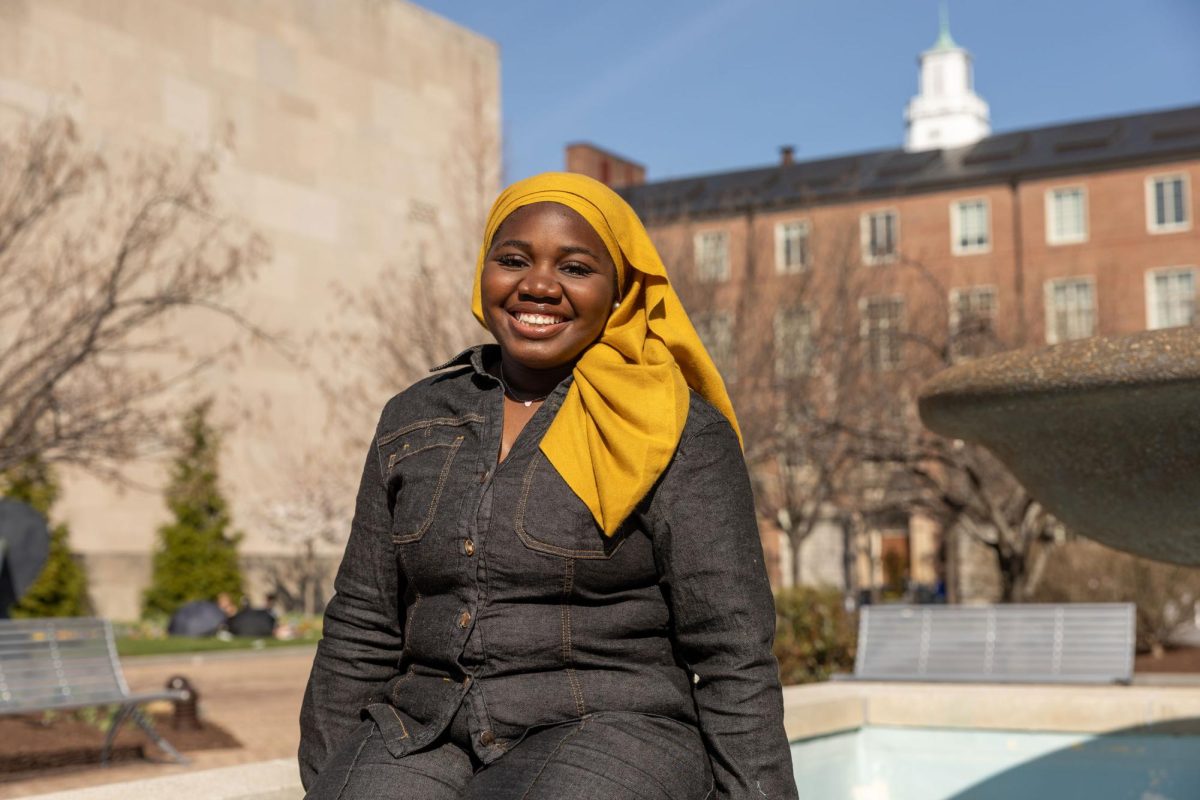
Student Government Association Sen. Aicha Sy (CCAS-U) announced her bid to become SGA vice president last week.
Sy, a sophomore studying political science from West Virginia and the first to declare for the vice presidential race, said if elected, she would work to ensure identity-based student organizations receive sufficient funding, establish an SGA policy writing office to help students bring their ideas to the body and create a first-year forum within the SGA to advocate for new students. She said she also hopes to provide more structure and support for senators in the body through specific opportunities for them to learn how to navigate the SGA Senate and advance initiatives.
Sy, the chair of the SGA Senate’s Community, Advocacy and Inclusion Committee, said she was inspired to run because she believes the body needs to better represent minority students and cultural student organizations. She said her tenure in the SGA working in diversity, equity and inclusion and interactions with diverse groups of students has allowed her to see how the organization’s complicated structures affect students who might not have previous student government experience and have difficulty navigating the SGA.
“I think my experience in the Senate this year has given me the resources necessary to understand the bylaws, understand what it means to write legislation and really make tangible change through policy writing,” Sy said.
She said she thinks many senators feel “lost” or don’t know how to craft their ideas into tangible policy and advocacy the SGA can execute. She said as vice president she would work to expand opportunities for senators to engage with the body by hosting workshops on policy writing and understanding the finance system.
“I’m interested in taking down those barriers and making SGA an organization that collaborates on campus instead of presiding over them,” Sy said.
Sy said she would work to amend the SGA’s bylaws to create a policy writing office, a resource that would pair students and student organizations facing issues with an SGA senator who could help draft legislation to address them. She said the office would help both students, who would be able to take part in the SGA’s advocacy, and senators, who might be unsure how exactly to connect with their constituents or advocate for initiatives they want.
“The main barrier for students outside of SGA to engage in our processes is policy and legislation as it is right now,” Sy said. “Senators write legislation, they pass it, and then students just watch from the outside. I think that it’s important that we break that barrier down.”
Sy said as a Muslim and African student she would work to dedicate a portion of the legislative branch’s fund as an “emergency fund” for identity-based organizations that are in need of funding to hold large events on campus because they “fuel” GW’s campus culture and “define” what it means to be a GW student. Sy said that student organization leaders she has spoken to are hesitant to plan new events or initiatives because they fear they will not be able to secure the funding they need from the SGA or other sources.
SGA funds available for student organizations doubled this semester, but leaders have still had to make some cuts to organizations’ funding requests due to limited funds. Cultural student organizations can also apply for funding for large events through the University-Wide Programs Fund — a joint fund separate from the SGA run by administrators, SGA representatives and students — though the program ran out of funds earlier this spring, leaving student organizations few funding pathways for holding large events.
Sy said as the University seemingly rolls back its commitment to DEI initiatives, it provides students an opportunity to show the University they stand in favor of diversity and inclusion programs. Sy sponsored a resolution the SGA Senate passed unanimously earlier this year calling on officials to resist pressure from President Donald Trump’s administration to eliminate DEI initiatives on campus and make a greater effort to protect student speech.
She said she is “specifically proud” of the resolution because she feels it was one of the only times this year student organizations felt heard in what they wanted to see the SGA do on campus. She said working on the resolution also helped her build connections with student organizations and campus leaders — connections and conversations that she could bring to the vice presidency.
“SGA is here to represent students and not greater University ideas or needs,” Sy said.
Sy said she would also create a first-year student forum, which would host town hall meetings with first-year students to hear their concerns and gather the issues first-years are facing to route them to the SGA for policy action, and members of the forum would also serve as “point people” for their peers about the SGA and campus concerns. She said first-years are particularly “vulnerable” at GW as they consider whether to stay or transfer and how to get involved on campus.
“A lot of those problems can be fixed through conversation and through bridging that connection between administration and students,” Sy said.
The SGA candidate registration opened Thursday and will remain open until 5 p.m. on March 25. Sy must collect at least 359 student signatures before she will officially be on the ballot for the April 16-17 elections, pending Joint Elections Commission verification of her signatures.