
A year into contract negotiations, the union representing GW Hospital nurses says most issues remain unresolved, stalled by hard bargaining from the hospital’s owner and limited bargaining sessions.
GW Hospital nurses voted to unionize in July 2023 but did not begin bargaining until last March, after a nearly two-year appeals process before the National Labor Relations Board, which rejected the hospital’s challenge, certified the union and required the hospital to recognize it. But as of Feb. 9, Executive Director of the District of Columbia Nurses Association Edward Smith said the nurses and hospital leadership had agreed on just 10 or 11 of roughly 30 contract articles — leaving high-priority issues like compensation unresolved.
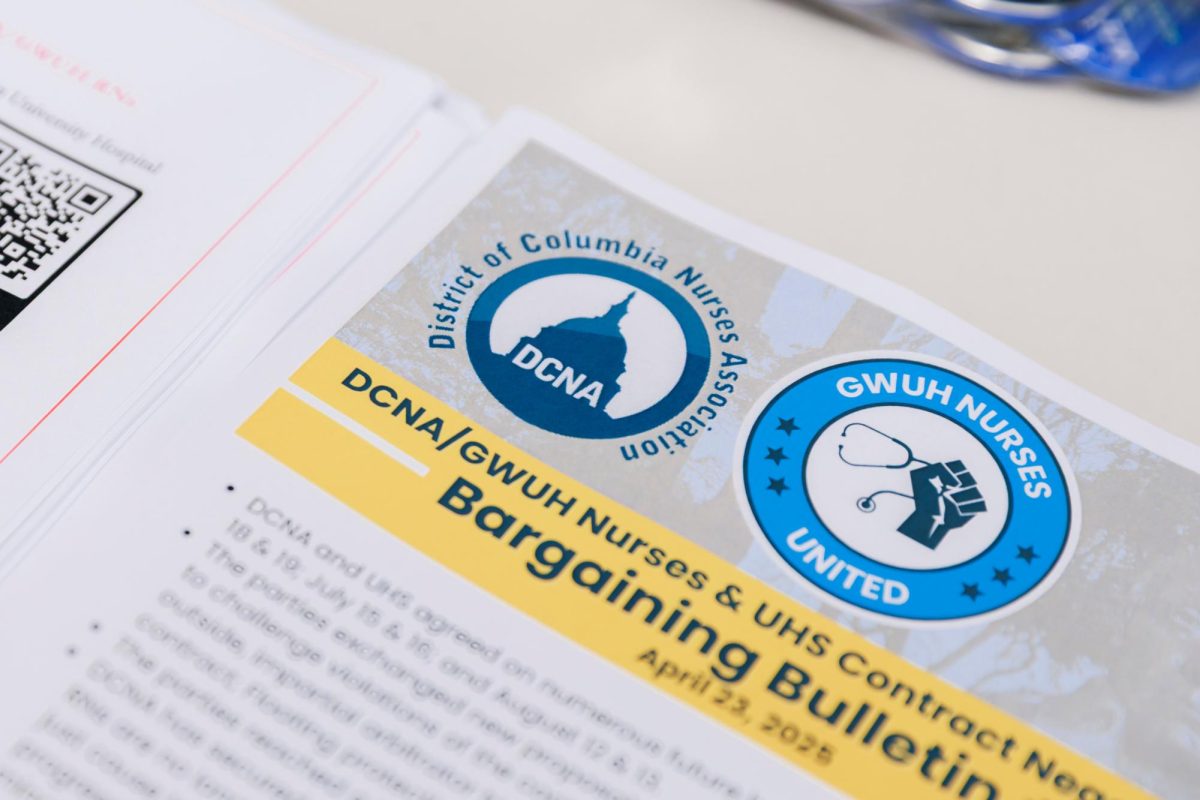
The union has reached a tentative agreement with the hospital on employee discipline and discharge policies, a nondiscrimination clause and layoff procedures but has yet to resolve issues, like nurse autonomy — how nurses are allowed to delegate nursing and non-nursing — and compensation, according to monthly updates from the DCNA newsletter on ongoing bargaining.
Negotiations are moving slowly because Universal Health Services, GW Hospital’s owner, and other hospital management are “bargaining very hard,” Smith said. He said parts of the contract the union expected to be straightforward have become heated points of debate, though he declined to specify which ones.
GW first partnered with UHS, one of the country’s largest hospital management companies, in 1997 to run GW Hospital, and it became the sole owner of the hospital when the University sold its minority stake in 2022. Experts and union leaders in September 2024 said UHS has previously signaled union avoidance at GW — a legal approach employed by corporations and hospitals to slow union progress by attempting to stop union election wins.
They pointed to UHS’ history of not recognizing unions and refusing to bargain, with Smith describing the company as “one of the most anti-union care companies” he has ever worked with. Union efforts at UHS-owned hospitals in Pennsylvania, California and Nevada have also failed in recent years.
Smith said bargaining is always a long process because hospital management has to look over every proposal the union places on the table, which are often dense. He said UHS has limited bargaining sessions to only two per month as coordinating with UHS’ Florida attorneys makes it difficult to find more times to meet, which is elongating the process.
Despite working without a contract for the past year, GW nurses’ union representation means hospital leadership and UHS cannot change working conditions without consulting union representatives and reaching an agreement, Smith said. But without a contract, there is no grievance arbitration process, meaning any complaints nurses have must be handled in court, not internally with an independent arbiter.
Without a grievance arbitration process, the only course of action the union has to resolve disputes over the interpretation of the contract with GW Hospital is to take the complaint straight to court or the National Labor Relations Board. This is often more costly than working with an impartial arbiter and takes significantly more time, Smith said.
“It’s true and tested,” Smith said. “The arbitration system has been around in labor disputes for longer than I’ve lived and certainly longer than you’ve lived, and it’s much, much less costly.”
Smith in September 2024 alleged that UHS officials suspended a nurse for participating in union organizing, installed surveillance cameras in staff spaces and discouraged union participation in private meetings with nurses. For nearly a year after the union vote, GW Hospital refused to recognize the union, arguing its messaging, voter identification and the brief presence of supervisors at the union election thwarted the vote. DCNA has since filed at least nine unfair labor practice charges since the nurses announced their intent to unionize.
The nurses voted to unionize in the summer of 2023 to advocate for better patient care and working conditions, Smith said. A February 2023 release from the union stated that previous attempts to work with hospital leadership failed to result in “lasting systemic improvements,” leading them to unionize in an attempt to address inadequate staffing issues and poor working conditions.
DCNA and the hospital reached a settlement in December 2024, where the NLRB required the hospital to begin bargaining, which they then began in March. But the union filed five unfair labor practice charges against hospital management in April 2025, which allege the hospital may have violated the December settlement by disciplining and firing nurses for posting union materials, coinciding with the parties commencing bargaining meetings in March 2025.
UHS declined to comment on the bargaining progress they’ve made, when they anticipate reaching a tentative contract agreement and Smith’s allegations of hard bargaining. GW Hospital did not return multiple requests for comment on an expected timeline for the contract and what interests the hospital is trying to advance at the bargaining table.
Last April, UHS and the union reached tentative agreement on a discipline and discharge article, which was a “major win” for the union, according to their newsletter. In this tentative agreement, UHS agreed to discipline registered nurses only for a “just cause,” meaning RNs will no longer be considered at-will employees and cannot be disciplined unless there is just cause to support the disciplinary action, according to the newsletter.
“Additionally, UHS agreed to utilize progressive discipline, thus ensuring that RNs cannot be fired immediately for minor misconduct,” the April 2025 newsletter states.
In August, DCNA proposed a weekend incentive program for nurses, which management rejected, claiming nurses would manipulate proposed scheduling options for their own gain, per the newsletter. The newsletter stated this was an example of management’s “disdain for nurses” because they assumed nurses would try to manipulate the system.
In November, DCNA presented a full compensation package to UHS at their two bargaining sessions, according to the newsletter. UHS and GW Hospital provided zero proposals on compensation packages but would not agree to the DCNA package, according to the newsletter.
DCNA’s November proposals included a decrease to the percentage employees contribute to their healthcare coverage in each paycheck, an annual uniform allowance of $500 and an immediate 6 percent match of 401(k) contributions. The DCNA also proposed negotiating for new service providers for 2027 health insurance.
“We’re still waiting on a wage counter proposal for management, not just wages, but any and all compensation benefits, including insurance, including any kind of differential pay, leave, how much leave you get, leave accrual,” Smith said. “So some major aspects of what would traditionally be part of a collective bargaining agreement are still open.”
The nurses’ union is still working to secure a contract, but the School of Medicine & Health Sciences residents and fellows secured a contract with GW in December 2024 after about a year of bargaining.
Smith said the nurses union is negotiating a brand new contract, so they are “building the house” from the ground up and negotiating every section. This is the first time that the nurses have successfully unionized, so they have no prior contract to use as a base for the negotiations and must draft every article from scratch, Smith said.