
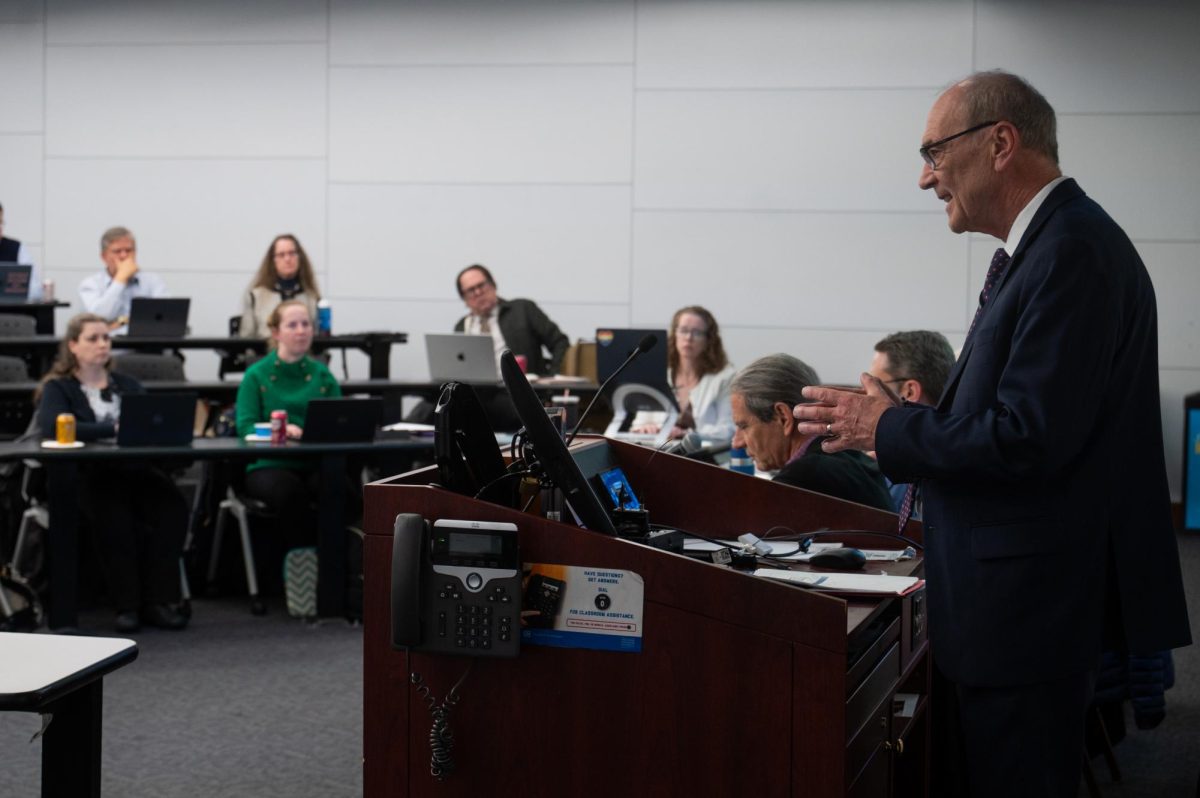
The Trump administration terminated 62 externally funded awards at GW — 35 direct awards and 27 subawards — last year across ten schools and units, Interim Vice President for Research Bob Miller shared in his annual report to the Faculty Senate.
The terminations resulted in the loss of $7.2 million in current-period funds and $10.5 million in future-year funds, with appeals filed for 17 of the awards, amid the Trump administration’s regulatory changes and cuts to federal research projects over the last year. Despite the cuts, Miller told the Faculty Senate Friday that GW’s research enterprise is “holding steady” even as officials monitor federal policies on indirect costs and changes to grant funding structures and work to improve efficiency by integrating administrative roles, like human resources, more directly into the research enterprise.
“We are a little bit down this year, but we’re certainly doing quite well in terms of our peers as well,” Miller said. “I think this reflects something that’s very important about GW, which is that it has a very broad spectrum of research activity. It’s not heavily focused, although you see obviously in the health arena, but not heavily focused in particularly discrete disciplines.”
President Donald Trump in his first year back in office has targeted research funding in an effort to reduce “inefficiency” in the federal government and cut costs. To do so, his administration has capped indirect costs for National Institutes of Health at 15 percent and cut funding from research related to diversity, equity and inclusion initiatives and other fields they deemed less directly tied to immediate health or national security priorities.
Many colleges and universities, given their reliance on federal research dollars, were significantly affected by the federal administration’s policy shifts. Throughout 2025, the Trump administration targeted over 4,000 grants across 600 institutions, terminating awards that total between $6.9 billion and $8.2 billion, according to a Center for American Progress report.
GW’s affected projects include at least five NIH grants totaling more than $3 million that examined the effects of HIV on racial minority populations in the U.S. The terminations also included more than $1 million in foreign language grants affecting three GW programs that supported research and courses in Middle East studies, East Asian studies and international business education.
Researchers said last March that the cuts to federal research funding had decreased morale, disrupted ongoing projects and stalled applications for new grants, creating uncertainty in the community.
Miller said the federal government’s approach of cutting grants to save money remained in place for most of 2025, but has “dropped off” in recent months, signaling the Trump administration may be looking at other approaches to regulate research at higher education institutions.
Earlier this month, the 1st U.S. Circuit Court of Appeals unanimously ruled that the NIH cannot cap indirect costs at 15 percent for current and new research grants, which Miller said has spurred discussions on Capitol Hill about a new funding structure for the Department of Health and Human Services and the indirect cost reimbursement policy.
“But whatever happens, we are going to have to respond to a much more inquisitive organization about how we spend our money,” Miller said. “So I think indirect costs are a challenge. I don’t think it’s going to be as bad as we thought it would be.”
He said one challenge officials are grappling with is the federal government’s shift toward a forward-funding policy, under which grants are awarded in a single lump sum rather than distributed incrementally over several years — a change he said “dries up” the funding pool more quickly. Last year, the NIH began allocating half of its research project grant budget using forward funding, a move that is expected to reduce the number of new grants the agency can award each year.
Miller’s presentation shows federal research expenditures rose from $183.7 million in FY2024 to $193.2 million in FY2025. Federal expenditures are down 4.2 percent year to date as of December at $90 million, though the figure is still in line with the University’s three-year rolling average, Miller said.
“There’s major concern across the organization, across the country, that this will challenge the ability to continue to fund a broad spectrum of research activity,” Miller said.
Still, he said the University has been able to maintain a “robust” research portfolio, which he said is thanks to GW’s “broad spectrum” of research activity, as opposed to one that is heavily focused on one arena.
Out of the $234.9 million that makes up GW’s total research expenditures, 26.1 percent went to medicine and health sciences, 22.1 percent went to public health, 18.3 percent went to biostatistics, 15.1 percent went to science and engineering, 14.8 percent went to social sciences and 3.6 percent went to other fields like nursing and humanities, according to Miller’s presentation.
“I think we should be very proud of the fact that we are holding steady,” Miller said.
Miller said his office and the Research Administration department — which provides administrative support to GW researchers — need to work more closely with other University units to improve research efficiency. He said they have supported this goal by assigning a human resource officer dedicated to the University’s research enterprise and working with the Faculty Senate Research Committee to update GW’s research misconduct policy to align with federal regulations, sponsor requirements and ethical standards.
“We really do need to think about how we maximize the administrative resources that are going in to support the research activity and how we get the maximum benefit from all the activities that we are supporting,” Miller said.
Faculty senators also heard updates from University President Ellen Granberg, Interim Provost John Lach and Faculty Senate Executive Committee Chair Guillermo Orti. Granberg reiterated that officials met with the Justice Department earlier this month to discuss the department’s investigation that found GW acted deliberately indifferent to complaints of campus antisemitism.
She also said application materials for the next provost are finalized, adding that the search advisory committee is currently reviewing the materials to create a list of candidates to invite for virtual interviews. She said officials expect the interviews to take place in the first half of February.
Lach said faculty senators nominated a list of faculty members to serve on the search committee to name a permanent vice provost for faculty affairs, which will be chaired by former provost and political science professor Forrest Maltzman. He said FSEC voted to submit all names for consideration, and he will make his selections to form the committee and formally launch the search in the coming weeks.
Lach also said officials are assessing any potential implications to academics, research and programs after Russia labeled the University an “undesirable organization” last month. He said individuals should follow the State Department’s warning to not travel to Russia under any circumstance.
A December press release from the Russian General Prosecutor’s Office stated GW was a threat to the country because of its Russia Program, claiming the program spread false narratives about the war in Ukraine that have “discredited” the country.
The Faculty Senate unanimously passed a resolution of appreciation for former Faculty Senate Executive Committee Chair Katrin Schultheiss for her service as chair from May until October. Schultheiss resigned from her position in late October after six of nine committee representatives asked her to resign over unspecified concerns about her leadership.
Gianna Jakubowski, Alyssa Wismar and Elijah Edwards contributed reporting.