
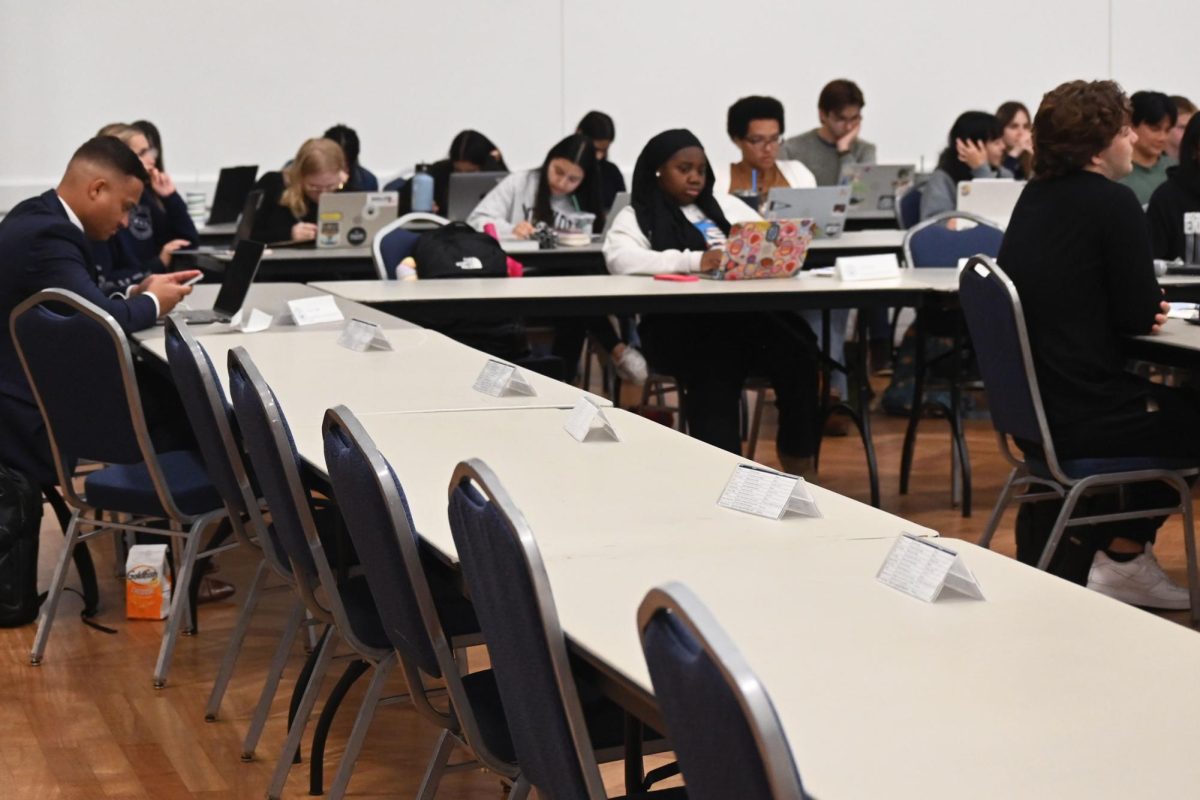
The Student Government Association’s two advisory assemblies have not met regularly this semester, leaving the bodies in violation of SGA bylaws requiring biweekly meetings.
The Mental Health and Dining assemblies — groups the SGA created in 2023 and 2025, respectively, to advise policy decisions and advocate for students on specific issues — have not met regularly this semester and currently lack structured membership, according to the assemblies’ co-chairs and publicly available meeting minutes. The Dining Assembly has yet to hold an official meeting, though it hosted its first town hall event last week, while the Mental Health Assembly has met only once in the past three months — issues the assemblies’ leaders attributed to difficulty coordinating schedules and transitioning into their roles as co-chairs.
The SGA’s bylaws require each assembly to have at least two co-chairs — one appointed by the SGA Senate and one by the executive branch — and grant those chairs the authority to appoint public members who may vote on assembly business though no minimum membership is specified. The bylaws also mandate that both assemblies hold at least two meetings per month.
SGA Sen. Sofio Kipiani (ESIA-U), co-chair of the Mental Health Assembly, said the group has met only once this semester but plans to hold its second meeting of the year Friday. She said she is aware the bylaws require assemblies to meet at least twice a month, but that it has been difficult to accommodate a majority of members’ schedules, and there will be at least two meetings per month moving forward.
“The meetings have been a bit slow since my co-chair and I have been working on transitioning from last year, and working with individual members to combine ideas for moving forward,” Kipiani said in a message.
Kipiani said about a dozen students participated in the assembly’s first meeting, with around 40 more expressing interest in future meetings through a form circulated in the SGA’s newsletter.
“We’re working more so with an informal structure since there’s many people interested in being part of the assembly,” Kipiani said. “So it’s a bit of a free flowing system, but we have a solidified group of students that are returning members.”
Members of the public are allowed to speak at assembly meetings, but according to the SGA’s bylaws, they differ from official public members who have the authority to vote on recommending legislation to the SGA and release reports.
The SGA launched the Mental Health Assembly in 2023 to make recommendations to officials and the SGA on how to improve mental health resources on campus. The assembly had an active membership last year, with about 12 appointed members, its former leader junior Jacob Wilner said last September.
Kipiani said the assembly has advertised its meetings through the SGA’s Instagram and newsletter and plans to become more active on its own Instagram to better engage with its members. The Mental Health Assembly Instagram account last posted on April 25, before Kipiani took over leadership in May, with her co-chair George Cann-Gudat, the SGA executive branch’s director for mental health policy, joining in mid-September.
Former SGA President Ethan Fitzgerald, who co-founded the Mental Health Assembly in 2023, said the assembly helped secure access to free virtual therapy sessions for students, launched a peer-to-peer program called Resource Revolutionaries and advocated for mental health days in course syllabi. Fitzgerald said the SGA designed the group to include both SGA and non-SGA students through an application process that appointed official members with voting rights so they could pass meaningful recommendations to the SGA, and that the group drew such high interest he capped the membership at about 20 students because he wanted to ensure efficient and productive discussions.
“We got a lot of interest, and there was good activity as well,” Fitzgerald said. “Really early on, we made sure to assign roles based on where people’s interests were, and teams that covered different areas that we would need people working on.”
Wilner, Fitzgerald’s successor, reduced the size of the Mental Health Assembly further over concerns that including too many students in the conversation made it difficult for the group to take any meaningful action.
SGA Vice President Liz Stoddard said the assemblies changed this year from hand-selected members to a more open format. Historically, the assembly chairs have formally appointed members, while this year members of the public have filled out an interest form and then been included in all email communications.
She said the Dining Assembly currently has about 12 interested members and the Mental Health Assembly has about 42, according to the interest forms.
“It just takes a second to get everything off the ground as you need to wait for the co-chairs before you send out the interest form to get members,” Stoddard said in a message.
She said “scheduling conflicts” have caused the Mental Health Assembly not to satisfy its biweekly meeting obligations, and the Dining Assembly has fallen short on its obligations because it was newly launched this semester.
“As far as I’m concerned, they have held regular meetings,” Stoddard said.
Emma Lin, the executive co-chair of the Dining Assembly created in March after Stoddard proposed combining the legislative branch’s dining committee and the executive branch’s team on dining into a single body, said the assembly has not yet appointed public members but is trying to create awareness among the public through Instagram posts and an interest form sent in the SGA’s newsletter.
“We’re first trying to raise awareness about it among the public so far, but it’s definitely within our goals that we’re going to work on that,” Lin said.
The Dining Assembly hosted a town hall on Thursday, which Lin said five people attended but has yet to hold a meeting with appointed public members. She said the assembly has held private meetings that included herself, Dining Assembly Legislative Co-Chair Beatriz Salim and their assistants to plan the town hall.
Lin said dining assembly leaders shared updates at the town hall, like their observations from a walkthrough of Pelham Dining Hall on the Mount Vernon Campus earlier this month and plans to coordinate with GW Dining administrators on improving staff training and student experiences but is not yet ready to hold a public meeting with appointed members.
“It was just an open forum for everyone who was there,” Lin said.
Salim said she and Lin wanted to wait until after the SGA retreat held Sept. 13 to Sept. 14 to begin planning and scheduling meetings but added that they’re planning to hold at least two more town halls before the semester is over. Salim said it has been difficult to plan meetings, and booking a room for a town hall was “basically impossible” because of the high demand for spaces during midterms.
“It’s our first year running Dining as an Assembly and my first year ever in anything SGA like so it’s been hard setting everything up,” Salim said in a message.